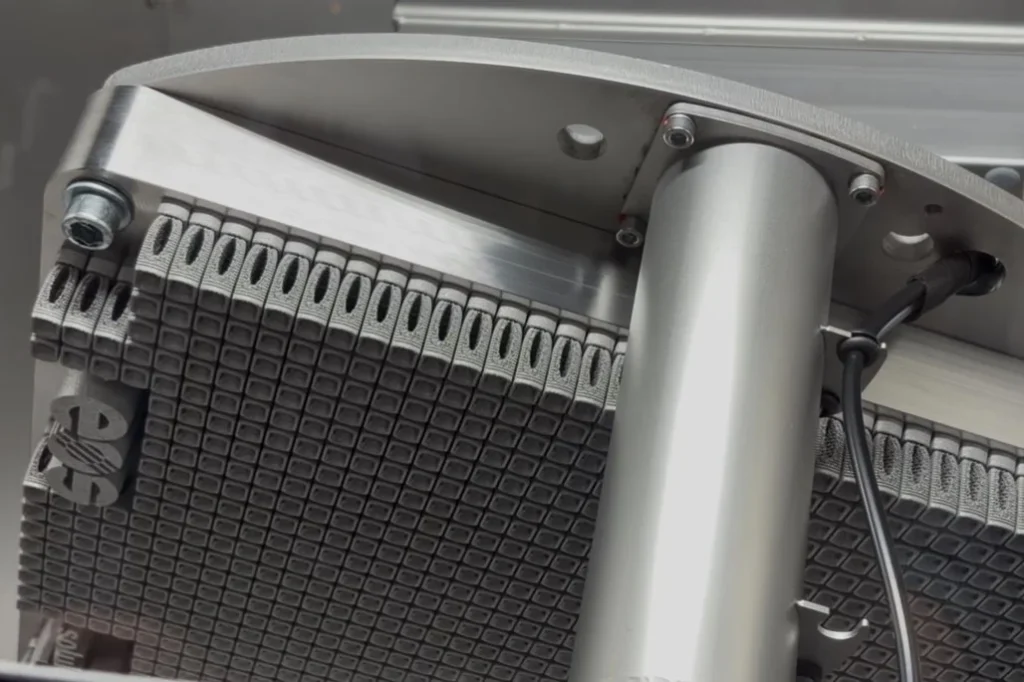
This week’s featured image showcases an impressive array of 1,100 compact titanium spinal cages meticulously arranged on an EOS M4 Onyx build plate, poised for precise powder removal. This intricate process is facilitated by a specially adapted version of Solukon’s SFM-AT350-E depowdering system. The pictured system has undergone significant reconfiguration to seamlessly integrate with the EOS M4 Onyx 3D printer, a machine boasting a substantial build volume of 17.7 x 17.7 x 15.7 inches, including the build plate. The collaboration between Solukon, a leader in automated depowdering solutions for additive manufacturing (AM), and EOS, a renowned provider of industrial 3D printing systems, highlights a significant advancement in the post-processing of complex metal components, particularly for critical medical applications.
The debut of this specialized SFM-AT350-E system at RAPID + TCT 2026 in Boston, Massachusetts, marked a pivotal moment for the AM industry. This event, a premier gathering for additive manufacturing professionals, serves as a crucial platform for showcasing cutting-edge technologies and fostering industry-wide advancements. Solukon’s innovation addresses a persistent challenge in metal AM: the efficient and thorough removal of residual powder from intricate geometries, a step that is vital for the integrity and performance of the final printed part.
The SFM-AT350-E, in its standard configuration, is optimized for depowdering smaller parts with a Z-height below 250 mm and a weight capacity of up to 100 kg. The spinal cages featured in this instance perfectly exemplify the type of components that benefit from this system’s capabilities. These particular spinal cages were fabricated using laser powder bed fusion (LPBF) technology, a widely adopted method in metal AM known for its precision and ability to create complex, lightweight structures. The choice of titanium as the material underscores the demanding nature of the application, as titanium alloys are favored in spinal implants for their biocompatibility, strength-to-weight ratio, and resistance to corrosion.
The Science Behind Efficient Depowdering: Ultrasonic Vibration
At the core of Solukon’s SFM-AT350-E system’s efficacy lies its sophisticated use of high, self-regulating ultrasonic vibration. This technology is a testament to the principles of piezoelectricity, where electrical energy is converted into mechanical energy. When an electrical voltage is applied to a piezoelectric material, it undergoes deformation, leading to controlled vibrations. In the context of depowdering, these precisely controlled vibrations are transmitted through the build plate and the parts themselves, effectively dislodging and separating fine powder particles from even the most intricate internal channels and surfaces.
The efficiency of ultrasonic vibration in depowdering is further enhanced by the system’s ability to dynamically adjust its parameters. This self-regulation ensures that the vibration intensity is optimized for the specific geometry and material of the parts being processed, preventing potential damage while maximizing powder removal. While the precise cleaning time can vary depending on the complexity of a part’s design, the depicted batch of 1,100 spinal cages was successfully depowdered in approximately 30 minutes. This rapid processing time is a significant advantage in high-volume production environments, contributing to increased throughput and reduced turnaround times for critical medical devices.
A Strategic Integration: Solukon’s SFM-AT350-E and the EOS M4 Onyx
The re-engineering of the SFM-AT350-E to accommodate the EOS M4 Onyx 3D printer represents a strategic integration designed to streamline the entire metal AM workflow. The EOS M4 Onyx is a robust industrial 3D printer renowned for its advanced capabilities, including its powerful six-laser architecture, which enables rapid and precise melting of metal powders. Its generous build volume makes it suitable for producing larger components or batches of smaller parts, such as the spinal cages in question.
The integration required modifications to the depowdering system to ensure compatibility with the M4 Onyx’s build plate dimensions and its associated powder handling mechanisms. This collaborative engineering effort underscores the growing trend in the AM industry towards integrated solutions that optimize each stage of the production process, from design and printing to post-processing. By creating a synergistic workflow, manufacturers can achieve greater efficiency, reduce manual intervention, and enhance the overall quality of their end products.
RAPID + TCT 2026: A Nexus of Innovation

The choice of RAPID + TCT 2026 as the platform for unveiling this specialized depowdering system was highly strategic. This annual trade show and conference is a cornerstone event for the additive manufacturing community in North America, attracting thousands of industry professionals, researchers, and innovators. It serves as a vital marketplace for new technologies, a forum for knowledge exchange, and a catalyst for partnerships and collaborations.
The unveiling of the Solukon SFM-AT350-E, reconfigured for the EOS M4 Onyx, at such a prominent industry event generated significant interest. It signaled to medical device manufacturers and other industries relying on high-precision metal AM parts that advanced solutions are available to address their post-processing needs. The event provided an opportunity for potential users to witness the system in action, engage with technical experts from both Solukon and EOS, and understand the tangible benefits it offers in terms of efficiency, quality, and cost-effectiveness.
The Significance for the Medical Device Industry
The depowdering of spinal cages is a critical step in the manufacturing process for these medical implants. Incomplete powder removal can lead to several issues, including:
- Reduced Biocompatibility: Residual powder particles can act as foreign bodies, potentially triggering inflammatory responses or compromising the integration of the implant with bone tissue.
- Compromised Mechanical Properties: Trapped powder can create stress risers or micro-voids within the implant, weakening its structural integrity and increasing the risk of fracture or failure under physiological loads.
- Surface Finish Degradation: Incomplete powder removal can result in a rough or uneven surface finish, which can impact the implant’s interaction with surrounding tissues and potentially lead to complications.
- Increased Sterilization Challenges: Residual powder can harbor microorganisms, posing a risk to patient safety if not thoroughly removed during the sterilization process.
The Solukon SFM-AT350-E, with its precise ultrasonic vibration technology, ensures a thorough and consistent removal of powder from the intricate lattice structures often found in 3D printed spinal cages. This meticulous cleaning process is paramount for meeting the stringent quality and safety standards required for medical implants. The ability to process such a large quantity of parts in a relatively short timeframe also addresses the growing demand for patient-specific implants and the need for efficient, scalable manufacturing solutions in the healthcare sector.
Broader Implications for Additive Manufacturing
The successful integration of Solukon’s depowdering technology with EOS’s advanced metal 3D printing systems has broader implications for the entire additive manufacturing landscape. It demonstrates a commitment from leading AM equipment providers to develop comprehensive solutions that address the entire production chain. This holistic approach is crucial for the continued growth and adoption of AM across various industries.
- Enhanced Automation: The development of automated depowdering systems reduces the reliance on manual labor, which is often labor-intensive, time-consuming, and can introduce human error. This automation contributes to increased productivity and consistency.
- Improved Part Quality and Reliability: By ensuring thorough powder removal, these systems directly contribute to the production of higher-quality, more reliable AM parts, thereby increasing confidence in the technology for critical applications.
- Cost Reduction: Increased efficiency, reduced manual labor, and minimized scrap rates associated with improved depowdering contribute to lower overall manufacturing costs, making AM more competitive with traditional manufacturing methods.
- Enabling New Geometries and Applications: The ability to reliably depowder increasingly complex geometries opens up new design possibilities and enables the creation of advanced components that were previously unfeasible with traditional manufacturing.
- Industry Collaboration: The partnership between Solukon and EOS exemplifies the power of industry collaboration in driving innovation. By working together, companies can leverage their respective expertise to create integrated solutions that benefit the entire AM ecosystem.
Looking Ahead: The Future of Post-Processing in AM
The advancements showcased by Solukon and EOS at RAPID + TCT 2026 are indicative of a broader trend towards sophisticated and automated post-processing solutions in additive manufacturing. As AM technologies continue to evolve and produce increasingly complex parts for demanding applications, the importance of efficient, reliable, and validated post-processing steps will only grow.
The focus on ultrasonic vibration technology by Solukon represents a significant leap forward, offering a powerful and adaptable method for tackling residual powder challenges. The ability to reconfigure these systems for specific printer models, like the EOS M4 Onyx, further highlights the flexibility and customer-centric approach being adopted by AM solution providers.
The continued development of such integrated workflows, from printing to final finishing, is essential for unlocking the full potential of additive manufacturing and solidifying its role as a transformative technology across a wide spectrum of industries, with the medical field being a prime beneficiary of these advancements. The precise and efficient depowdering of critical components like titanium spinal cages is a testament to the maturity and growing capabilities of the additive manufacturing sector.