The groundbreaking observations, published recently in the prestigious journal Nature, offer tantalizing evidence for a phenomenon known as ‘vacuum birefringence.’ This effect, theorized nearly 90 years ago by quantum mechanics pioneer Werner Heisenberg, posits that a perfect vacuum is not an inert void but rather a dynamic realm teeming with ‘virtual particles’ that briefly materialize and vanish. If confirmed, this detection would mark a significant milestone in our understanding of fundamental physics, providing a unique window into the quantum universe under extreme conditions.
The Enigma of the Quantum Vacuum
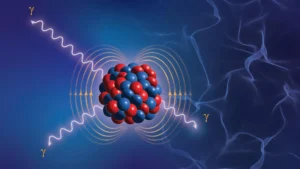
The concept of a truly empty vacuum has been challenged since the early days of quantum mechanics. Heisenberg, along with other luminaries of the field, proposed that the vacuum is far from empty. Instead, it is a frothing sea of virtual particle-antiparticle pairs – such as electron-positron pairs – constantly popping into and out of existence in accordance with the Heisenberg Uncertainty Principle. These ephemeral particles exist for such fleeting moments that they cannot be directly observed but are thought to exert subtle influences on their surroundings.
One such predicted influence is vacuum birefringence. In essence, an exceptionally strong magnetic field is theorized to affect this sea of virtual particles. Under these conditions, the virtual particles are expected to temporarily align themselves with the magnetic field lines, causing space itself to become anisotropic, or direction-dependent. This alignment would, in turn, influence how light travels through this "magnetized vacuum," causing it to refract in a specific, measurable way – much like how certain crystals split unpolarized light into two polarized beams, hence the term "birefringence." This subtle alteration in light’s path and polarization state is a direct prediction of Quantum Electrodynamics (QED), one of the most rigorously tested and successful theories in physics, which describes how light and matter interact. However, despite QED’s remarkable accuracy in other domains, directly observing vacuum birefringence has remained an elusive quest due to the immense magnetic field strengths required.
Magnetars: Nature’s Extreme Laboratories
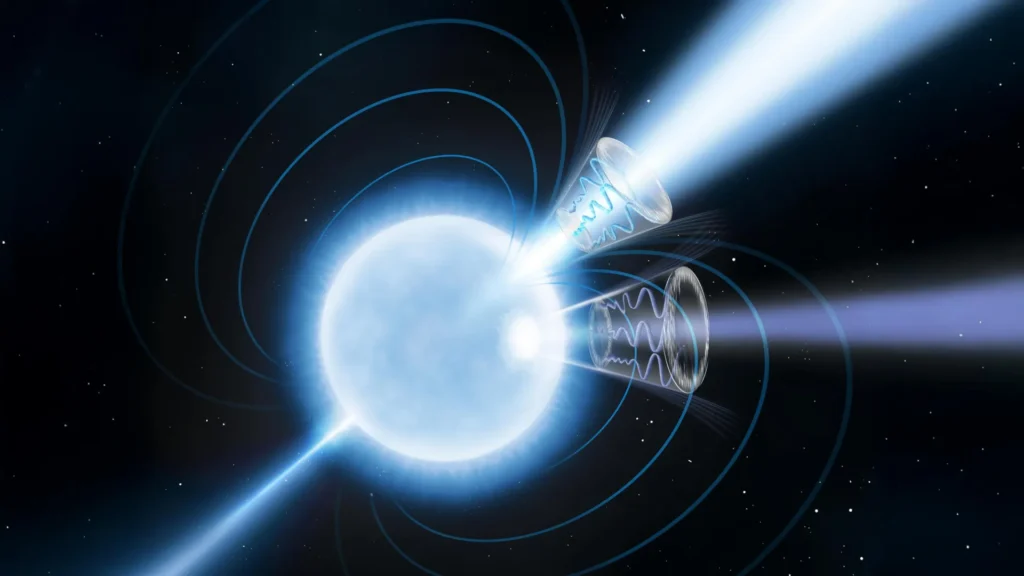
The quest to detect vacuum birefringence led an international team of researchers to focus on magnetars. These rare and exotic objects are a type of neutron star, the super-dense remnants of massive stars that have collapsed under their own gravity following a supernova explosion. What distinguishes magnetars is their extraordinarily powerful magnetic fields – by far the strongest known in the universe. While a typical neutron star might possess a magnetic field on the order of 10^8 to 10^12 Gauss, a magnetar’s field can reach an astonishing 10^14 to 10^15 Gauss. To put this into perspective, Earth’s magnetic field is roughly 0.5 Gauss, and the strongest continuous magnetic fields achievable in laboratories on Earth are around 10^5 Gauss. A magnetar’s field is millions of billions of times stronger than Earth’s and thousands of times more powerful than even the most cutting-edge laboratory magnets.
These extreme conditions make magnetars the perfect "cosmic laboratories" for investigating vacuum birefringence. The theoretical models predict that magnetic fields exceeding approximately 10^13 Gauss are necessary to produce an observable effect on the virtual particles of the vacuum. Magnetars comfortably surpass this threshold, offering a unique opportunity to test quantum predictions in environments far beyond anything reproducible on Earth.
The Research Team and Advanced Instrumentation
The investigation into this long-standing quantum mystery involved a dedicated international research team, including Dr. Marcus Lower from Swinburne University of Technology in Australia. Their work relied on a multi-observatory approach, combining the capabilities of cutting-edge astronomical instruments.
The primary instrument for this study was NASA’s Imaging X-ray Polarimetry Explorer (IXPE). Launched in December 2021, IXPE is a space observatory designed to measure the polarization of X-rays from cosmic sources. X-ray polarization provides crucial information about the magnetic fields and particle acceleration mechanisms in extreme astrophysical environments. For this research, IXPE’s ability to precisely measure the polarization state of X-rays was paramount to detecting the subtle changes predicted by vacuum birefringence.
Complementing IXPE’s X-ray observations were data from other vital telescopes. The NICER (Neutron star Interior Composition Explorer) X-ray telescope, aboard the International Space Station, provided additional X-ray timing and spectral data, helping to characterize the magnetar’s emission properties. Furthermore, radio observations were critical. Dr. Lower himself played a key role in collecting these data using Murriyang, CSIRO’s Parkes radio telescope, located in Australia. This iconic 64-meter dish, operated by Australia’s national science agency, provided crucial information about the magnetar’s radio emission and its rotation. The subsequent analysis of these complex datasets was performed on Swinburne’s Ngarrgu Tindebeek supercomputer, highlighting the computational power required to decipher such intricate astronomical signals.
Focusing on Magnetar 1E 1547.0-5408
The team zeroed in on the magnetar 1E 1547.0-5408 (or 1E1547 for short), a highly active magnetar known for its intense bursts of X-rays and gamma rays. This particular magnetar presented an unusually favorable viewing geometry for the study. The researchers meticulously tracked how the polarization state of radio waves emanating from 1E1547 changed as the star rotated. These measurements allowed them to determine that the magnetar’s magnetic and rotational axes are nearly aligned. Crucially, 1E1547 is also observed from a nearly pole-on perspective from Earth.
This "ideal viewing geometry" is critical because it simplifies the interpretation of polarization changes. If the magnetic and rotational axes were highly misaligned or if the magnetar were viewed edge-on, the complex interplay of magnetic field lines and viewing angles would make it much harder to isolate the specific signature of vacuum birefringence from other astrophysical effects. The alignment allowed scientists to observe the magnetic field’s influence on light with minimal confounding factors, making 1E1547 a prime candidate for this investigation.
The Chronology of Discovery and Key Findings
The observational campaign and subsequent analysis unfolded over several months, integrating data from different observatories. Radio observations from Murriyang provided an initial understanding of the magnetar’s rotation and basic polarization properties. These observations, combined with earlier studies of 1E1547, helped to establish the magnetar’s favorable geometry.
The pivotal moment came with the IXPE observations. X-rays generated by the magnetar, after traversing its extraordinarily magnetized environment, were detected by IXPE. The team found two crucial pieces of evidence pointing towards the quantum effect:
- Extremely High Levels of Polarization in X-rays: The X-ray emission from 1E1547 exhibited an unusually high degree of polarization, far greater than what would typically be expected from standard astrophysical processes alone in such an object. This strong polarization is a key signature predicted for vacuum birefringence.
- Consistent Polarization Direction: The direction of this X-ray polarization remained consistently tied to the magnetic field of 1E1547, mirroring the behavior observed in the radio wavelengths. This correlation across different parts of the electromagnetic spectrum, and its alignment with the magnetar’s rotating magnetic field, is precisely what is expected if the virtual particles in the vacuum are being aligned by the magnetar’s immense magnetic field.
Dr. Lower explained the significance: "Because of the magnetic field’s strength, Heisenberg’s virtual particles become aligned with the direction the field is pointing. By carefully tracking the direction the radio waves and X-rays oscillate as the magnetar rotates, the team found that the alignment of 1E1547’s magnetic and rotational poles were ideal for detecting vacuum birefringence." The coherence between radio and X-ray observations, both showing a consistent polarization signature linked to the magnetic field orientation, strongly supports the vacuum birefringence interpretation.
Implications for Fundamental Physics
If this interpretation is definitively confirmed, the implications for fundamental physics would be profound. It would represent the first direct observational evidence of vacuum birefringence, closing a nearly 90-year gap between theoretical prediction and empirical verification. This would serve as a powerful validation of Quantum Electrodynamics (QED) in an entirely new, extreme regime. QED is renowned for its incredible accuracy in predicting phenomena at atomic and subatomic scales, with some predictions matching experimental results to more than ten decimal places. However, testing QED in the presence of such colossal magnetic fields has always been a theoretical challenge due to the impossibility of replicating these conditions on Earth.
The detection would demonstrate that the quantum vacuum is indeed a dynamic medium, capable of being influenced and, in turn, influencing light. This insight could open new avenues for understanding the fundamental nature of space-time and the properties of elementary particles. It might also provide a novel tool for probing the extreme environments around neutron stars and black holes, allowing astronomers to "see" the effects of magnetic fields in ways previously unimaginable. Understanding how light propagates through these extreme quantum environments is crucial for interpreting observations from other highly magnetized cosmic objects.
The Road Ahead: Confirmation and Future Research
While the current findings represent the strongest evidence to date, the scientific community maintains a degree of cautious optimism. As Dr. Lower noted, "Although vacuum birefringence was predicted in the 1930s, scientists have yet to obtain a definitive detection." The complexity of magnetar environments means that other astrophysical processes could, in principle, contribute to observed polarization signals. Distinguishing the precise quantum signature from other physical phenomena around magnetars requires meticulous analysis and further observation.
The path to definitive confirmation involves several key steps. Dr. Lower suggested that "additional observations and more advanced computer simulations could help establish whether the signal truly comes from vacuum birefringence." Future observations with IXPE and other X-ray polarimeters, potentially targeting other magnetars with similar favorable geometries or observing 1E1547 over longer periods, will be crucial. These new data sets will allow researchers to refine their models and rule out alternative explanations.
Furthermore, more sophisticated computer simulations are vital. These simulations would model the entire magnetar environment, including its complex magnetic field structure, plasma distribution, and various emission mechanisms, to predict the precise polarization signatures under different scenarios. By comparing these highly detailed theoretical predictions with observed data, scientists can strengthen the case for vacuum birefringence or identify other contributing factors.
"With these future data on hand and our updated simulations, we may finally be able to complete the quest started by Heisenberg nearly 90 years ago," Dr. Lower concluded. The journey from a theoretical scribble on a blackboard to observational evidence spanning nearly a century underscores the enduring power of scientific inquiry and the relentless pursuit of understanding the universe’s most profound secrets. The potential confirmation of vacuum birefringence stands as a testament to humanity’s capacity to unravel the mysteries of the cosmos, one quantum prediction at a time.