The initiative, spearheaded by Professor Francois Barthelat, who leads the Laboratory for Advanced Materials & Bioinspiration, represents a significant pivot in the ongoing quest for innovative building blocks in material science. "We’ve been playing around with the idea of building blocks and geometry for many years, but we started looking at interlocking, entangled particles only recently," Barthelat stated, emphasizing the novelty of their current focus. He added, "We are excited about the combination of properties we can get out of these systems and we believe this technology has the potential to go in many directions." The preliminary findings of this pivotal research were recently published in the esteemed Journal of Applied Physics, marking a crucial milestone in the exploration of these novel material states.
The Enigma of Entanglement: From Everyday Objects to Scientific Breakthrough
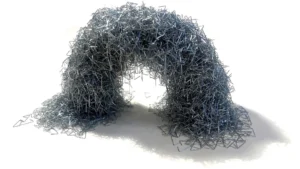
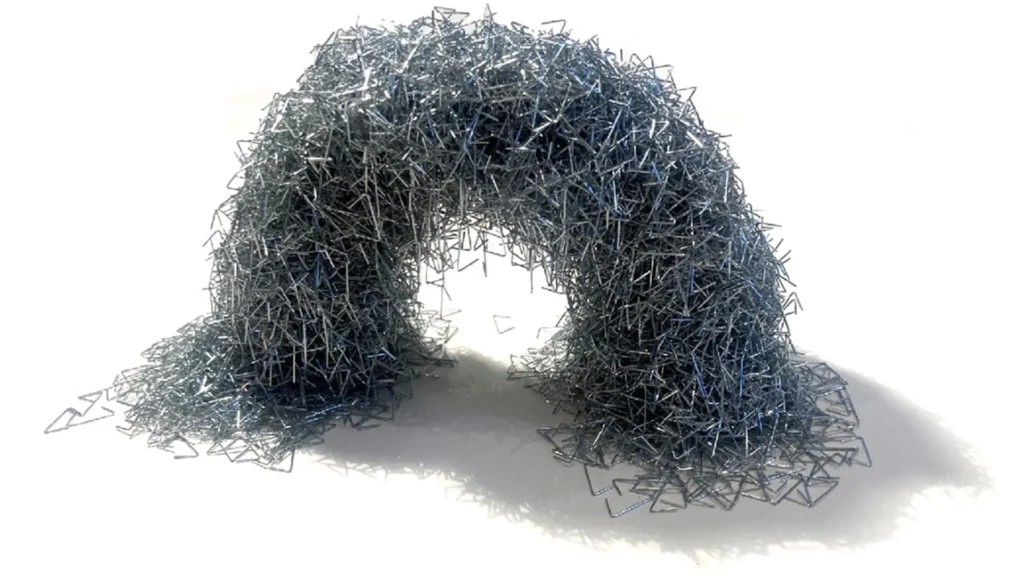
The concept of entanglement, while often associated with quantum mechanics, holds a fundamental and pervasive role in the macroscopic world, particularly in the realm of material science. It describes a state where individual components become intertwined, forming complex interconnections that collectively contribute to a material’s overall properties. The simple office staple, often overlooked in its mundane utility, provides a compelling everyday analogy for this phenomenon. When numerous staples are jumbled together, their bent, two-pronged structure allows them to hook onto one another, creating a surprisingly resilient, almost monolithic cluster. This everyday observation, elevated to scientific inquiry, highlights the potential of geometry in dictating material behavior.
Granular materials, such as sand, gravel, or even powders, are ubiquitous in both natural and engineered systems. Traditionally, the mechanical properties of these materials are largely determined by friction and compaction. However, these interactions typically result in limited tensile strength—they are good at resisting compression but easily fall apart under pulling forces. The challenge for material scientists has long been to impart cohesive strength and adaptability to granular systems, moving beyond the simple frictional models. The CU Boulder team’s work represents a significant step towards overcoming this limitation by introducing a new paradigm: designed interlocking.
The Laboratory for Advanced Materials & Bioinspiration, under Professor Barthelat’s guidance, has a long-standing reputation for drawing inspiration from biological systems to develop novel materials. Nature, in its infinite wisdom, frequently employs entanglement to achieve remarkable structural integrity with seemingly disparate components. From the interwoven twigs and fibers that form the robust yet lightweight architecture of a bird’s nest to the intricate network of hard mineral components (hydroxyapatite) and softer protein fibers (collagen) that imbue bones with their characteristic strength and toughness, entanglement is a fundamental design principle. These natural blueprints provide compelling evidence that engineered entanglement could unlock similar advantages in synthetic materials.
Methodology: Unlocking Shape’s Secrets Through Simulation and Experimentation
The CU Boulder team’s research centers on a critical insight: the shape of individual particles is paramount in facilitating entanglement and, consequently, dictating the macroscopic mechanical properties of the assembled material. PhD student Youhan Sohn articulated this principle succinctly, using sand as a comparative example. "Let’s take sand as an example. Sand is smooth and convex-shaped, meaning it cannot interlock from grain to grain," Sohn explained. "However, we found that if we change the shape of a grain of sand, we can drastically affect its behavior and mechanical properties, including the particle’s ability to link with other particles." This fundamental understanding shifted the research focus from merely packing efficiency to deliberate geometric design.
To systematically investigate the myriad possibilities of particle geometries, the researchers employed sophisticated computational techniques, specifically Monte Carlo simulations. Monte Carlo methods are a broad class of computational algorithms that rely on repeated random sampling to obtain numerical results. In this context, they allowed the team to model the interactions of countless particles with varying shapes under different conditions, efficiently exploring a vast design space that would be impractical to test experimentally. The objective was clear: identify particle geometries that would maximize the degree of entanglement, thereby enhancing the material’s cohesive properties. These simulations served as a powerful predictive tool, narrowing down the most promising candidates for physical prototyping.
Following the identification of several compelling designs through the computational phase, the research progressed to real-world validation. The team conducted a series of "pickup tests," a direct and intuitive method to assess the entanglement capabilities of physically produced particles. In these tests, samples of the engineered granular materials were subjected to controlled lifting or manipulation to observe how effectively the particles interlocked and resisted separation. This empirical stage was crucial for verifying the theoretical predictions and understanding the practical nuances of these novel materials.
The Staple’s Triumph: Unprecedented Properties for a New Class of Materials
The experimental phase yielded a clear winner: a "two-legged" particle, strikingly reminiscent of an everyday office staple, demonstrated the highest degree of entanglement. This particular geometry proved to be exceptionally effective at interlocking with its neighbors, forming a cohesive network. Beyond its superior entanglement capabilities, this staple-like particle revealed several unexpected and highly desirable benefits, presenting a paradigm shift in granular material design.
One of the most significant breakthroughs was the material’s ability to simultaneously exhibit high tensile strength and toughness—two properties that are often considered mutually exclusive in conventional engineering materials. Tensile strength refers to a material’s resistance to breaking when stretched or pulled, while toughness is its ability to absorb energy and deform plastically without fracturing. For instance, ceramics are known for their high compressive strength but are brittle and lack toughness. Many polymers, conversely, are tough but may lack the requisite strength for structural applications. The entangled granular material, employing these staple-like particles, defied this conventional trade-off. As PhD student Saeed Pezeshki highlighted, "Our entangled granular material using the staple-like particle demonstrates both high strength and toughness at the same time." This dual capability opens doors to applications where materials need to withstand significant forces while also resisting impact and deformation without catastrophic failure.
Furthermore, the staple-like particles displayed another truly remarkable characteristic: rapid and reversible assembly and disassembly. The researchers discovered that by applying different vibration patterns, they could precisely control the degree of entanglement within the material. Gentle, low-frequency vibrations encouraged the particles to interlock more robustly, effectively strengthening the material into a more cohesive structure. Conversely, stronger, higher-frequency vibrations caused the intricate network to unravel, allowing the particles to separate and return to a loose, individual state. This dynamic control over material properties is a hallmark of "smart materials," but the simplicity and mechanical basis of this entanglement mechanism offer distinct advantages.
Professor Barthelat characterized this novel state of matter as truly unique. "It’s a strange material because it’s obviously not a liquid. However, it’s also not quite solid," he observed. This ambiguous classification underscores the material’s groundbreaking nature, transcending traditional phase boundaries. "This opens new and intriguing engineering possibilities," Barthelat added, noting that "handling a bundle of these entangled particles feels very remote and exotic." This ability to transition between a fluid-like, disaggregated state and a solid-like, load-bearing state simply through controlled vibrations positions these materials at the forefront of adaptive engineering.
Future Horizons: Potential Uses in Construction, Robotics, and Beyond
The implications of this research extend across multiple sectors, promising to revolutionize several engineering disciplines. The most immediate and impactful applications are envisioned in sustainable construction and advanced robotics.
In the realm of construction, the technology offers a compelling solution to the burgeoning problem of demolition waste and the environmental impact of traditional building practices. Current construction methods often result in structures that are difficult, costly, and environmentally taxing to dismantle, leading to vast quantities of landfill waste. Imagine bridges, buildings, or other large-scale infrastructure constructed from entangled materials. At the end of their service life, instead of being demolished into rubble, these structures could be vibrated apart, allowing the constituent particles to be fully recovered, reused, or recycled. This circular economy approach to construction materials would drastically reduce waste, conserve resources, and lower the carbon footprint of the built environment. While scaling up the production of such geometrically complex particles and developing large-scale vibration systems present engineering challenges, the long-term environmental and economic benefits could be transformative. This aligns with global efforts to transition towards more sustainable urban development and infrastructure.
The concept also holds immense promise for advancements in robotics, particularly in the burgeoning field of swarm robotics and reconfigurable systems. PhD student Saeed Pezeshki articulated a vision for swarm robots that could leverage this technology: "I was talking with other students who believe this technology can be used in swarm robotics – where small robots can entangle, do a task and then disentangle when they are done." This capability would enable unprecedented levels of adaptability and versatility for robotic systems. Imagine a swarm of small, individual robotic units that can coalesce to form a larger, stronger structure to lift heavy objects, then disaggregate to navigate confined spaces, and finally reconfigure into a different shape for another task.
Professor Barthelat further elaborated on this futuristic potential, drawing a vivid analogy: "Yes, kind of like that liquid metal T-1000 in Terminator 2 who can change shape to slide under a door and then transform back to a human’s size on the other side." While acknowledging the significant hurdles of cost and scalability for such advanced applications, he stressed, "It’s expensive and scaling up is a challenge, but it’s something that’s on everybody’s mind." Beyond swarm robotics, this technology could inspire soft robotics that can change stiffness on demand, adaptive tools that reconfigure to fit different tasks, or even temporary shelters that can be rapidly deployed and dismantled. The ability to dynamically alter material properties from a fluid-like to a solid-like state at will represents a profound leap in design freedom for engineers.
Moreover, the principles of engineered entanglement could find applications in other high-value sectors. In aerospace, lightweight, repairable structures could be conceived, where damaged sections could be "disentangled" and replaced, rather than requiring full component replacement. In biomedical engineering, temporary implants or drug delivery systems that can dissolve or reconfigure in situ might be developed. The potential for custom-designed materials with on-demand adaptability is vast and largely unexplored.
The Next Frontier: Enhancing Entanglement with "Spiky Burrs"
The research team is not resting on its laurels; they are already pushing the boundaries of this nascent field. The current stage of their research focuses on even more intricate particle designs, aiming to further enhance entanglement effects and unlock new levels of material performance. Their latest experiments involve a new particle design that incorporates additional protruding "legs," moving beyond the simple two-legged staple.
The researchers draw an evocative analogy for this new shape: the spiky burrs commonly found in nature, which cling stubbornly to clothing and animal fur. These natural burrs are exceptionally good at adhering to surfaces due to their multiple, sharp projections. By incorporating similar multi-pronged features into their engineered particles, the CU Boulder team anticipates creating even stronger, more robust entanglement effects. This biomimetic approach, once again drawing inspiration from the natural world, holds the promise of developing materials with unprecedented cohesive strength and adaptability.
The ongoing research will explore how these more complex geometries influence the dynamics of entanglement, the forces required for assembly and disassembly, and the overall mechanical properties. Key challenges include optimizing the design of these "burr-like" particles for ease of manufacturing, understanding their long-term performance under various environmental conditions, and scaling up production to quantities relevant for industrial applications. The ultimate goal is to create a library of particle designs, each offering a unique combination of strength, toughness, and reversibility, paving the way for a new era of dynamically reconfigurable and sustainable materials.
In conclusion, the seemingly simple office staple has provided a profound inspiration for a revolution in material science. The pioneering work at CU Boulder, leveraging advanced simulations and meticulous experimentation, has demonstrated that by carefully engineering particle geometries, particularly those resembling staples, it is possible to create granular materials with an extraordinary blend of strength, toughness, and reversible adaptability. This breakthrough not only challenges conventional definitions of solid and liquid but also offers tangible pathways towards more sustainable construction, highly adaptable robotics, and a myriad of other innovations. As researchers continue to refine these "entangled particles," drawing further inspiration from nature’s ingenious designs, the potential for transformative technologies appears boundless, promising to redefine how we build, interact with, and ultimately recycle the materials of our future.