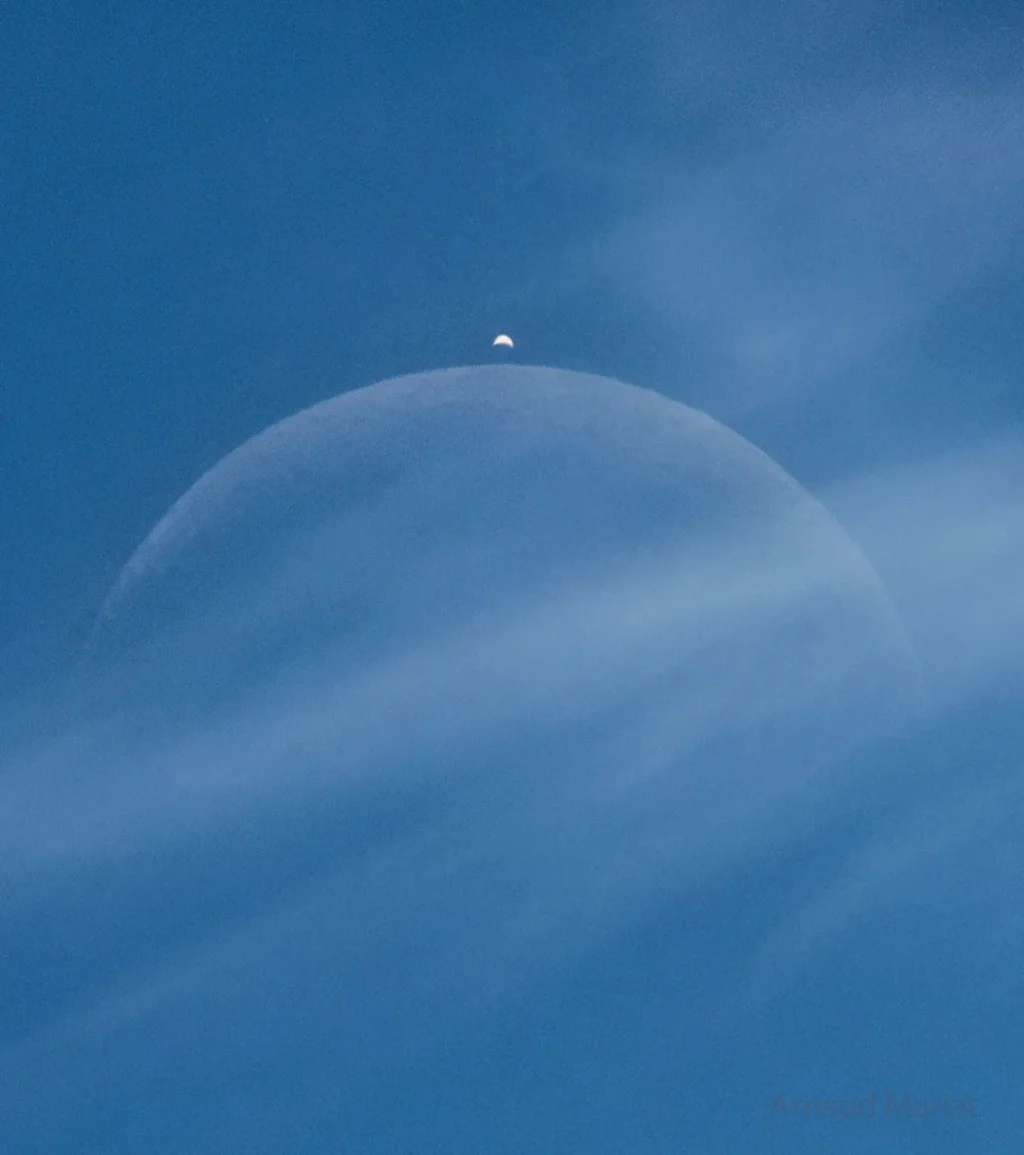
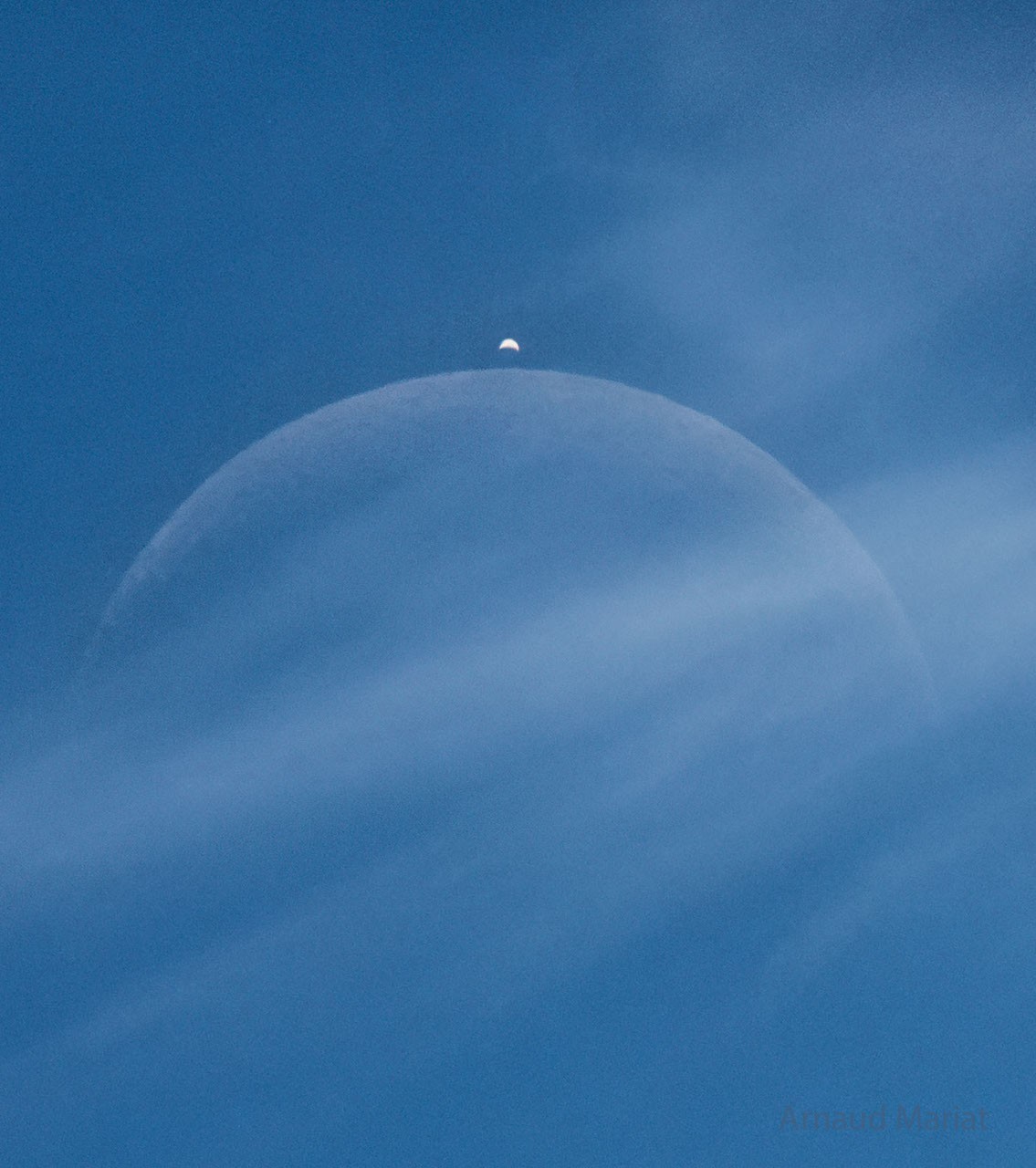
The celestial dance of our solar system offered a captivating spectacle on a recent afternoon above the small village of Cessy, France, as the Moon and the planet Venus appeared in close conjunction, both presenting delicate crescent phases against a pale blue, cloud-streaked sky. This rare daytime alignment, captured in a single, expertly timed exposure, provided a striking visual testament to the dynamic nature of our cosmic neighborhood.
A Fleeting Daytime Conjunction
The image, part of NASA’s esteemed Astronomy Picture of the Day (APOD) series, showcases a scene that might have been easily overlooked. The Moon, barely visible due to its slender crescent phase and the pervasive daylight, was initially obscured by a light cloud. However, as the clouds parted, the Moon’s faint glow became apparent, a subtle sliver illuminated by the Sun. Shortly thereafter, the brilliance of Venus emerged from behind the lunar silhouette.
This conjunction was not merely a visual pairing but a celestial event of occultation, where one celestial body passes in front of another. In this instance, Venus was partially hidden by the Moon. While such occultations are more dramatic and common when viewed at night, this daytime event presented unique challenges for observation and photography.
Understanding the Celestial Players
The Moon: Earth’s only natural satellite, the Moon, orbits our planet at an average distance of approximately 384,400 kilometers (238,900 miles). Its phases are determined by the angle at which sunlight illuminates it as it orbits Earth. The crescent phase occurs when less than half of the Moon’s illuminated surface is visible from Earth. In this particular observation, the Moon was exhibiting a very slender crescent, with only about 10 percent of its face illuminated by the Sun. This indicates that the Moon was relatively close to the Sun in the sky from Earth’s perspective, a phase often referred to as a "waxing crescent" if it precedes the full moon or a "waning crescent" if it follows.
Venus: Known as Earth’s "sister planet" due to its similar size and mass, Venus is the second planet from the Sun, orbiting at an average distance of about 108 million kilometers (67 million miles). Venus is renowned for its dense atmosphere, composed primarily of carbon dioxide, which creates a powerful greenhouse effect, making it the hottest planet in our solar system. Its brilliant appearance in our sky is due to its highly reflective cloud cover, which bounces sunlight back into space. During this observed conjunction, Venus displayed a more pronounced crescent phase than the Moon, with approximately 25 percent of its illuminated surface visible. This fuller crescent suggests Venus was further from the Sun in its orbit relative to Earth’s viewing angle at that moment, but its inherent reflectivity still made it a prominent object in the daytime sky.
The Mechanics of the Occultation
The phenomenon of an occultation, where one celestial body obscures another, is a predictable event governed by orbital mechanics. The apparent size of celestial objects in the sky, known as their angular diameter, plays a crucial role. While the Moon is much closer to Earth, its angular diameter is comparable to that of Venus when viewed from Earth. However, the Moon’s proximity means it can easily block out more distant objects like planets.
The fact that Venus appeared brighter than the Moon in this scenario is attributed to two primary factors:
- Proximity to the Sun: Venus, being closer to the Sun than Earth, receives more intense sunlight.
- Albedo: Venus possesses an exceptionally high albedo, meaning its atmosphere reflects a significant portion of the sunlight that strikes it. Its sulfuric acid clouds are highly reflective, giving Venus its characteristic brilliant white appearance. In contrast, the Moon’s surface is relatively dark, with a low albedo, absorbing a considerable amount of sunlight.
A Fleeting Moment Captured
The photographer, Maria T., captured this remarkable image near Cessy, France. The single featured exposure highlights the delicate interplay of light and shadow, the subtle hues of the daytime sky, and the celestial proximity of two familiar yet distinct bodies. The cloud crossing the image adds a layer of texture and depth, making the appearance of the Moon and Venus even more striking.
The observation that "there was something behind the clouds" speaks to the subtle nature of daytime celestial events. Unlike the dramatic emergence of planets or the Moon from the night sky, daytime sightings often require careful observation and an understanding of where to look. The fact that the Moon was "hard to see yesterday around noon" is typical for a very thin crescent, especially when competing with the brightness of the Sun.
The Significance of Daytime Astronomy
Daytime astronomy, while often overlooked in favor of the more dramatic night sky, offers unique observational opportunities. The Sun’s dominance in the sky can make fainter objects challenging to detect, but with clear skies, a good vantage point, and knowledge of celestial positions, planets like Venus and Mercury, as well as the Moon, can be observed. These daytime conjunctions provide a valuable reminder that our solar system is a dynamic place, with its inhabitants constantly in motion.
Broader Implications and Context
This APOD image serves as more than just a beautiful photograph; it’s an educational tool that encourages a deeper appreciation for astronomy. The APOD program itself, a long-standing NASA initiative, aims to "Discover the cosmos!" by featuring a different image or photograph of the universe daily, accompanied by explanations written by professional astronomers. This particular image, by highlighting a daytime conjunction, emphasizes that astronomical phenomena are not confined to the darkness of night.
The Earthly Perspective
The article notes that an occultation of Venus by the Moon is visible to only about 10 percent of the Earth. This is due to the specific geometry of the orbits and the observer’s location on the planet. For this particular event, the path of totality, where Venus would be completely hidden by the Moon, passed over a limited region. Furthermore, the article mentions that "even most of that was experiencing daytime." This highlights a crucial aspect of observing such events: the time of day in the observer’s location can significantly impact visibility, even within the geographical region where the occultation is technically visible. Daytime occultations require observers to contend with the Sun’s glare, making them more challenging to witness and photograph than their nocturnal counterparts.
The APOD Migration
An interesting piece of contextual information embedded within the article is the mention of APOD’s main NASA site migrating from apod.nasa.gov to science.nasa.gov/apod. This transition signifies a potential strategic shift in how NASA presents its astronomy content, possibly integrating it more closely with broader scientific initiatives and making it more accessible through a unified science portal. Such migrations are common for large organizations to streamline their online presence and improve user experience.
Conclusion: A Glimpse of Cosmic Harmony
The photograph of the crescent Moon and Venus in the daytime sky over France is a powerful reminder of the constant, intricate ballet of celestial bodies. It underscores the importance of looking up, not just during the night, but also during the day, to appreciate the wonders of our solar system. The APOD program continues to be an invaluable resource for fostering curiosity and understanding about the universe, bringing the cosmos closer to us, one breathtaking image at a time. The subtle beauty of this daytime conjunction, captured through skillful photography and explained by astronomical expertise, invites us to ponder our place within this vast and ever-moving cosmic tapestry.