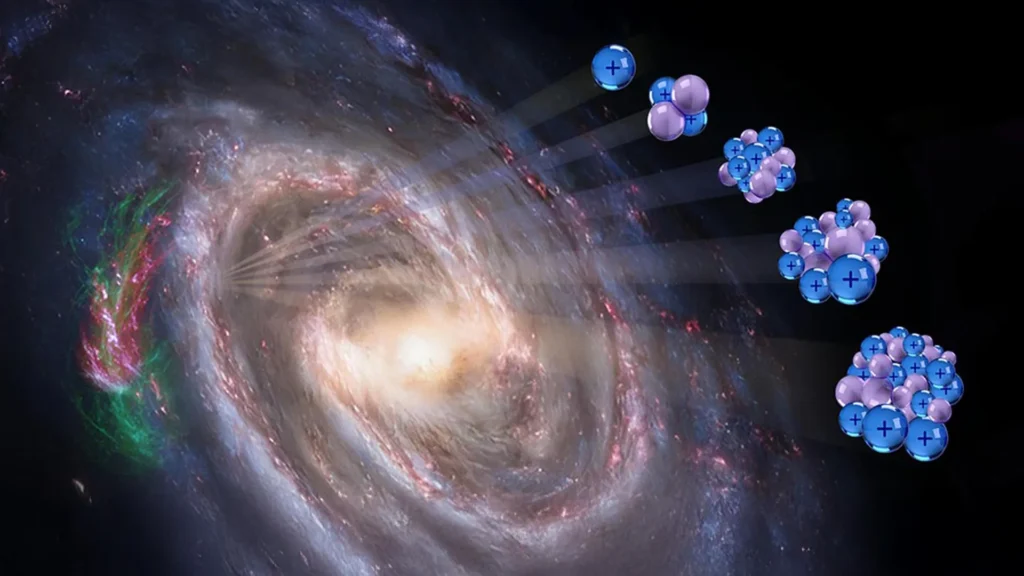
For over a century, the universe’s most energetic particles, known as cosmic rays, have presented one of astronomy’s most enduring puzzles. These incredibly powerful particles traverse vast cosmic distances at extreme energies, yet their precise origins and the mechanisms driving their acceleration have remained largely elusive. Now, a significant breakthrough by researchers leveraging data from the Dark Matter Particle Explorer (DAMPE) space telescope has unveiled a crucial new clue. Published in the prestigious journal Nature, their findings identify a common, fundamental feature shared by various types of these enigmatic particles, promising to significantly advance humanity’s understanding of their genesis and journey through the cosmos.
The Enduring Mystery of Cosmic Rays
Cosmic rays stand as the highest-energy particles ever observed in nature, dwarfing the capabilities of even the most advanced particle accelerators on Earth, such as the Large Hadron Collider (LHC). While the LHC can accelerate protons to energies of about 6.5 teraelectronvolts (TeV), individual cosmic rays can reach energies exceeding 10^20 electronvolts (eV), or 100 exaelectronvolts (EeV) – energies millions of times greater than anything achievable terrestrially. Scientists generally theorize that these ultra-high-energy particles are forged in some of the universe’s most violent and energetic phenomena. Prime candidates include the cataclysmic explosions of supernovae, the powerful jets emanating from supermassive black holes at the centers of galaxies, and the rapidly spinning, highly magnetized remnants of massive stars known as pulsars. These extreme environments provide the colossal energies and powerful magnetic fields necessary to propel particles to such incredible velocities.
Despite the theoretical frameworks, directly pinpointing the sources of cosmic rays proves challenging. As charged particles, their trajectories are constantly bent and scattered by the complex magnetic fields pervading our galaxy and intergalactic space. This cosmic "pinball machine" effect means that by the time they reach Earth, their original direction of travel is largely obscured, making it impossible to trace them back to their points of origin. This inherent difficulty has fueled the long-standing "cosmic ray problem," a multifaceted challenge encompassing their acceleration mechanisms, propagation pathways, and ultimate sources. The observed energy spectrum of cosmic rays, which exhibits distinct features like the "knee" (around 10^15 eV) and the "ankle" (around 10^18 eV), further complicates the picture, hinting at different acceleration processes or sources contributing to different energy ranges.
The DAMPE Mission: A Window to High-Energy Cosmos
The DAMPE space telescope, an ambitious astrophysics mission primarily led by the Chinese Academy of Sciences (CAS) with significant international collaboration, was launched into orbit on December 17, 2015. Nicknamed "Wukong" after the mythical Monkey King, the satellite’s primary objectives were twofold: to investigate the precise nature of high-energy cosmic rays, including their spectrum and composition, and to search for potential signatures of dark matter annihilation or decay products within the cosmic ray flux. Orbiting at an altitude of approximately 500 kilometers, DAMPE is equipped with an array of sophisticated detectors designed for exceptional energy resolution and particle identification capabilities. Its main instruments include a Plastic Scintillator Detector (PSD) for charge measurement, a Silicon-Tungsten Tracker (STK) for precise trajectory reconstruction and charge measurement, a Bismuth Germanate (BGO) calorimeter for energy measurement, and a Neutron Detector (NUD) to help distinguish between different particle types.
Crucially, the mission has benefited from substantial contributions from European institutions, including the astrophysics group at the Department of Nuclear and Particle Physics (DPNC) at the University of Geneva (UNIGE). Their involvement has been instrumental across multiple facets of the mission, from detector development to sophisticated data analysis.
Geneva’s Pioneering Role in the Discovery
Researchers from the University of Geneva played a pivotal role in the recent breakthrough. The UNIGE team was at the forefront of developing advanced artificial intelligence (AI) methods specifically tailored to reconstruct particle events detected by the DAMPE telescope. These AI algorithms are essential for accurately identifying particle types, determining their energies, and reconstructing their paths amidst the complex background noise of space. The precision offered by these AI techniques significantly enhanced the quality and reliability of the collected data.
Beyond data analysis, the Geneva group made critical contributions to the fundamental measurements of proton and helium fluxes, which are the most abundant components of cosmic rays. Their expertise also extended to the analysis of carbon nuclei data, expanding the scope of the investigation to heavier elements. Furthermore, the UNIGE team spearheaded the development of one of DAMPE’s key instruments: the Silicon-Tungsten Tracker (STK). This state-of-the-art detector is absolutely essential for accurately tracing the paths of incoming cosmic rays and, critically, for determining their electrical charge. The ability to precisely measure charge is vital for distinguishing between different types of nuclei and for understanding their interaction with magnetic fields. The precision and robustness of the STK, largely due to the Geneva team’s efforts, underpin the reliability of the observed spectral features.
Andrii Tykhonov, an associate professor at the DPNC in the Faculty of Science at UNIGE and a co-author of the study, emphasized the diverse composition of cosmic rays: "Cosmic rays are primarily composed of protons, but also of helium, carbon, oxygen, and iron nuclei. These particles are also categorised according to their energy: low, up to a few billion electron-volts; intermediate, from a few billion to several hundred billion electron-volts; and high, from 1,000 billion electron-volts and beyond." This granular understanding of cosmic ray composition and energy ranges was fundamental to the DAMPE collaboration’s ability to identify a universal pattern across these different species.
The Unveiling of a Shared Cosmic Ray Pattern
By meticulously examining the highly precise data collected over years by DAMPE, researchers uncovered a remarkable and previously unrecognized universal pattern within the energy spectra of primary cosmic ray nuclei. This pattern was observed across a wide range of nuclei, from the lightest protons to much heavier iron nuclei. The discovery centers on an effect dubbed "spectral softening."
Normally, the number of cosmic ray particles detected decreases as their energy increases – higher-energy particles are less common. However, the DAMPE observations revealed a dramatic shift: for every type of nucleus studied, the rate at which the number of particles drops accelerates sharply after reaching a certain threshold. This decline becomes significantly steeper beyond a rigidity of approximately 15 teravolts (TV).
To understand the profound implication of this finding, it is crucial to grasp the concept of "rigidity." In astrophysics, rigidity is a fundamental property that describes how strongly a charged particle’s path resists being bent by magnetic fields. It is defined as the particle’s momentum divided by its electric charge. For a given magnetic field strength, particles with higher rigidity will deviate less from a straight line. The fact that this spectral softening occurs at a common rigidity value, rather than a common energy value, across multiple types of nuclei, is the cornerstone of this discovery.
Implications for Cosmic Ray Acceleration and Propagation
The finding that this same feature – spectral softening at a common rigidity – appears across many different types of particles carries immense weight for theoretical models. It provides compelling and robust evidence supporting theories that suggest both the acceleration of cosmic rays and their subsequent movement through interstellar space are predominantly controlled by rigidity. This indicates a common physical process affecting all these diverse nuclei once they reach a certain rigidity threshold.
Conversely, the data largely rules out competing explanations based on energy per nucleon (the total energy of the particle divided by the number of protons and neutrons in its nucleus). The researchers reported a staggering confidence level against these alternative models, reaching 99.999%. This statistical certainty effectively narrows the field of plausible explanations, guiding future research toward rigidity-dependent mechanisms.
Inferred Reactions from the Scientific Community
The publication in Nature and the robust statistical evidence are expected to generate considerable excitement within the high-energy astrophysics community. Dr. Tykhonov’s statements already underscore the collaborative nature and the significance of the findings. A spokesperson for the DAMPE collaboration, likely from the Chinese Academy of Sciences, might state: "This discovery represents a significant step forward in our quest to unravel the cosmic ray mystery. The universal rigidity-dependent softening provides a powerful new constraint on the processes that accelerate and propagate these extreme particles, bringing us closer to understanding the most energetic phenomena in the universe."
Similarly, a senior researcher from the University of Geneva could add: "Our team’s extensive work in developing sophisticated AI for data reconstruction and our leadership in the Silicon-Tungsten Tracker instrument were absolutely crucial to achieving this level of precision. It’s a testament to the power of international collaboration and advanced technology in pushing the boundaries of scientific understanding." The broader scientific community would likely welcome the paper as a robust, data-driven constraint on theoretical models, providing a clear direction for future investigations.
Broader Impact and Future Outlook
The findings mark an important advance in understanding two fundamental aspects of cosmic ray physics: how they are created and how they travel through the galaxy. By identifying a rigidity-dependent spectral softening, scientists now have tighter limits on existing models of particle acceleration in astrophysical sources. This suggests that the escape mechanism from acceleration sites, or the acceleration process itself, might be intrinsically tied to a particle’s rigidity. For example, some theories propose that cosmic rays escape from supernova remnants when their gyroradius (the radius of their circular motion in a magnetic field, which is rigidity-dependent) becomes too large to be contained.
Furthermore, these results significantly improve our understanding of how high-energy particles diffuse and move through the turbulent magnetic fields of interstellar space. The galactic magnetic field acts as a colossal filter, and the observed rigidity dependence points to a common interaction mechanism for all nuclei at a certain rigidity, influencing their residence time in the galaxy before escaping into intergalactic space.
This discovery also holds potential implications for the search for dark matter. While DAMPE’s primary focus includes dark matter, a clearer understanding of the "background" cosmic ray spectrum is essential to identify any anomalous signals that could point to dark matter interactions. By better characterizing the standard cosmic ray population, scientists can more effectively filter out known physics and home in on potential exotic phenomena.
The era of precision multi-messenger astronomy, combining observations from cosmic rays, neutrinos, and gamma rays, is rapidly advancing. This new DAMPE result provides a crucial piece of the puzzle, complementing data from other observatories like the Pierre Auger Observatory (for ultra-high-energy cosmic rays) and Fermi-LAT (for gamma rays). Future missions and ongoing analyses will undoubtedly build upon this foundation, seeking to extend these observations to even higher energies, refine the spectral measurements, and ultimately, connect these cosmic travelers to their violent birthplaces across the universe. The long-standing cosmic ray mystery, while far from fully solved, has just received a powerful new key.