The European Space Agency’s Argonaut landers are poised to revolutionize lunar exploration by delivering substantial payloads of up to 1,500 kilograms to the Moon’s surface. This significant cargo, encompassing everything from advanced rovers and sophisticated scientific instruments to vital components for future lunar infrastructure, will necessitate a robust and precise method for offloading. Recognizing the critical need for such capabilities, a collaborative effort between Romania’s COMOTI (Center of Research, Development and Innovation in Technologies for the Manufacturing of Technological Processes) and Initium Space has culminated in the development of a specialized lunar crane, code-named "Loader." This innovative system, designed to lift up to 1,000 kilograms of cargo from a lunar lander like Argonaut and place it up to six meters away, is a crucial step in enabling complex lunar surface operations. The project is a testament to ESA’s commitment to fostering cutting-edge space technologies through its Technology Development Element (TDE) program, which aims to mature critical capabilities for future space missions.
The Challenge of Lunar Cargo Deployment
The success of future lunar missions hinges not only on the ability to transport significant mass to the Moon but also on the efficient and safe deployment of that cargo. Argonaut, a key element of Europe’s lunar exploration strategy, is designed to deliver a substantial payload, far exceeding what current robotic arms on landers can manage. This increased cargo capacity opens the door to more ambitious scientific endeavors and the establishment of a sustained human presence. However, the very nature of these payloads presents unique deployment challenges. Sensitive scientific instruments, for instance, often require placement at a considerable distance from the lander to ensure the integrity of their measurements, free from any electromagnetic interference or vibrations emanating from the lander itself. This requirement immediately places such instruments beyond the reach of standard robotic manipulators, necessitating a more versatile and capable solution.
The development of the Loader crane directly addresses this critical gap. Its ability to offload heavy payloads and position them at a distance is fundamental to maximizing the scientific return and operational effectiveness of missions utilizing landers like Argonaut. This capability is not merely about moving objects; it is about enabling the precise placement of critical assets, facilitating complex scientific experiments, and laying the groundwork for future lunar bases.
Loader: A Specialized Tool for the Lunar Frontier
The Loader crane, a product of Romanian ingenuity and European space ambition, is engineered to operate within the harsh and unforgiving environment of the Moon. Its design prioritizes both lifting capacity and precision placement, crucial for a variety of lunar surface tasks. The crane can handle loads of up to 1,000 kilograms, a significant portion of the potential cargo that Argonaut landers are capable of delivering. Furthermore, its ability to extend its reach up to six meters provides the necessary flexibility for positioning delicate instruments or larger components away from the lander.
A key aspect of the Loader’s design is its ability to be launched in a compact, folded configuration, optimizing space within the lander’s payload bay. Upon reaching the lunar surface, a sophisticated deployment sequence will unfold the crane, preparing it for operation. This clever engineering ensures that the crane does not become an impediment to other mission objectives or a significant drain on valuable launch mass. Daniel Useriu from COMOTI elaborates on this aspect, stating, "The crane will be launched in a folded configuration on the lander’s payload deck and will deploy once it reaches the lunar surface. A dedicated cable-management system and a carefully defined unfolding sequence ensure that the crane is very compact when stowed while still easy to control and deploy." This meticulous attention to detail in stowage and deployment is vital for the success of any lunar mission.
Testing and Validation: Bringing the Crane to Life
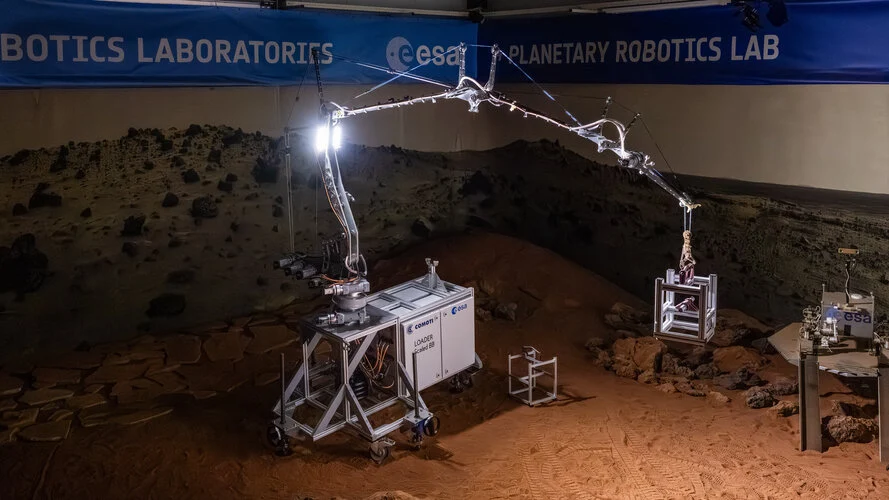
To rigorously test and validate the Loader’s functionality, a scaled model of the crane has undergone extensive testing in ESA’s Planetary Robotics Laboratory in the Netherlands. This state-of-the-art facility provides a controlled environment that simulates key aspects of the lunar environment, allowing engineers to assess the crane’s performance without the risks and costs associated with actual lunar missions. The tests involve moving payload mock-ups, allowing engineers to observe the crane’s articulation, reach, and stability.
Gunter Just, ESA’s robotics engineer, highlighted the significance of these tests: "This scaled model is only able to lift 30 kg under Earth gravity, equivalent to a little over 180 kg on the Moon, but it allows us to test the functionality and accuracy of the device in a lab environment." This scaling is a common practice in engineering, allowing for cost-effective testing of fundamental principles and mechanisms. The Earth-based tests provide invaluable data on the crane’s operational parameters, including its control systems, joint movements, and load-bearing capabilities. The next iteration of the crane will be significantly larger, with the intention of it being more than twice the size of the tested model. This scale increase, coupled with the Moon’s significantly weaker gravity (approximately one-sixth of Earth’s), will enable the crane to achieve its full lifting capacity of up to a tonne.
The testing phase also focuses on the crane’s adaptability to varying lunar terrain. A crucial feature is its specialized leveling system, designed to maintain the crane’s vertical orientation even if the lunar lander settles on a sloped surface. This is a critical consideration, as lunar landing sites are rarely perfectly flat. The system ensures that the crane can operate reliably, regardless of minor imperfections in the landing site, further enhancing its operational robustness.
Advanced Gripping and Control Mechanisms
The Loader crane’s operational end features a sophisticated set of grippers, designed for both robust handling and precise manipulation of cargo. This dual-gripper system comprises a passive, spring-loaded gripper and a battery-powered, articulated gripper. The passive gripper is designed to securely lock onto payloads without requiring continuous power, ensuring a reliable hold even in the event of temporary power fluctuations. This is a critical safety feature for lunar operations.
The battery-powered gripper, on the other hand, offers a higher degree of dexterity. It can rotate and articulate the load, allowing for more precise positioning of cargo. This capability is particularly important for delicate operations, such as the placement of sensitive scientific instruments or the assembly of modular components for lunar habitats. The combination of these two gripper types provides a versatile solution for a wide range of deployment tasks.
A Foundation for Future Lunar Infrastructure
The successful development of the Loader crane represents a significant milestone for Europe’s lunar ambitions. It demonstrates a clear capability to manage substantial cargo on the lunar surface, a prerequisite for more complex and ambitious missions. The insights gained from the testing of this demonstrator will pave the way for the refinement and eventual deployment of the full-scale crane.
Daniel Useriu expressed his pride in the team’s achievement: "I am very proud of what the COMOTI team, in collaboration with Initium Space, has achieved with this demonstrator. We have successfully met, and in some areas exceeded, our initial expectations. There is still a great deal of work ahead to refine the crane, but this demonstrator gives us a strong foundation for the next steps." This statement underscores the iterative nature of space technology development, where initial successes build the confidence and knowledge base for future advancements.
The implications of this technology extend far beyond the initial Argonaut missions. The ability to deploy heavy payloads efficiently and precisely is fundamental to the establishment of a sustained human presence on the Moon. This includes the construction of habitats, the deployment of power generation systems, and the setup of communication networks. The Loader crane, therefore, can be seen as a foundational piece of technology for enabling the ambitious lunar infrastructure envisioned for the coming decades.
Broader Context: Europe’s Lunar Strategy
The development of the Loader crane is intrinsically linked to ESA’s broader strategy for lunar exploration and utilization. Programs like Argonaut are designed to provide Europe with independent access to the lunar surface, fostering scientific research, technological innovation, and the development of a European lunar economy. The agency envisions a future where lunar resources can be utilized, and where Europe plays a leading role in establishing a permanent human presence beyond Earth.
The Technology Development Element (TDE) program, which supports projects like Loader, is crucial in this regard. It acts as an incubator for promising technologies, nurturing them from early concepts to flight-ready systems. By investing in such foundational capabilities, ESA ensures that Europe remains at the forefront of space exploration and is well-equipped to meet the challenges and opportunities of the new space age.
The timeline for the full deployment of the Loader crane is intrinsically tied to the development and launch schedule of the Argonaut landers. While specific dates for Argonaut missions are subject to ongoing planning and funding, the successful testing of the Loader demonstrator indicates that the technology is on track to be ready for integration into future lunar lander designs. This forward-looking approach ensures that Europe’s lunar ambitions are supported by robust and cutting-edge technological solutions.
The successful development and eventual deployment of the Loader crane by COMOTI and Initium Space, with the support of ESA, represent a significant leap forward for Europe’s lunar exploration capabilities. This specialized lunar crane is not just a piece of machinery; it is a critical enabler of future scientific discovery and the ambitious vision of a sustained human presence on the Moon. As Europe continues to forge its path in lunar exploration, technologies like Loader will be instrumental in transforming ambitious plans into tangible achievements on the lunar surface.