The perennial discussion among corporate leaders regarding climate strategy often circles back to a singular, unwavering message: sustainability is paramount, even in the face of competing priorities and significant external pressures. However, a comprehensive new report from the MIT Sustainable Supply Chain Lab reveals a critical divergence between this stated commitment and the actual capacity of organizations to implement and maintain their sustainability initiatives. The "2026 State of Supply Chain Sustainability Report," based on a robust survey of 1,810 supply chain professionals across 91 countries, indicates that while 83 percent now deem sustainability crucial for long-term business success – a record high over the report’s seven-year history – this conviction is increasingly being tested by a volatile global environment and internal structural deficiencies.
H2: The Paradox of Progress: Commitment Outstrips Capacity
The findings of the 2026 report paint a complex picture. While an overwhelming majority of respondents express a deep-seated belief in the importance of sustainability, the practical execution of these goals is encountering significant headwinds. The report highlights a stark reality: a surge in commitment, particularly in the wake of recent U.S. policy shifts that have, at times, appeared to deprioritize environmental concerns, has not been met with a commensurate increase in organizational capacity.
Sreedevi Rajagopalan, director of the MIT Sustainable Supply Chain Lab and lead author of the report, articulates this central tension. "Commitment is strong, measurement is expanding, and AI is accelerating," she stated. "What comes next is harder: converting commitment into accountability, operational integration into strategic decision-making, and incremental decarbonization into genuine transition." This sentiment underscores the report’s core argument that the supply chain sustainability agenda is currently navigating a precarious balance between deeply held convictions and formidable, often unforeseen, constraints.
H2: Geopolitical Tremors and the Erosion of Stability
A significant external factor identified as undermining sustainability efforts is the pervasive impact of ongoing geopolitical conflicts. More than 80 percent of respondents across North America, Europe, and Asia concur that global instability is actively diminishing the effectiveness of their organizations’ climate actions. This is a critical revelation, as many decarbonization strategies were meticulously crafted under the assumption of a relatively stable international trade environment and a degree of global peace. The current reality, characterized by heightened geopolitical tensions and unpredictable trade dynamics, has rendered these foundational assumptions obsolete.
The ripple effects of this instability are tangible. The report specifically points to tariff uncertainty as a major impediment. A staggering 68 percent of respondents reported that fluctuating tariffs have compelled them to either delay, scale back, or entirely abandon their sustainability strategies. Even more concerning, nearly one-third of these organizations have experienced an actual increase in their operational emissions directly attributable to tariff-related disruptions. This paradoxical outcome underscores the intricate web of global commerce and environmental impact, where well-intentioned sustainability goals can be inadvertently undermined by economic protectionism and trade disputes.
H3: The Impact of Tariffs: A Case Study in Disruption
The introduction of tariffs, often implemented to protect domestic industries or address trade imbalances, has historically created volatility in global supply chains. In recent years, the landscape of international trade has become particularly unpredictable, with various nations engaging in retaliatory measures and policy shifts. For companies deeply integrated into global supply networks, these tariffs represent not just an increased cost of goods but a fundamental disruption to their operational planning.
When a company has invested in sustainable sourcing, for example, or established logistics networks designed for efficiency and reduced carbon footprint, the sudden imposition of tariffs on specific components or finished goods can necessitate a complete re-evaluation of these strategies. This might involve seeking alternative, potentially less sustainable, suppliers to circumvent tariffs, or rerouting shipments through less efficient, but tariff-exempt, pathways. Such adjustments inevitably lead to increased transportation distances, more complex logistics, and potentially higher energy consumption, thereby negating previous emissions reductions. The report’s finding that nearly a third of companies saw increased operational emissions due to tariff uncertainty provides a stark quantitative measure of this disruptive effect.
H2: Internal Vulnerabilities: The Governance Gap
Beyond the external pressures, the MIT report also illuminates significant internal vulnerabilities within organizations that are hindering the effective integration of sustainability. While many companies now boast publicly stated sustainability goals, the report reveals a critical deficit in the necessary governance structures to translate these ambitions into tangible action.
A key finding is that only 51 percent of companies with public sustainability commitments have established a formal, cross-functional sustainability team. This collaborative structure is widely recognized as the most effective model for embedding sustainability principles into the daily decision-making processes across different departments. Furthermore, the oversight of sustainability initiatives at the board level remains surprisingly limited, with only 33 percent of companies placing such responsibility at this highest echelon of corporate governance.
The implication is clear: public ambition is significantly outpacing the development of internal accountability infrastructure. The report quantifies this gap by comparing the integration of sustainability into daily decisions. Companies with dedicated cross-functional teams reported that sustainability is "frequently or always" considered in decisions 57 percent of the time. In stark contrast, where sustainability responsibility is confined to a single functional department, this figure plummets to a mere 13 percent, revealing a substantial 44-point difference that highlights the significant return on investment in robust governance.
H3: The Power of Cross-Functional Collaboration
The establishment of a cross-functional sustainability team is not merely an administrative detail; it represents a fundamental shift in how an organization approaches environmental and social responsibility. In a traditional siloed structure, sustainability might be seen as the purview of a specific department, such as environmental health and safety, or corporate social responsibility. This can lead to fragmented efforts, a lack of buy-in from other departments, and a failure to integrate sustainability into core business operations.
A cross-functional team, on the other hand, brings together representatives from various departments, including operations, procurement, product development, finance, and marketing. This ensures that sustainability considerations are brought to bear on all aspects of the business. For instance, procurement can identify sustainable sourcing opportunities, product development can design for recyclability, and finance can assess the long-term financial benefits of sustainable investments. The report’s data strongly supports this, showing a substantial difference in the frequency of sustainability integration into daily decisions when such a structure is in place. This demonstrates that effective governance is a critical enabler of sustainable practices, not just a bureaucratic hurdle.
H2: Operational Efficiency vs. Strategic Transformation
The report further dissects where sustainability is gaining traction and where it falters. It appears that companies are becoming more adept at making their day-to-day operations more sustainable. Key areas showing deeper integration include transportation and logistics (39 percent), procurement (35 percent), warehousing (34 percent), and product design (33 percent). These are the areas where incremental improvements can be readily identified and implemented.
However, the integration thins out dramatically when it comes to decisions that have long-term, systemic implications for emissions. These include capital investment, network design, and supply chain risk planning. This distinction is crucial: organizations are becoming better at operating sustainably, but not yet at designing sustainable supply chains for the future. This suggests a focus on short-term gains and operational tweaks rather than the fundamental architectural changes needed for true long-term decarbonization.
H3: The Long-Term Investment Dilemma
The reluctance to embed sustainability into long-term strategic decisions like capital investment and network design can be attributed to several factors. Capital-intensive projects, such as building new, more sustainable manufacturing facilities or redesigning complex global logistics networks, require significant upfront investment and carry a longer payback period. In an environment of economic uncertainty and volatile trade policies, businesses may be hesitant to commit to such long-term projects.
Furthermore, the risk associated with these decisions is often higher. A miscalculation in network design, for instance, could lead to years of inefficiencies and increased costs, especially if geopolitical factors change or consumer demand shifts unexpectedly. Companies might therefore prioritize investments in areas with more immediate returns or those that offer greater flexibility in the face of uncertainty. The report’s findings highlight a critical challenge for the future: the need to bridge the gap between operational sustainability improvements and the strategic foresight required to build truly resilient and environmentally responsible supply chains for the decades to come.
H2: The Double-Edged Sword of Artificial Intelligence
The increasing adoption of Artificial Intelligence (AI) presents a complex, and at times contradictory, narrative within the realm of supply chain sustainability. A substantial 78 percent of North American organizations report current use of AI in their sustainability initiatives, with a remarkable 87 percent of these adopters claiming positive impacts on their sustainability goals. Specific benefits cited include reduced material waste (86 percent), decreased energy consumption (81 percent), and improved estimation of missing supplier emissions data (63 percent).
However, a deeper dive into the data reveals a nuanced reality. Among users of mature, agentic AI systems (those capable of autonomous decision-making and action), only 53 percent report a reduction in their total greenhouse gas emissions. More alarmingly, 29 percent report an increase in emissions. This suggests that while AI can drive operational efficiencies and optimize specific processes, these gains do not automatically translate into a net reduction in overall emissions. The challenge lies in ensuring that AI deployment is strategically aligned with overarching decarbonization objectives, rather than simply optimizing for existing, potentially carbon-intensive, operational paradigms.
H3: AI in Warehousing: Efficiency at What Cost?
The warehousing sector provides a particularly illustrative example of this AI paradox. Among advanced and fully automated warehouses employing AI, a significant 78 percent reported higher energy consumption following AI implementation. Similarly, 76 percent noted an increase in waste generation. Despite these concerning trends, a mere 24 percent of these facilities utilize AI-driven real-time monitoring to track their environmental consequences. This disconnect implies that many organizations may be inadvertently increasing their environmental footprint through AI adoption without realizing it until well after implementation, or perhaps not at all, due to a lack of granular environmental impact tracking.
The potential for AI to optimize energy usage, improve inventory management, and reduce the need for physical movement of goods is immense. However, if the underlying infrastructure or operational logic remains carbon-intensive, or if the AI itself requires substantial energy to operate, the net environmental benefit can be diminished or even reversed. The report underscores the urgent need for companies to integrate comprehensive environmental impact assessments into their AI deployment strategies, ensuring that technological advancements serve genuine sustainability goals.
H2: Freight Transportation: Policy Signals and the Pace of Transition
The freight transportation sector, a major contributor to global emissions, presents a mixed picture of progress and persistent challenges. The report indicates that nearly all freight companies are actively engaged in emission reduction efforts through strategies such as route optimization, load consolidation, and driver behavior programs. These are vital operational improvements that contribute to greater efficiency.
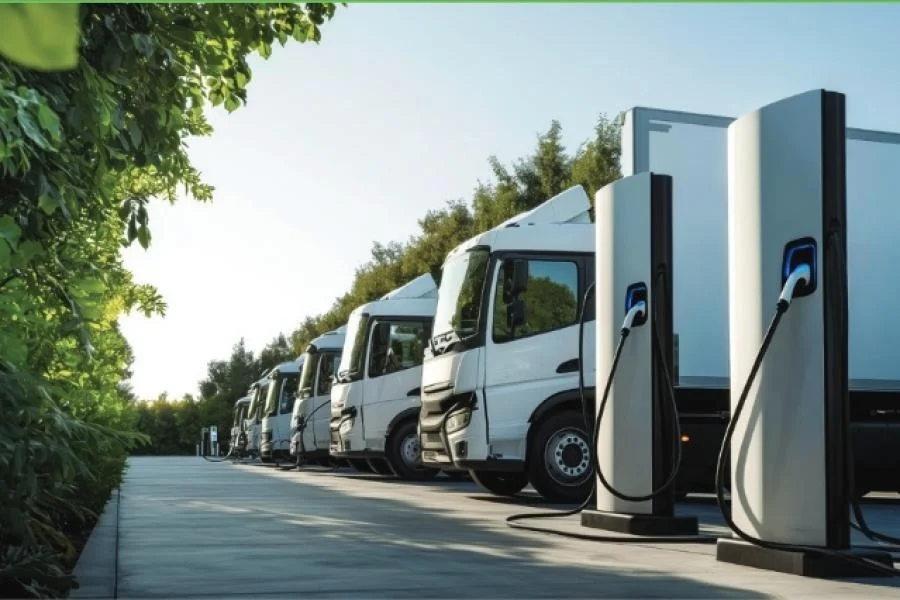
However, the transition to lower-emission energy sources remains a significant hurdle. A substantial 43 percent of fleets continue to operate predominantly or entirely on conventional diesel fuel, and only a modest 8 percent have achieved a full transition to low-emission energy alternatives. The divergence in progress between different regions highlights the critical role of policy. In Europe, 84 percent of freight companies report that recent policy changes have positively influenced their decarbonization strategies. In contrast, only 44 percent of their North American counterparts share this sentiment. This disparity suggests that when policy signals are clear and supportive, capital-intensive technological transitions, such as the adoption of battery-electric vehicles, accelerate. Indeed, battery-electric vehicles are reportedly at scale in 60 percent of European companies, compared to only 36 percent in North America, demonstrating a direct correlation between policy support and the pace of decarbonization in this capital-intensive sector.
H3: The European Policy Advantage
The findings regarding freight transportation in Europe underscore the significant impact of proactive and consistent government policy on driving sustainable innovation and adoption. European nations and the European Union have, over the past decade, implemented a range of regulations, incentives, and targets aimed at reducing transport emissions. These include stricter emissions standards for new vehicles, subsidies for the purchase of electric and alternative fuel vehicles, investments in charging infrastructure, and the implementation of carbon pricing mechanisms.
This comprehensive policy framework creates a more predictable and supportive environment for businesses to invest in cleaner technologies. When companies can anticipate long-term regulatory trends and benefit from financial incentives, they are more likely to commit to the substantial capital outlays required for fleet modernization. The contrast with North America, where policy signals may be less consistent or more politically contentious, explains the slower pace of transition in that region. This regional difference serves as a powerful case study for policymakers globally, demonstrating that clear, long-term policy direction is a critical catalyst for decarbonization in sectors heavily reliant on technological investment.
H2: A Collaborative Breakthrough: Tackling Scope 3 Emissions
Amidst the challenges, one of the most encouraging trends identified by the report is the significant progress in tackling Scope 3, or indirect, emissions. These are the emissions that occur in a company’s value chain, both upstream and downstream, and are notoriously difficult to measure and control. Participation in joint supplier engagement and decarbonization programs has surged dramatically, increasing from 31 percent to 58 percent in just one year.
Furthermore, partnerships focused on managing the emissions of shared suppliers have more than doubled, rising from 23 percent to 55 percent. The proportion of companies attempting to tackle Scope 3 emissions entirely alone has collapsed from 18 percent to a mere 6 percent. This indicates a widespread recognition that Scope 3 emissions cannot be effectively addressed in isolation. The report, which received support from prominent organizations including the C.H. Robinson Foundation, Breakthrough, and CO2 AI and Dassault Systèmes, highlights this collaborative shift as a pivotal development in the pursuit of comprehensive supply chain sustainability.
H3: The Imperative of Scope 3 Collaboration
Scope 3 emissions often represent the largest portion of a company’s total carbon footprint. They encompass a vast array of activities, including the extraction and production of purchased materials and fuels, transportation and distribution, waste generated in operations, business travel, and the use of sold products. Historically, companies have focused primarily on Scope 1 (direct) and Scope 2 (indirect from purchased energy) emissions, as these are more directly within their control and easier to measure.
However, the growing awareness of climate science and the increasing pressure from stakeholders, investors, and regulators have brought Scope 3 emissions into sharp focus. The challenge lies in the fact that these emissions occur outside the company’s direct operational boundaries, requiring extensive collaboration with suppliers, customers, and other partners in the value chain. The report’s data on the surge in joint programs and partnerships is a testament to the evolving understanding that these complex emissions can only be effectively managed through collective action. By pooling resources, sharing best practices, and establishing common goals, companies can exert greater influence over their extended value chains and achieve more substantial emissions reductions than they could individually.
H2: The Path Forward: From Commitment to Accountability
The overarching conclusion drawn from the "2026 State of Supply Chain Sustainability Report" is that the primary constraint on ongoing sustainability efforts is no longer corporate commitment. Instead, the key obstacles lie in the realm of governance, accountability structures, technological infrastructure, and robust measurement capabilities.
Organizations that successfully navigate the current landscape will be those that can bridge the external gap by building resilience against disruptions – a critical lesson learned from the impact of geopolitical instability and trade volatility. Simultaneously, they must address the internal gap by hard-wiring accountability into their organizational structures. This involves not just setting ambitious goals but establishing clear lines of responsibility, robust oversight mechanisms, and performance metrics that ensure these goals are met. Ultimately, the report suggests that ambition without accountability will yield limited progress, leaving companies’ sustainability commitments vulnerable to the vagaries of an increasingly complex and uncertain global environment. The journey from stated intent to tangible, lasting impact hinges on the diligent construction of both external resilience and internal fortitude.