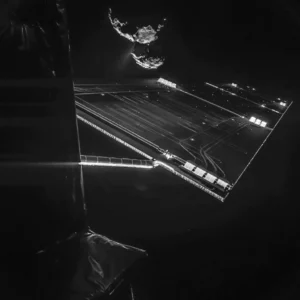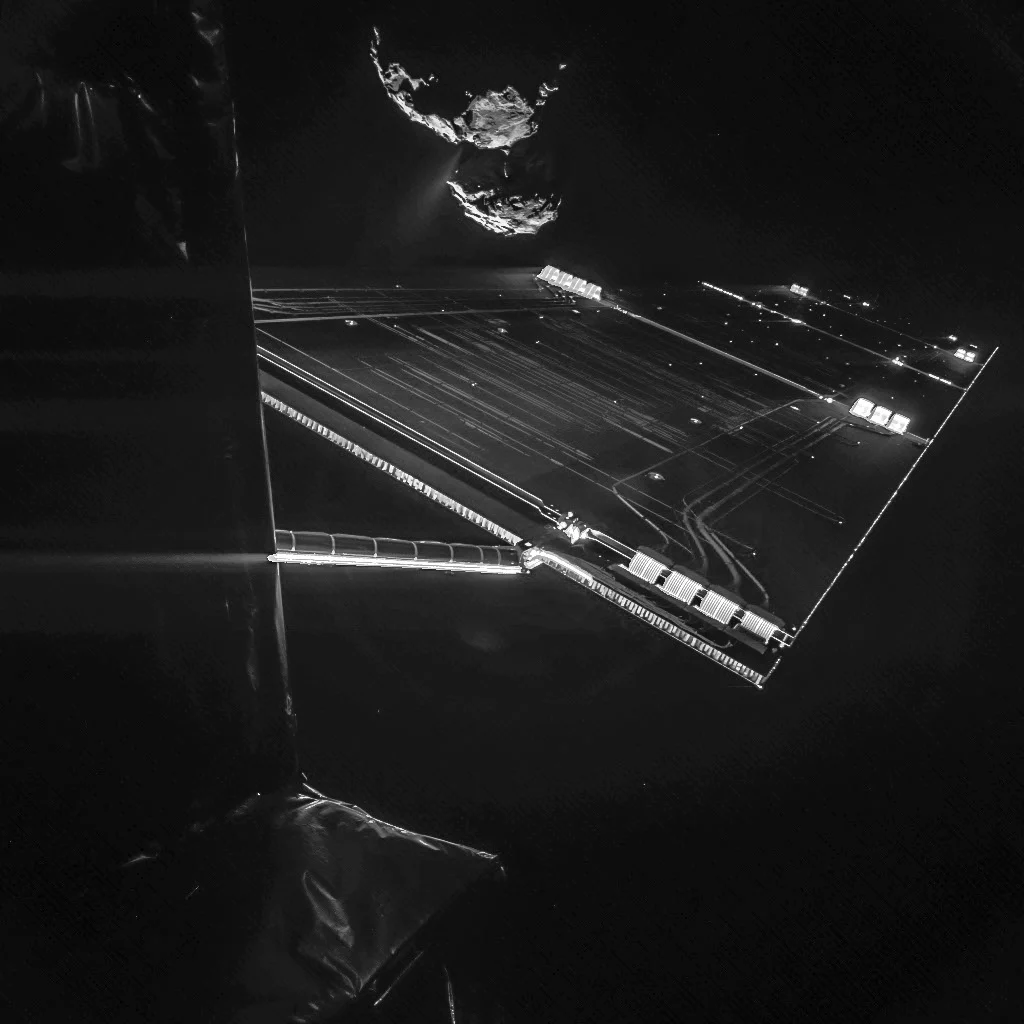
A breathtaking image, captured by the European Space Agency’s (ESA) Rosetta spacecraft on October 7, 2014, offers a unique perspective of the comet 67P/Churyumov-Gerasimenko, with the spacecraft’s own solar array prominently featured in the foreground. This remarkable "selfie" was taken when Rosetta was approximately 472 million kilometers from Earth, but a mere 16 kilometers from the comet’s enigmatic, double-lobed nucleus. The photograph, processed using data from the CIVA (Comet Infrared and Visible Analyzer) camera system on Rosetta’s Philae lander, provides an intimate glimpse into the comet’s dynamic environment and the sophisticated engineering that enabled this unprecedented close encounter.
The image reveals a stream of dust and gas emanating from the comet, a testament to its active nature as it journeyed closer to the Sun. The brilliant glare of sunlight reflects off one of Rosetta’s expansive 14-meter-long solar arrays, a crucial component for powering the spacecraft’s extensive suite of scientific instruments. The dramatic high-contrast scene was achieved by combining two separate exposures, one short and one long, a technique employed to capture both the dimly lit comet and the intensely bright solar array.
This image holds particular significance as it was one of the last taken by Philae’s camera before its planned separation from the Rosetta orbiter on November 12, 2014. Philae’s primary landing site had been identified on the visible hemisphere of the smaller lobe of the comet’s nucleus, a meticulously chosen location for its scientific potential. The image serves as a poignant reminder of the ambitious mission and the close collaboration between the orbiter and its lander.
Background: The Rosetta Mission and its Comet Rendezvous
The Rosetta mission, launched by ESA on March 2, 2004, was a groundbreaking endeavor to study comet 67P/Churyumov-Gerasimenko in unprecedented detail. After a decade-long journey, involving multiple gravity assists from Earth and Mars, Rosetta arrived at the comet in August 2014. This marked the first time a spacecraft had orbited a comet, allowing for sustained observation of its evolution and behavior.
Comet 67P/Churyumov-Gerasimenko is a Jupiter-family comet, meaning its orbit is influenced by Jupiter’s gravity. It has an estimated orbital period of about 6.45 years. The comet itself is characterized by its peculiar double-lobed shape, believed to be the result of a gentle collision between two smaller cometesimals early in the solar system’s history. Its nucleus is roughly 4.3 kilometers by 4.1 kilometers in size.
The primary scientific objectives of the Rosetta mission were to:
- Study the nucleus of the comet: Analyze its composition, structure, and physical properties.
- Investigate the coma and tail: Observe the outgassing of volatile materials and the formation of the comet’s atmosphere and tail as it approached the Sun.
- Understand the origin and evolution of the solar system: Comets are considered pristine remnants from the early solar system, and studying them provides insights into the conditions under which planets formed.
- Investigate the potential role of comets in delivering water and organic molecules to Earth: This was a key question related to the origin of life on our planet.
The Philae lander, attached to Rosetta, was designed to perform the first-ever soft landing on a comet nucleus. Its suite of instruments was intended to conduct in-situ analyses of the comet’s surface and subsurface.
Chronology of Key Events Leading to the "Selfie"
The capture of this iconic "selfie" occurred within a critical period of the Rosetta mission, leading up to the historic landing of Philae.
- August 6, 2014: Rosetta successfully enters orbit around comet 67P/Churyumov-Gerasimenko, becoming the first spacecraft to orbit a comet.
- September 2014: Intensive mapping and analysis of the comet’s surface are conducted to identify potential landing sites for Philae.
- October 7, 2014: The "selfie" image, featuring the Rosetta spacecraft’s solar array and the comet’s nucleus, is captured by the CIVA camera system. This image was taken from a distance of 16 kilometers from the comet.
- November 12, 2014: Philae separates from the Rosetta orbiter.
- November 12, 2014: Philae successfully lands on the surface of comet 67P/Churyumov-Gerasimenko, transmitting valuable data before its power reserves were depleted.
The "selfie" image, taken shortly before Philae’s separation, serves as a visual testament to the complex and intricate operations of the Rosetta mission. It highlights the advanced capabilities of the spacecraft and the lander, showcasing their ability to operate in the harsh environment of deep space and perform intricate maneuvers.

Supporting Data and Scientific Significance
The image, while visually striking, is underpinned by significant scientific data and context. The CIVA instrument on Philae was a multi-camera system designed to provide panoramic and stereoscopic views of the comet’s surface. It comprised seven individual cameras: one wide-angle camera and six narrow-angle cameras arranged in a panoramic head. This configuration allowed for detailed imaging and the creation of 3D models of the cometary landscape.
The dual exposure technique used to create the "selfie" is a critical aspect of astronomical imaging, particularly when dealing with objects that have vastly different brightness levels. The short exposure captures the brightly lit solar array without overexposing it, while the long exposure allows for sufficient light to be gathered from the dimmer comet nucleus and its surrounding coma. By combining these exposures, scientists can create a single image that retains detail in both the foreground and background.
The distance of 16 kilometers from the comet’s nucleus at the time of the photograph is crucial. This proximity allowed for a detailed view of the comet’s surface features, including the rugged terrain, fractured surfaces, and the emanating dust and gas. The observed streaming of dust and gas is a direct consequence of the comet’s sublimation—the process by which ice turns directly into gas—as it is heated by the Sun. This sublimation is what forms the comet’s coma and tail.
The double-lobed structure of comet 67P/Churyumov-Gerasimenko is a key characteristic that scientists have been studying. The "selfie" offers a direct visual confirmation of this unique morphology. The analysis of the comet’s shape and composition is vital for understanding the processes of cometary formation and evolution, which in turn shed light on the early conditions of the solar system.
Official Responses and Mission Context
While specific "statements or reactions" directly to this single "selfie" image from October 7, 2014, are not explicitly detailed in the provided content, the broader context of the Rosetta mission elicited significant global attention and official pronouncements from ESA and its partner agencies. The successful orbit insertion and the subsequent landing of Philae were met with widespread acclaim and were heralded as monumental achievements in space exploration.
ESA officials consistently emphasized the scientific importance of the mission, highlighting the potential for Rosetta to unlock fundamental questions about the origins of our solar system and the potential for life beyond Earth. The images and data returned by Rosetta and Philae were regularly disseminated to the public and scientific community through press conferences, online platforms, and scientific publications.
The image itself, as part of the ongoing scientific data stream, would have been meticulously analyzed by the Rosetta science team. The CIVA instrument’s data, including this image, contributed to the overall understanding of the comet’s surface morphology, illumination conditions, and the processes driving its activity.
Broader Impact and Implications
The Rosetta mission, and images like this "selfie," have had a profound impact on our understanding of comets and the early solar system.
- Enhanced understanding of cometary activity: The mission provided unparalleled insights into how comets become active as they approach the Sun, shedding light on the composition and release mechanisms of volatiles.
- Insights into solar system formation: The detailed study of comet 67P/Churyumov-Gerasimenko’s composition and structure has provided valuable clues about the building blocks of the solar system and the conditions that prevailed during its formation.
- Technological advancements: The mission pushed the boundaries of spacecraft design, navigation, and autonomous operation in deep space, paving the way for future complex missions.
- Public engagement and inspiration: The stunning visuals and scientific discoveries from Rosetta captured the public’s imagination, inspiring a new generation of scientists and engineers and fostering a greater appreciation for space exploration.
- Potential for astrobiology: The discovery of organic molecules on comets, a key focus of Rosetta, has fueled ongoing research into the role comets may have played in delivering the essential ingredients for life to early Earth.
The "selfie" from Rosetta is more than just a visually striking photograph; it is a symbol of human ingenuity, scientific curiosity, and our relentless quest to understand our place in the cosmos. It represents a pivotal moment in the exploration of comets, offering a unique perspective that bridges the gap between the spacecraft and the celestial body it was sent to study. The data and imagery generated by this mission continue to be analyzed, promising further revelations about the history and evolution of our solar system. The legacy of Rosetta extends far beyond the images it captured, influencing the direction of space science and inspiring future generations to reach for the stars.