In 2022, the global construction sector emerged as a significant contributor to anthropogenic climate change, accounting for over 7 percent of total carbon emissions, according to the International Energy Agency (IEA). A substantial portion of these emissions is directly linked to the production of materials used in building homes, commercial structures, and critical infrastructure like bridges. A groundbreaking computational technique known as topology optimization holds the potential to dramatically reduce this environmental footprint by designing structures that utilize significantly less material – in some cases, up to 90 percent less. However, its widespread adoption in large-scale construction projects has been hampered by a critical disconnect: the designs generated are often too complex and costly to build using conventional methods, a fact that has historically relegated the technique primarily to academic research and niche applications like 3D printing.
Now, a team of researchers at the Massachusetts Institute of Technology (MIT) has developed a novel framework that bridges this gap, making topology optimization designs more practical and constructible for the real-world demands of the building industry. Their innovative approach, detailed in a recent publication in the journal Automation in Construction, allows engineers to impose specific constraints on algorithmically generated structures, thereby limiting their complexity without compromising their structural integrity or material efficiency. This advancement promises to unlock substantial reductions in building-related carbon emissions, potentially in the order of multiple gigatons globally.
The core of the MIT team’s innovation lies in their ability to integrate crucial real-world considerations directly into the optimization process. Traditionally, topology optimization algorithms focus on achieving maximum structural performance (strength, stiffness) with minimum material usage within a defined design space. While effective in generating highly efficient forms, these designs often result in intricate, organic shapes with numerous interconnected components and complex junctions that are difficult, time-consuming, and expensive to fabricate and assemble on-site. This lack of "buildability" has been the primary barrier preventing the widespread adoption of this promising technology by the engineering and construction sectors.
"There’s an interplay between the materials you’re using, the constructability of designs, and the optimization of the structure," explains Josephine Carstensen, an associate professor in MIT’s Department of Civil and Environmental Engineering and the senior author of the study. "You need to be able to address all three at the same time. That’s what we tried to do here."
The researchers’ framework introduces a sophisticated set of user-defined constraints that guide the optimization process toward more manageable designs. These constraints can limit the number of components that meet at any given point within a structure, thus simplifying connection details. They can also define the minimum allowable size for individual components, ensuring that parts are not so small as to be impractical to manufacture or handle. Furthermore, the framework builds upon prior research by enabling the design of structures incorporating multiple materials, carefully considering their individual properties to optimally distribute loads and specify secure connections between disparate elements.
"In the literature, there’s sometimes been a disconnect between the carbon savings you can achieve on a computer and the realistic carbon savings you can achieve for built structures – especially when it comes to design technologies like topology optimization," Carstensen elaborates. "The problem lies in the lack of constructability of designs. These designs have been perceived as too difficult to make with conventional methods, so they are never even attempted. That’s what is exciting about our approach: we can add constraints so that you will never be in a situation where the design that comes out is too hard to make."
Bridging the Gap Between Computational Design and Construction Reality
Topology optimization, a technique that has been in development for decades, employs computational algorithms to determine the optimal distribution of material within a given volume to achieve desired performance criteria, such as maximizing stiffness or minimizing weight. The resulting forms are often characterized by their organic, lattice-like structures, which are highly efficient but pose significant challenges for traditional construction methods.
"A big question Josephine and I were asking is why isn’t industry using it?" recalls Zane Schemmer, a doctoral student in civil and environmental engineering at MIT and the first author of the paper. "What are the obstacles that prevent industry from designing things more efficiently, and how can we fill the gaps between research and real life?"
Previous efforts to enhance the usability of topology optimization have focused on various aspects, but Schemmer and Carstensen aimed to synthesize and expand upon these approaches. Their work specifically addresses the critical need for designs that can be realized within the practical constraints of time and budget that are paramount to the construction industry.
"A big aspect of sustainability going forward will be not only using less material, but also implementing materials efficiently based on considerations like where you are in the world, your access to materials, and each of their associated carbon costs," Schemmer explains. This forward-looking perspective highlights the multi-faceted nature of sustainable construction, which extends beyond mere material reduction to encompass resource availability and embodied carbon.
A More Granular Approach to Design Constraints
The MIT researchers’ framework utilizes a class of mathematical tools known as mixed-integer algorithms. These algorithms are adept at making discrete, binary decisions, which are essential for determining material choices and connection types in a structural design.
"You can’t have a part that’s 72 percent timber and 28 percent steel," Schemmer illustrates, explaining the practical application of these algorithms. "Instead, it says, ‘This truss or cable is going to be made out of this,’ and then based on that decision, how do we make sure all of these connections meet their strength standards?" This binary decision-making process ensures that the generated designs are composed of distinct, identifiable components made from specific materials, aligning with standard manufacturing and assembly practices.
The system’s intelligence extends to its consideration of material properties. For instance, it recognizes that while steel is an excellent material for compressive loads (struts), it is not suitable for tensile loads where cables are preferred. The model also incorporates more realistic representations of how different parts connect to one another, a significant improvement over earlier methods that often treated connections as idealized points.
"In 3D printing, the way things come together is easy," Carstensen notes, drawing a contrast with the complexities of large-scale construction. "In construction, that’s not the case. If you’re building with timber, there’s a certain rule set, versus steel has a different rule set." The MIT framework acknowledges and integrates these distinct rule sets for different materials, ensuring that the generated designs are compatible with conventional construction techniques for each material.
Users of the framework can further refine the complexity of their designs by specifying parameters such as the maximum number of connections allowed at each joint and the minimum angle between connected components. The inclusion of minimum size limits for parts also contributes to enhanced constructability, preventing the generation of components that are too small to be practically handled or installed.
"It’s tough to give a contractor these complex, intricate designs because it’s going to be super difficult to build," Schemmer emphasizes. "A lot of times contractors won’t pick up a project like that to begin with." By precluding such overly complex designs, the MIT framework aims to increase the likelihood of designs being considered and adopted by the industry.
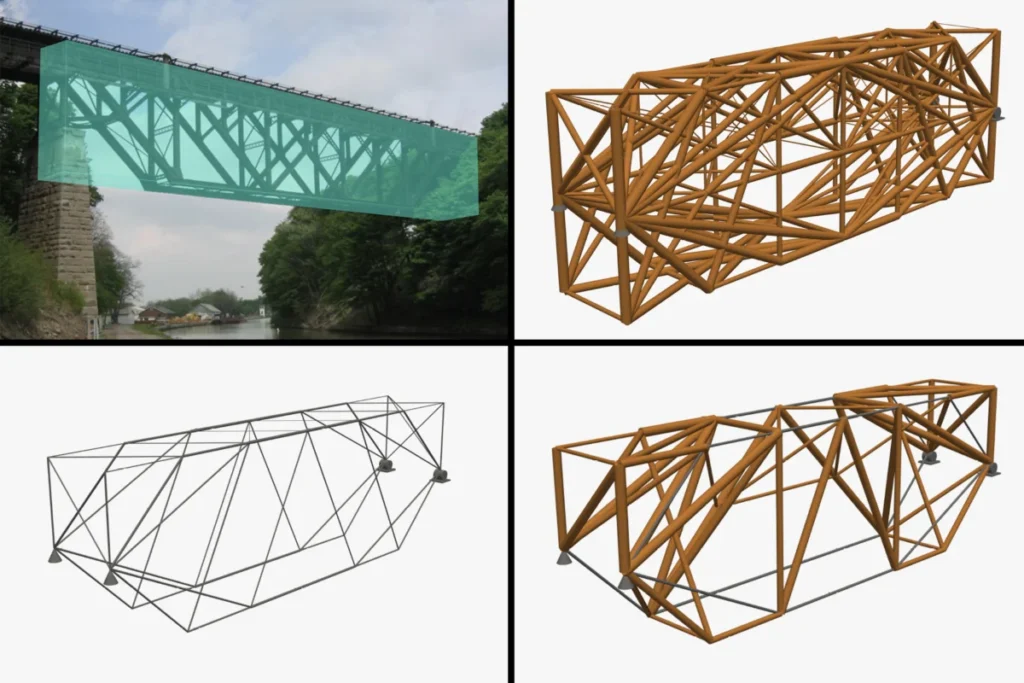
To demonstrate the efficacy of their approach, the researchers applied it to various truss structures, including those designed for buildings and bridges. They compared structures generated using their constrained topology optimization method with those produced by conventional, unconstrained methods. The results showcased dramatic differences in the final designs, fundamentally altering how the structures would be built. As a case study, they analyzed the truss design of the Lockport "Upside-Down Bridge" near Buffalo, New York. By applying individual constraints, such as a minimum angle on part connections or minimum part sizes, they were able to precisely understand how each constraint influenced the final structural form and material distribution.
Furthermore, the team explored the design of truss structures using wood only, steel only, and a combination of both wood and steel. This analysis highlighted the trade-offs inherent in different material choices regarding environmental impact and constructability.
"We saw how the system knew that you could design a bridge of pure steel, but that might not be best from a carbon standpoint," Schemmer states. "Or you could design a bridge out of purely timber, but that might not be the strongest. But these materials can work together, so you use timber for the carbon savings and steel where you need extra strength, and there’s a balance you can find in these structures." This exemplifies the framework’s ability to optimize for multiple objectives simultaneously, including structural performance, environmental impact, and cost-effectiveness.
From Academic Innovation to Industry Application
While the MIT researchers acknowledge that their approach is more computationally intensive than some alternative methods, they report that their experiments were successfully run on a standard MacBook Pro. They are confident that this level of computational feasibility makes their framework practical for adoption by most civil engineering firms.
"It’s computationally a little tougher to solve, but there’s a lot of tools coming out nowadays that make these problems a lot more feasible," Schemmer notes. "This approach has been avoided by industry in the past, but now we think it’s a practical way to solve problems dealing with variable constraints." The increasing availability of powerful computing resources and advanced software tools further supports the viability of this approach for widespread industry use.
The researchers envision that with access to greater computational resources, their approach could be extended to handle a wider array of materials and to design significantly larger and more complex structures, far beyond homes, small buildings, and bridges, potentially encompassing large-scale infrastructure projects.
Looking ahead, Professor Carstensen indicated that the team plans to construct scaled-down physical models based on designs generated by their framework. This experimental validation will serve to further confirm the accuracy of the model’s predictions and its ability to translate computational designs into tangible structures. Additionally, they aim to incorporate even more sophisticated constraints into their model, with the goal of making it even more intuitive and seamless for civil engineers to integrate into their daily design workflows for the world’s infrastructure.
"As a structural engineer by training, I was never taught how to design for low-carbon," Schemmer reflects. "To tackle a problem as big as climate change, addressing the built environment is a great place to start. One of the most tangible things we can do is work at the layer of construction, at the design stage, because that’s a fundamental step that we can control. There’s a lot of decisions we make early on that lead us to use extra material we don’t need."
This sentiment underscores the profound impact that early-stage design decisions have on the overall environmental performance of constructed projects. By equipping engineers with tools that prioritize both efficiency and sustainability from the outset, the MIT framework represents a significant step towards decarbonizing the construction sector.
The research was made possible through funding from the MIT Morningside Academy for Design, an initiative dedicated to fostering interdisciplinary collaboration and innovation in design research.
Broader Implications for Sustainable Development
The implications of this research extend far beyond theoretical advancements in computational design. By making topology optimization a practical tool for engineers, the MIT framework has the potential to catalyze a paradigm shift in how structures are conceived and built.
Reduced Embodied Carbon: The most direct impact will be a significant reduction in embodied carbon. Embodied carbon refers to the greenhouse gas emissions associated with the extraction, manufacturing, transportation, and installation of building materials. By using less material, the energy and emissions associated with these processes are inherently reduced. For example, concrete and steel production are energy-intensive industries with substantial carbon footprints. Minimizing their use directly translates to lower emissions.
Material Efficiency and Cost Savings: Beyond environmental benefits, using less material can lead to substantial cost savings for construction projects. Reduced material procurement, transportation, and waste disposal costs can make infrastructure projects more economically viable, particularly in regions facing material scarcity or high transportation expenses.
Innovation in Material Usage: The framework’s ability to handle multi-material designs opens doors for innovative material strategies. Engineers can leverage the unique properties of different materials in a synergistic manner, using more carbon-intensive materials like steel only where absolutely necessary for structural integrity, while relying on lighter, more sustainable options like timber or advanced composites for other components. This "material intelligence" can lead to designs that are both structurally sound and environmentally optimized.
Enhanced Durability and Performance: While not the primary focus, optimized designs can sometimes lead to structures that are inherently more resilient and durable. By carefully distributing stress and load paths, these structures may be less susceptible to fatigue and damage, potentially leading to longer lifespans and reduced maintenance needs over time.
Scalability and Future Infrastructure: The potential for this technology to scale up to large infrastructure projects means it could play a crucial role in future urban development and climate adaptation strategies. As cities grow and the need for resilient infrastructure intensifies, tools that enable more efficient and sustainable construction will be invaluable.
Industry Adoption and Training: The success of this framework will depend on its adoption by the engineering and construction industry. The researchers’ focus on making the tool practical for existing workflows and computational resources is a critical step. Furthermore, educational institutions will need to integrate such advanced design methodologies into their curricula to train the next generation of engineers in low-carbon design practices.
Policy and Regulatory Influence: As this technology matures and demonstrates its efficacy, it could influence building codes and environmental regulations. Policies that incentivize or mandate the use of performance-based design and material optimization techniques could accelerate the transition to a more sustainable built environment.
The MIT researchers’ work represents a significant leap forward in making advanced computational design tools accessible and applicable to the pressing challenges of climate change within the construction sector. By directly addressing the constructability hurdle, they have paved the way for a future where highly efficient, low-carbon structures are not just theoretical possibilities but practical realities.