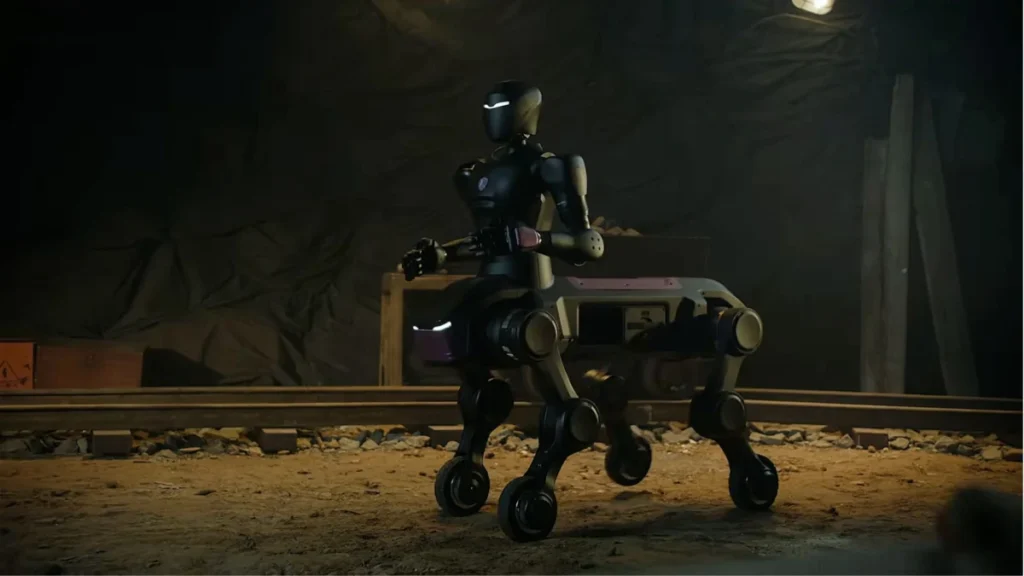
The field of robotics is witnessing a transformative era as bioinspired multimodal robots rapidly advance toward matching the unparalleled versatility and agility found in the animal kingdom. These sophisticated machines, capable of seamlessly switching between diverse forms of locomotion such as flying, walking, swimming, or climbing, are poised to redefine human interaction with complex and unpredictable environments. A recent comprehensive review, spearheaded by researchers from prestigious institutions including Beihang University, Dalian University of Technology, and EPFL, not only charts the evolutionary trajectory of these remarkable systems but also meticulously outlines the formidable engineering hurdles that impede their widespread deployment. Crucially, the study introduces a pioneering framework comprising five distinct performance metrics, designed to standardize evaluation and propel the development of a new generation of more capable, efficient, and inherently adaptable robots. This scientific endeavor is not merely about adding more movement options; it is about fundamentally improving overall performance in scenarios where conventional, single-mode robots fall short, thus paving the way for machines that can truly adapt and thrive in the multifaceted challenges of the real world.
The Dawn of Adaptive Machines: A Paradigm Shift in Robotics
For decades, the realm of robotics was largely dominated by specialized machines, each meticulously engineered for a singular purpose or mode of locomotion. Industrial robots excelled in repetitive factory tasks, wheeled robots navigated structured environments, and aerial drones revolutionized surveillance and delivery. However, the inherent limitation of these specialized designs became acutely apparent when faced with the unstructured, dynamic, and often hazardous conditions prevalent outside controlled settings. A robot designed solely for ground locomotion, for instance, would be rendered useless by a sudden obstacle like a river or a vertical wall. Conversely, a flying robot might struggle with the precision required for ground-level inspection or interaction.
This realization spurred a profound shift in robotic design philosophy, drawing profound inspiration from nature’s most accomplished engineers: animals. Biomimicry, the innovative approach of emulating natural designs and processes to solve human problems, has long been a driving force in engineering. From the aerodynamic efficiency of birds inspiring aircraft design to the adhesive properties of gecko feet informing climbing mechanisms, nature offers a vast repository of optimized solutions. In robotics, this translates into machines that not only mimic the form of animals but also their extraordinary functional adaptability. The objective is to imbue robots with the capacity to perceive, analyze, and autonomously choose the most effective locomotion strategy for any given situation, much like an animal effortlessly transitions from running to climbing or swimming based on environmental cues. This quest for "natural agility" is foundational to the emergence of multimodal robotics, promising a future where robots are no longer confined by their single mode of operation but are liberated by a repertoire of movements that allows them to navigate virtually any terrain or medium.
A Chronicle of Evolution: From Specialized to Integrated Systems
The journey towards fully integrated bioinspired multimodal robots has been a gradual yet accelerating process, marked by incremental innovations and a growing understanding of biological principles. Early attempts at multimodal locomotion often involved disparate mechanisms bolted onto a single platform. For instance, a robot might have wheels for ground travel and propellers for flight, but these systems operated largely independently, leading to significant inefficiencies and design compromises. The components required for one mode often became "dead weight" in another, consuming valuable onboard space and energy without contributing to the active locomotion.
However, the field has progressively evolved beyond these rudimentary combinations. The past decade has witnessed a pivotal shift towards creating integrated, animal-inspired systems that leverage shared structures and intelligent control algorithms. Researchers began to explore how a single component could serve multiple functions, inspired by how an insect’s legs can be used for walking, jumping, or even assisting in flight. Key milestones in this evolution include the development of early amphibious robots capable of modest transitions between land and water, and hybrid aerial-ground vehicles that could land and drive. While initial prototypes were often bulky and slow to transition, they proved the fundamental feasibility of combining different modes.
More recently, advancements in materials science, miniaturization, and computational power have enabled the creation of more sophisticated prototypes. For example, some designs now utilize compliant mechanisms or soft robotics principles, allowing for physical reconfiguration of the robot’s body to optimize for different movement types. This evolution, as highlighted by the Beihang, Dalian University of Technology, and EPFL review, underscores a maturation of the field, moving from merely combining capabilities to deeply integrating them, striving for the seamless and energy-efficient transitions characteristic of biological organisms. This historical progression illustrates a clear trajectory towards robots that are not just multi-talented but truly polymorphous, adapting their very physical structure to suit the task at hand.
Engineering the Unconventional: Overcoming Form and Function Challenges
Despite the rapid advancements, the path to fully versatile multimodal robots is fraught with significant engineering challenges. These obstacles are not merely technical hurdles but fundamental dilemmas in design and integration that demand innovative solutions across multiple scientific disciplines.
One of the most formidable challenges lies in the limited onboard space and the optimization of weight and energy. Every additional movement mode necessitates extra actuators, sensors, batteries, and mechanical components, all of which contribute to the robot’s overall size and mass. As the review meticulously points out, components useful in one mode can become unproductive ballast in another, significantly reducing efficiency. For instance, a robot equipped with wings for flight might find those wings a hindrance when navigating dense ground terrain, adding unnecessary weight and potentially snagging on obstacles. Engineers are constantly battling the trade-off between functionality and payload capacity, striving for maximal capability within minimal physical constraints. This necessitates breakthroughs in lightweight, high-power-density batteries and miniaturized, multi-functional components that can perform diverse roles.
Another critical challenge is body morphing – the ability of a robot to physically reconfigure its structure to optimally support different types of movement. This involves dynamic changes in shape, rigidity, and kinematics. Achieving smooth and rapid body transformations requires sophisticated material science, advanced actuation systems, and intelligent control. Designers must strike a delicate balance between stiffness, which is crucial for stability and power transmission in modes like walking or climbing, and flexibility, which is essential for fluid movements like swimming or adapting to irregular surfaces. The integration of different actuation systems – electrical motors, pneumatic artificial muscles, shape memory alloys, or electroactive polymers – into a cohesive, reconfigurable whole presents a complex control problem. Furthermore, ensuring that these multiple locomotion modes work in concert rather than interfering with one another requires intricate design and robust control algorithms that can manage the complex dynamics of transitioning between states.
Finally, energy management remains a pervasive issue. Powering multiple, often energy-intensive, locomotion modes from a limited onboard energy source is a significant hurdle. Each transition and each mode of movement has its own energy profile. Optimizing energy consumption across different states, harvesting energy where possible, and extending operational endurance are critical for practical applications. These challenges collectively underscore the complexity of creating a truly adaptable robot – a machine that can not only move in various ways but also intelligently and efficiently transform itself to do so.
Defining Excellence: A New Framework for Evaluation
The rapid proliferation of diverse multimodal robot designs has underscored a critical need for standardized evaluation methods. Without common metrics, comparing the performance and effectiveness of different robots becomes subjective and inconsistent, hindering systematic progress. To address this, the researchers have proposed a pioneering framework comprising five distinct performance metrics, designed to provide a comprehensive and objective assessment of these complex systems.
-
Number of Movement Modes: This metric quantifies the raw versatility of a robot by simply counting the distinct forms of locomotion it possesses (e.g., flying, walking, swimming, climbing, jumping). While a higher number generally indicates greater adaptability, this metric alone does not convey efficiency or seamlessness.
-
Additional Cost of Adding New Capabilities: This metric delves into the efficiency of design by measuring the incremental cost (in terms of weight, volume, energy consumption, or complexity) associated with each additional movement mode. A robot that adds a new mode with minimal additional cost is considered more elegantly designed and efficient than one that requires substantial additional hardware. This metric directly addresses the "dead weight" problem.
-
Component Sharing Ratio: This metric assesses the degree to which components are repurposed or shared across different modes. For instance, if a robot uses the same limbs for walking and climbing, or if a single actuator drives multiple movement types, its component sharing ratio would be high. High sharing indicates a more integrated and efficient design, reducing overall complexity and weight.
-
Mode Switching Efficiency: This crucial metric measures the time or energy required for the robot to transition between different locomotion modes. A truly versatile robot must be able to switch quickly and with minimal energy expenditure to respond effectively to dynamic environments. Slow or energy-intensive transitions diminish the practical utility of multimodal capabilities.
-
Overall Performance Gains: Beyond merely possessing multiple modes, this metric evaluates the tangible improvements in mission success, speed, endurance, or adaptability achieved by combining multiple forms of locomotion compared to a single-mode counterpart. For example, if a flying-walking robot can complete a complex search-and-rescue mission significantly faster or more thoroughly than either a purely flying or purely walking robot, it demonstrates substantial performance gains.
This framework is not just a tool for comparison; it serves as a guiding principle for future research and development. By providing clear, quantifiable targets, these metrics will enable researchers and engineers to systematically optimize their designs, fostering the creation of robots that are not only versatile but also practical, efficient, and robust in real-world applications. The adoption of such standardized metrics is a vital step towards accelerating the maturity and widespread application of multimodal robotics.
Innovations on the Horizon: Design Strategies and AI Integration
The continued evolution of multimodal robotics hinges on breakthroughs in both hardware design and intelligent control systems. Researchers are actively exploring several promising strategies that promise to enhance the capabilities and efficiency of future robots.
On the hardware front, soft materials and flexible structures are emerging as game-changers. Unlike rigid robots, soft robots can deform and adapt their bodies to their surroundings, allowing for more fluid movement, safer interaction with delicate objects, and robust navigation through constricted spaces. This inherent compliance also facilitates body morphing, enabling robots to change their shape and stiffness to optimize for different locomotion modes. Another significant approach is structure repurposing, where the same physical components are designed to perform multiple functions across different modes. This minimizes redundant parts and addresses the onboard space and weight constraints, leading to more integrated and efficient designs. Furthermore, the concept of multi-robot architecture offers an intriguing solution: instead of a single, complex robot performing all functions, teams of simpler, specialized robots cooperate to collectively achieve multimodal capabilities. This distributed intelligence and modularity can enhance robustness and scalability.
However, the hardware advancements must be paired with equally sophisticated software. The dramatic changes in dynamics that occur when a robot switches movement modes pose a significant challenge for conventional planning and control algorithms. A control system optimized for flight will be entirely inadequate for ground locomotion. This is where advancements in artificial intelligence become indispensable. The review highlights the crucial role of reinforcement learning (RL), a powerful AI paradigm where robots learn optimal behaviors through trial and error in simulated or real environments. RL can enable robots to autonomously discover efficient mode-switching strategies and adapt their control parameters on the fly.
Beyond RL, the integration of vision-language-action models (VLA) and world models is poised to revolutionize autonomous decision-making. VLA models allow robots to understand high-level commands, interpret visual information from their surroundings, and translate these into appropriate physical actions, including choosing the most suitable locomotion mode. World models, which are internal simulations of the robot’s environment and its own capabilities, allow robots to predict the consequences of their actions and plan complex sequences of movements and transformations without constant human intervention. Coupled with the development of physically intelligent robot bodies – designs that embed some computational or adaptive capabilities directly into their materials and structures – these AI advancements will be essential for enabling seamless transitions, autonomous navigation, and intelligent adaptation in highly complex and unpredictable environments. The synergy between advanced materials, intelligent hardware design, and cutting-edge AI promises to unlock unprecedented levels of robotic autonomy and versatility.
Real-World Applications and Societal Impact
The implications of highly versatile, multimodal robots extend far beyond academic research, promising transformative impacts across numerous sectors. Their ability to navigate diverse terrains and mediums makes them ideal candidates for tasks that are currently hazardous, inaccessible, or inefficient for human operators or single-mode robots.
In search and rescue operations, multimodal robots could revolutionize disaster response. An amphibious robot, for example, could fly rapidly to a disaster zone, land to navigate rubble-strewn streets, and then swim through flooded areas to locate survivors, inspect damaged infrastructure, or deliver aid. Similarly, a climbing-flying robot could survey collapsed buildings from the air and then precisely inspect structural integrity by climbing along facades. The current global market for rescue robots, though still nascent for multimodal systems, is projected to grow significantly, driven by the increasing frequency and intensity of natural disasters, with a Compound Annual Growth Rate (CAGR) estimated to be around 15-20% in the coming years, according to market analysis firms.
Environmental monitoring stands to benefit immensely. Robots capable of traversing land, air, and water can collect comprehensive data on ecosystems, pollution levels, and climate change indicators with unprecedented efficiency. They could inspect underwater