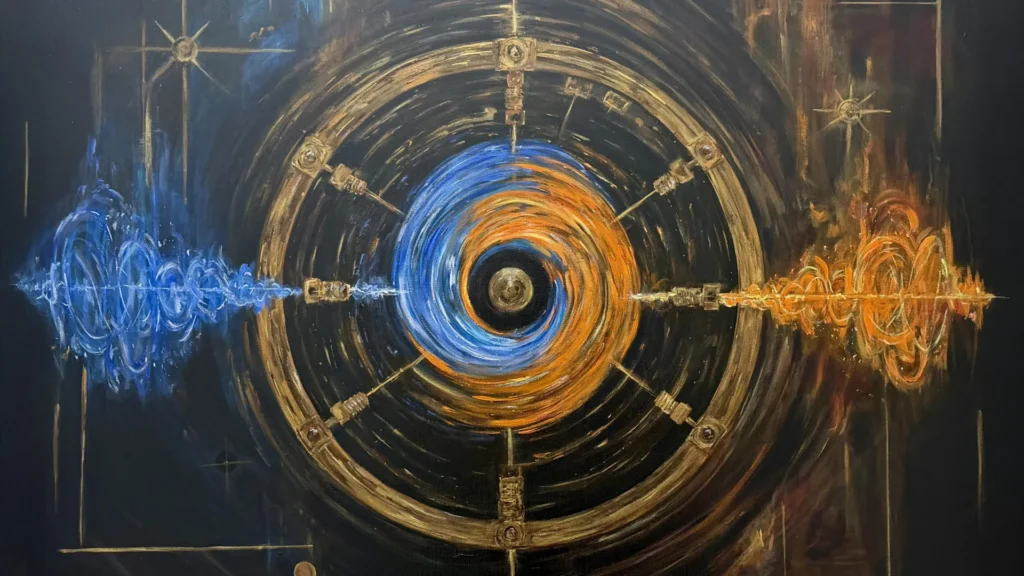
More than 50 years after physicist Sir Roger Penrose first theorized the possibility of extracting energy from a spinning black hole, and decades after Yakov Zel’dovich expanded this concept to waves, researchers at the Advanced Science Research Center at the CUNY Graduate Center (CUNY ASRC) have successfully demonstrated an experimental approach that validates these long-standing theories. Published in the prestigious journal Nature, their groundbreaking work reveals that wave amplification, a phenomenon analogous to energy extraction from extreme cosmic objects, can be achieved using a novel device that simulates ultrafast rotation without any physical spinning parts. This significant achievement not only bridges a substantial gap between theoretical astrophysics and practical experimentation but also opens unprecedented avenues for advancements in wireless communications, optics, photonics, and quantum technologies.
The Penrose-Zel’dovich Legacy: A Theoretical Frontier
The conceptual foundation for this pioneering experiment traces back to the mid-20th century, rooted in the esoteric yet profound realm of black hole physics. In 1969, British mathematical physicist Sir Roger Penrose proposed a remarkable mechanism for energy extraction from a rotating black hole, known today as the Penrose process. His theory posited that if a particle were to enter the ergosphere of a rapidly spinning black hole – a unique region surrounding the event horizon where spacetime itself is dragged along by the black hole’s immense rotation – it could potentially split into two fragments. One fragment, possessing negative energy relative to an observer at infinity, would fall into the black hole, effectively reducing its rotational energy. Crucially, the other fragment would escape the black hole’s gravitational pull, carrying away more energy than the original particle possessed. This net gain in energy for the escaping fragment, derived from the black hole’s rotational kinetic energy, was a stunning implication, suggesting a pathway to harvest colossal amounts of energy from one of the universe’s most enigmatic objects. Penrose’s calculations showed that up to 20.7% of a maximally spinning black hole’s mass-energy could theoretically be extracted this way.
A few years later, in the early 1970s, Soviet astrophysicist Yakov Zel’dovich expanded upon Penrose’s concept, extending the principle of energy extraction to classical waves. Zel’dovich theorized that waves interacting with an object rotating rapidly enough could also gain energy and become amplified, a phenomenon termed superradiance. He illustrated this with a thought experiment involving sound waves impinging on a rotating cylinder. If the cylinder rotated at a speed such that its surface moved faster than the phase velocity of the sound waves, the waves would "extract" energy from the cylinder’s rotation and emerge amplified. This was a crucial step, translating the abstract gravitational physics of black holes into a more tangible wave-matter interaction, albeit one still requiring extreme rotational speeds largely unattainable in conventional laboratory settings. The core challenge for decades remained the immense difficulty of recreating the conditions necessary for such superradiant amplification, particularly the requirement for objects to spin at speeds approaching, or even exceeding, the phase velocity of the incident waves. Mechanical systems simply could not sustain such velocities without disintegrating, severely limiting experimental investigations into these fascinating predictions.
Synthetic Rotation: A Paradigm Shift in Experimental Physics
The CUNY ASRC team, led by principal investigator Andrea Alù, a Distinguished Professor and Einstein Professor of Physics, and founding director of the CUNY ASRC’s Photonics Initiative, has circumvented these long-standing experimental hurdles through an ingenious approach: synthetic rotation. Instead of attempting to physically spin an object at speeds that would be impossible or destructive, the researchers engineered a radio frequency device whose electromagnetic properties were rapidly and precisely changed across both space and time. This carefully orchestrated system creates the profound illusion of ultrafast rotation, effectively reaching rotational speeds far beyond what any conventional mechanical system could ever hope to achieve.
The heart of their innovation lies in replacing actual physical motion with this "synthetic" equivalent. By manipulating the spatio-temporal properties of the medium itself, they created an environment where electromagnetic waves behave as if they are interacting with an object spinning at extraordinary velocities. This breakthrough represents a significant paradigm shift, liberating experimental studies of extreme rotational physics from the limitations imposed by material strength and mechanical engineering. "Our approach facilitates a new method of wave-matter interaction in which waves with selected rotational properties extract energy from synthetic time-engineered rotation, producing a form of broadband selective amplification," explained Professor Alù, highlighting the novelty and broad applicability of their method.
Unpacking the Experimental Design and Results
The fundamental question the researchers sought to answer was whether electromagnetic waves, interacting with a completely stationary device, could nonetheless behave as though they were encountering an object rotating at ultrafast speed and, critically, draw energy from that synthetic motion. To investigate this, they meticulously constructed a ring of electronic resonators. These resonators were not physically moving, but their individual properties were rapidly and continuously adjusted in a carefully synchronized sequence. This precise timing and sequencing of property changes generated a dynamic, traveling pattern around the stationary ring.
As a result, electromagnetic waves introduced into this system effectively experienced it as if it were spinning at an extraordinary, almost unfathomable speed. The team confirmed that "waves with the appropriate rotational characteristics extracted energy from the system and became amplified, reproducing the essential physics of the Penrose-Zel’dovich process," as stated by co-lead author Hady Moussa, a former PhD student with the CUNY ASRC Photonics Initiative. This direct experimental verification of superradiant amplification, achieved without a single moving part, marks a pivotal moment in physics. The researchers emphasized that their approach heavily relies on "engineered metamaterials," synthetic structures designed to control and manipulate the propagation of waves in ways not possible with conventional materials. This mastery over wave-matter interaction at a fundamental level was key to orchestrating the illusion of extreme rotation and achieving the desired energy amplification.
Lead author Hadiseh Nasari, a post-doctoral researcher with the CUNY ASRC’s Photonics Initiative, underscored the practical implications of their success. "This successful experiment moves ideas about extreme rotational dynamics from theory to practice and creates a versatile experimental platform for exploring a broad range of phenomena at the intersection of astrophysics, wave physics, and quantum science," Nasari stated. This versatile platform is crucial, as it provides a tangible, controllable environment to investigate phenomena previously confined to the blackboard or supercomputer simulations.
Broader Implications: Beyond Black Holes to Everyday Technologies
While rooted in the physics of black holes, the implications of this research extend far beyond astrophysics, promising to revolutionize various technological sectors. Because synthetic rotation can effectively imitate motion that, in some contexts, could even exceed the speed of light (for instance, the phase velocity of certain waves within the engineered medium), researchers now possess a controlled laboratory platform for exploring physical regimes that would otherwise be impossible to study directly. This opens doors to testing fundamental aspects of general relativity in new ways, investigating exotic phenomena indirectly related to gravitational waves, and delving into the physics of extreme environments without the need for actual cosmic objects.
The potential applications in technology are particularly exciting:
- Wireless Communications: The ability to achieve broadband selective amplification of electromagnetic waves holds immense promise for next-generation wireless communication systems. This could lead to more efficient signal boosting, improved signal-to-noise ratios, and potentially new methods for harvesting energy from ambient electromagnetic waves, extending battery life or even powering low-power devices autonomously. It could enable novel antenna designs that are highly directive and adaptable, enhancing connectivity and data transfer speeds.
- Optics and Photonics: In the realm of light, this principle could lead to unprecedented ways of controlling light. Imagine optical components that can amplify specific wavelengths of light without traditional gain media, or devices that can manipulate the angular momentum of photons with extreme precision. This could drive advancements in optical computing, high-power lasers, advanced optical sensors, and even new forms of quantum light sources. The ability to create "synthetic rotational" environments for light could unlock entirely new optical phenomena.
- Quantum Technologies: The principles demonstrated could also be extended to photonic and quantum systems, offering novel ways to control quantum states and process quantum information. For instance, manipulating the rotational properties of quantum waves or single photons could lead to advancements in quantum sensing, quantum cryptography, and the development of more robust quantum bits (qubits). By mimicking extreme gravitational effects in a controlled quantum system, researchers could gain new insights into the interplay between gravity and quantum mechanics, one of the holy grails of modern physics.
The researchers prudently note that while the foundational principles have been demonstrated, additional work will be needed before these groundbreaking ideas can be translated into practical, deployable devices. This includes scaling up the technology, optimizing efficiency, and integrating these novel components into existing systems. However, the conceptual leap has been made, establishing a robust framework for future innovation. The CUNY ASRC team firmly believes that the same underlying principles could be applied across different physical systems, from light to quantum particles, thereby opening vast new possibilities for controlling fundamental wave behavior, processing information, and exploring the universe’s most extreme environments from the comfort of a laboratory.
This pioneering research, supported by critical funding from the U.S. Department of Defense, the U.S. National Science Foundation, and the Simons Foundation, stands as a testament to the power of fundamental scientific inquiry. By turning half-century-old theoretical concepts into tangible, repeatable experimental results, the CUNY ASRC team has not only honored the intellectual legacy of Penrose and Zel’dovich but has also laid a robust foundation for a future where extreme physics informs the very technologies that shape our daily lives.






