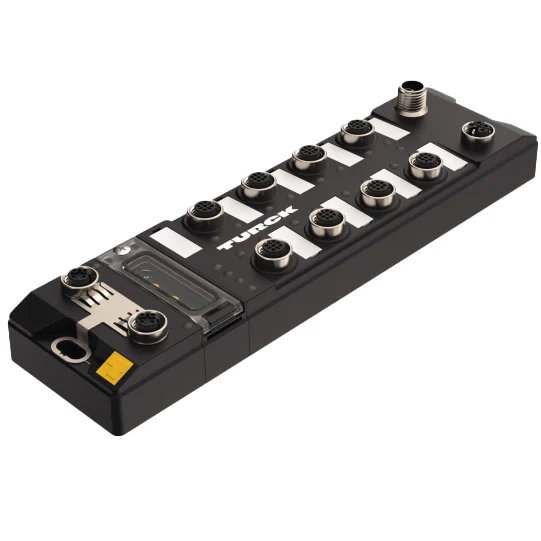
TURCK, a global leader in industrial automation, has announced the preview of its TBEN-LLH-4RMC, a groundbreaking compact multiprotocol Ethernet I/O module designed to optimize the control and integration of conveyor roller motors. This innovative module, slated for a U.S. launch in Q2 2026, marks a significant step forward in decentralized automation, promising to enhance efficiency, flexibility, and durability across material handling and intralogistics applications. Its introduction is poised to address long-standing challenges in complex automated systems, particularly within the burgeoning e-commerce, packaging, and manufacturing sectors.
A New Era for Intralogistics Automation
The TBEN-LLH-4RMC is engineered to meet the rigorous demands of modern conveyor systems, which form the backbone of intralogistics, packaging lines, and various manufacturing environments. These systems require precise motor control, robust system flexibility, and unwavering durability to ensure continuous operation and high throughput. Traditional approaches often rely on centralized Programmable Logic Controllers (PLCs) and extensive wiring, leading to complex installations, increased maintenance overheads, and limited scalability. TURCK’s new module directly confronts these issues by integrating onboard logic and comprehensive I/O functions within a rugged housing, facilitating field-level control and drastically simplifying system architectures.
The core premise behind the TBEN-LLH-4RMC is decentralized automation. By shifting intelligence closer to the point of action – in this case, individual conveyor roller motors – the module significantly reduces the reliance on centralized PLCs. This architectural change not only streamlines wiring configurations but also minimizes the complexity associated with commissioning and troubleshooting large-scale conveyor systems. For manufacturers and system integrators, this translates into tangible benefits: reduced installation time, lower material costs for cabling, and simplified maintenance routines. The compact design further allows for installation in space-constrained areas, a common challenge in optimized production and warehousing facilities.
Addressing Critical Industry Needs
The material handling and intralogistics industries are currently experiencing unprecedented growth, driven by the explosion of e-commerce, the need for faster order fulfillment, and increasing automation to combat labor shortages. According to recent market analyses, the global material handling equipment market is projected to reach over $180 billion by 2028, growing at a Compound Annual Growth Rate (CAGR) exceeding 6%. This growth is heavily reliant on efficient and adaptable conveyor systems capable of handling diverse product types and volumes.
Traditional conveyor control systems often present several pain points:
- Complex Wiring: Centralized control requires lengthy cable runs from individual motors and sensors back to a central PLC cabinet, increasing material costs and installation labor.
- Limited Flexibility: Modifying or expanding conveyor lines can be a time-consuming and costly endeavor due to the rigid nature of centralized wiring.
- Single Point of Failure: A malfunction in a central PLC can bring an entire system to a halt, leading to significant downtime and production losses.
- Diagnostic Challenges: Pinpointing faults in extensive, centrally wired systems can be difficult and time-consuming.
The TBEN-LLH-4RMC is purpose-built to overcome these limitations. Its decentralized architecture means that each module can control a localized segment of a conveyor, processing sensor data and controlling motors directly at the field level. This modularity allows for easier system expansion and reconfiguration, adapting quickly to changing production demands or facility layouts. Furthermore, localizing control logic means that if one module experiences an issue, it is less likely to impact the entire conveyor system, thereby enhancing overall system resilience and uptime.
The Power of Decentralized Intelligence
Shifting Paradigms: From Centralized to Distributed Control
The concept of decentralized automation has gained significant traction within the Industry 4.0 framework. It represents a fundamental shift from a hierarchical, master-slave control model to a more distributed, peer-to-peer approach. In a centralized system, a single powerful PLC handles all decision-making and control logic for numerous devices. While effective for smaller, less complex systems, this model becomes cumbersome and inefficient as complexity grows.

Distributed control, as exemplified by the TBEN-LLH-4RMC, delegates control tasks to intelligent field devices. Each module contains its own processing capabilities and can execute local control algorithms, communicate directly with adjacent modules, and only send aggregated data or critical alerts back to a higher-level controller. This approach offers several compelling advantages:
- Modularity and Scalability: Systems can be easily expanded or reconfigured by adding or removing modules without extensive re-wiring or re-programming of a central PLC.
- Reduced Latency: Decisions are made closer to the action, minimizing communication delays and enabling faster response times for critical operations.
- Improved Fault Tolerance: A failure in one module typically affects only a small segment of the system, preventing widespread shutdowns.
- Simplified Commissioning: Pre-configured modules can be quickly integrated, reducing startup times and specialized programming efforts.
Integrated Logic and I/O Functionality
The "onboard logic" feature of the TBEN-LLH-4RMC is a critical differentiator. This capability allows the module to execute basic control sequences and manage local I/O without constant communication with a central PLC. For instance, a module connected to a specific roller motor might interpret signals from a photo-eye sensor indicating product presence, and then automatically start or stop the motor, adjust its speed, or signal to an upstream module. This "edge computing" functionality offloads processing from the central controller, reducing its workload and simplifying its programming.
The integrated I/O functions mean the module provides direct connections for sensors, actuators, and other field devices, eliminating the need for separate I/O blocks. This consolidation further reduces component count, wiring complexity, and potential points of failure. For conveyor systems, this often involves managing inputs from proximity sensors, bar code readers, and emergency stops, alongside outputs to motor starters and indicator lights.
Multiprotocol Capabilities: Bridging the Communication Gap
A key characteristic of modern industrial automation environments is the diversity of communication protocols. Different machinery, legacy systems, and vendor preferences often result in a patchwork of industrial Ethernet protocols, such as EtherNet/IP, PROFINET, Modbus TCP, and EtherCAT. Integrating devices that speak different "languages" can be a significant hurdle for system integrators.
The TBEN-LLH-4RMC’s multiprotocol design directly addresses this challenge. By supporting multiple common industrial Ethernet protocols, the module offers unparalleled flexibility and interoperability. This means that a single module type can be deployed across various conveyor systems, regardless of the overarching network protocol being used. This capability simplifies inventory management for integrators and end-users, reduces training requirements, and enables seamless integration into heterogeneous automation architectures. For a manufacturer operating facilities with different installed bases, this module provides a unified solution, greatly streamlining their supply chain and maintenance operations.
Robustness and Reliability for Demanding Environments
Conveyor systems in intralogistics, packaging, and manufacturing are often subjected to harsh operating conditions. They must withstand dust, moisture, vibrations, temperature fluctuations, and sometimes even chemical exposure. The "rugged housing" of the TBEN-LLH-4RMC is designed precisely for these demanding environments. While specific IP (Ingress Protection) ratings are not detailed in the preview, industrial-grade I/O modules typically carry ratings such as IP65, IP67, or even IP69K, indicating high resistance to dust ingress and water jets or temporary immersion.
This robust construction is crucial for maintaining operational uptime. A durable module translates to fewer failures, reduced maintenance interventions, and extended operational life. This not only lowers the Total Cost of Ownership (TCO) but also contributes to greater overall equipment effectiveness (OEE), a key performance indicator in manufacturing. The ability of the module to reliably perform in challenging conditions directly impacts the continuity of production and logistics operations, which is paramount in today’s fast-paced industrial landscape.
Market Context and Strategic Timing
Growth of the Material Handling and Intralogistics Market
The launch of the TBEN-LLH-4RMC comes at a critical juncture for the material handling and intralogistics industries. The relentless growth of e-commerce has led to an explosion in warehouse and distribution center activity, necessitating highly automated and efficient sorting, conveying, and storage systems. Companies like Amazon, FedEx, and countless others rely on sophisticated conveyor networks to move billions of packages annually. Beyond e-commerce, sectors such as automotive manufacturing, food and beverage processing, and pharmaceuticals also heavily depend on automated material flow. The drive for greater operational efficiency, reduced labor costs, and enhanced safety continues to fuel investment in advanced automation technologies. TURCK’s module is strategically positioned to capture a significant share of this expanding market by offering a solution that directly addresses core operational challenges.
TURCK’s Position in the Automation Landscape
TURCK has a long-standing reputation as a leading manufacturer of sensors, fieldbus, and connectivity solutions for factory, process, and building automation. With decades of experience, the company has consistently delivered innovative products that enhance industrial efficiency and reliability. TURCK’s expertise spans a wide range of technologies, from inductive and capacitive sensors to industrial Ethernet gateways and remote I/O systems. The TBEN-LLH-4RMC is a natural evolution of their commitment to providing robust, intelligent solutions that simplify automation architectures and enable the transition to Industry 4.0. Their existing global distribution network and established customer base provide a strong foundation for the successful rollout of this new product.

The Q2 2026 U.S. Launch
The decision to launch the TBEN-LLH-4RMC in the U.S. in Q2 2026 is strategic. The United States represents one of the largest and most technologically advanced markets for industrial automation and logistics. Its robust manufacturing sector, combined with the immense scale of its e-commerce and retail distribution networks, makes it an ideal launchpad for a product designed to optimize conveyor systems. An early 2026 launch provides TURCK an opportunity to establish market leadership with this specific solution, gather valuable feedback from early adopters, and refine its global rollout strategy. The anticipation surrounding its release underscores the module’s potential to significantly impact operational efficiencies across various industries.
Statements and Industry Reactions
While official statements from TURCK executives are pending the full launch, industry experts and potential customers are likely to react positively to the preview.
A hypothetical statement from a TURCK spokesperson might emphasize: "The TBEN-LLH-4RMC represents TURCK’s unwavering commitment to pushing the boundaries of industrial automation. We recognize the evolving demands of material handling and intralogistics, and this module is engineered to provide unparalleled flexibility, ease of integration, and robustness. By enabling true decentralized control at the field level, we empower manufacturers and system integrators to build more efficient, scalable, and resilient conveyor systems, ultimately driving down their total cost of ownership and accelerating their journey towards smart factories."
System integrators, who often bear the brunt of complex wiring and programming, would likely welcome the simplification. A hypothetical system integrator might comment: "Integrating complex conveyor systems can be a logistical nightmare, especially with diverse client requirements and existing infrastructure. A multiprotocol I/O module with onboard logic, like TURCK’s TBEN-LLH-4RMC, could drastically simplify our project deployments. The promise of reduced wiring and less reliance on centralized PLCs means faster commissioning, lower labor costs, and greater adaptability for our clients. This is precisely the kind of innovation the industry needs to keep pace with demand."
Broader Implications for Industrial Automation
Enhancing Supply Chain Efficiency and Resilience
The deployment of advanced conveyor control modules like the TBEN-LLH-4RMC has profound implications for global supply chains. By enabling more efficient, flexible, and reliable material flow within warehouses and manufacturing plants, these modules directly contribute to faster throughput, reduced processing errors, and improved order accuracy. In an era where supply chain disruptions are a constant threat, enhancing the resilience of internal logistics operations is paramount. Systems that can quickly adapt to changes in demand, handle variations in product mix, and minimize downtime are crucial for maintaining continuity and competitiveness. The TBEN-LLH-4RMC helps build these robust, agile internal supply chain networks.
Accelerating Industry 4.0 Adoption
The TBEN-LLH-4RMC is more than just an I/O module; it is a key enabler for Industry 4.0 and the realization of smart factories. Its onboard logic and Ethernet connectivity allow for granular data collection at the edge, providing real-time insights into conveyor performance, motor health, and overall system status. This data can be fed into higher-level Manufacturing Execution Systems (MES) or cloud-based analytics platforms for predictive maintenance, operational optimization, and process improvement. By integrating seamlessly into larger digital ecosystems, the module helps bridge the gap between physical operations and digital intelligence, accelerating the adoption of fully connected, data-driven manufacturing environments.
Driving Down Total Cost of Ownership (TCO)
The economic benefits of adopting the TBEN-LLH-4RMC extend well beyond initial purchase costs. The significant reduction in wiring materials and installation labor directly impacts project budgets. Furthermore, simplified commissioning due to onboard logic and multiprotocol support means less time spent on complex PLC programming, freeing up highly skilled engineers for more strategic tasks. Post-installation, the rugged design and decentralized architecture contribute to lower maintenance costs and reduced downtime, leading to increased productivity and profitability over the operational lifespan of the conveyor system. The ability to quickly reconfigure or expand systems without major overhauls also protects future investments, making the TCO extremely attractive for long-term strategic planning.
Looking Ahead: The Future of Conveyor Control
The introduction of the TBEN-LLH-4RMC sets a new benchmark for conveyor roller motor control. As automation technologies continue to evolve, future iterations of such modules may incorporate even more advanced features, such as integrated AI/ML capabilities for self-optimizing performance, enhanced cybersecurity protocols, and tighter integration with augmented reality tools for maintenance and diagnostics. TURCK’s commitment to continuous innovation suggests that the TBEN-LLH-4RMC is not just a product launch but a foundational element for the next generation of intelligent, highly flexible, and resilient material handling systems. The industry eagerly awaits its official launch in Q2 2026, anticipating a transformative impact on how goods are moved and processed worldwide.






