U.K. air taxi developer Vertical Aerospace is setting its sights on 2029 for the certification of its flagship Valo electric aircraft, a slight adjustment from its previously announced timeline. The company, led by Chief Engineer David King, aims to finalize the Valo’s design this year, signaling a strategic evolution in its development path. This revised schedule moves the anticipated entry into service from 2028 to 2029, a move that underscores the complexities inherent in bringing a novel zero-emission aviation technology to market.
The Valo, envisioned as a six-passenger air taxi, represents a significant step forward for Vertical Aerospace, building upon the lessons learned from its earlier four-passenger prototypes that have been undergoing flight testing since 2022. The company’s strategic roadmap now includes the construction and certification of parts for seven Valo prototypes by 2027, with intensive flight testing slated to commence thereafter. These upcoming prototypes will be larger than their predecessors, reflecting the scaled-up passenger capacity of the production model.
Demonstration Flights Showcase Technological Maturity at Farnborough Airshow
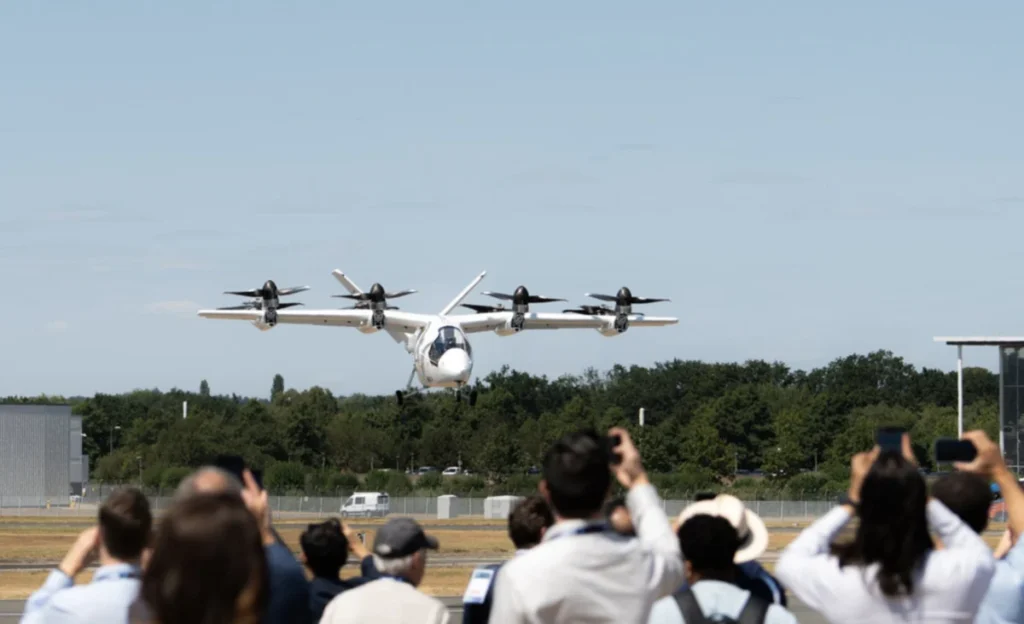
The company’s commitment to advancing its electric vertical takeoff and landing (eVTOL) technology was vividly demonstrated at the recent Farnborough International Airshow. One of Vertical Aerospace’s prototypes, the VA-1X, successfully completed two high-profile demonstration flights, showcasing its capabilities in vertical takeoff and landing (VTOL) followed by a seamless transition to horizontal or forward flight. These displays, which began on Monday and continued throughout the week, served as a crucial platform for King and his team to communicate the maturity of their technology to a global audience.
"One of the objectives of us here this week is to spread the word that the technology is mature," King stated during a video call following the demonstrations. "Now we can and are flying these transitions smoothly, effectively." The VA-1X’s performance at Farnborough underscored the progress made in mastering the complex flight dynamics required for eVTOL operations, a critical hurdle for widespread adoption of air taxis.
Navigating Technical Nuances: Gust Response and Control Software
During one of the Monday flights, while the aircraft executed a smooth approach in forward flight to a vertical landing, a minor anomaly occurred: one of the four forward tilt-propellers initiated its upward tilt fractionally earlier than the other three. Vertical Aerospace was quick to address this observation, clarifying that the incident was a deliberate and correct response by the aircraft’s flight control software to a sudden, significant gust of wind.
A spokesperson for Vertical Aerospace elaborated via email, stating, "The aircraft’s flight control software commanded the inner left tilt earlier than usual in response to a sudden large gust of wind. When we looked at the data, this was the normal and correct response to a change in conditions in landing. As a number of people have observed, the aircraft stayed incredibly stable throughout. This is a testament to the aircraft’s ability to operate safely and comfortably in unexpected circumstances." This incident, while observable, highlights the sophisticated nature of the flight control systems designed to maintain stability and safety even in challenging environmental conditions.
King further elaborated on the ongoing refinement of the Valo’s design, emphasizing continuous adjustments to its aerodynamics and control software. The Valo is designed to accommodate two rows of passengers, with three seats in each row, offering a comfortable and efficient cabin configuration. "It’s not the exact same software build, but for the purposes of understanding the aerodynamic characteristics, the majority of the software design is behind us," King commented, indicating that the core control logic for the aircraft’s flight envelope is largely established.
Evolution Towards Hybrid-Electric Propulsion
A significant development in Vertical Aerospace’s technological trajectory is the planned transition from fully electric prototypes to a hybrid-electric propulsion system for its upcoming aircraft. While the two VA prototypes currently undergoing flight testing are entirely electric, the third prototype, slated for completion later this year, will incorporate a turboelectric generator system. This system will be integrated into what is effectively the baggage bay of the aircraft.
"We’re going to keep doing flight testing to learn as much as we can. On aircraft three later this year, we will install a turboelectric generator system that we have in our lab, essentially the baggage bay of the aircraft," King explained. "And then we will do the risk reduction technology demonstration of our hybrid-electric derivative next year." This strategic pivot towards hybrid-electric technology is a pragmatic approach to address current limitations in battery energy density and charging infrastructure, potentially extending range and operational flexibility for air taxi services.
The move to hybrid-electric propulsion aligns with industry trends where some eVTOL developers are exploring similar architectures to overcome the range and payload challenges associated with purely battery-electric systems. This approach could allow for quicker turnaround times and longer operational routes, crucial factors for the economic viability of urban air mobility.
Government Support and Future Production Plans
Vertical Aerospace is actively engaged in discussions with the U.K. government to secure a grant of up to £10 million (approximately $13.5 million USD). This funding is intended to partially finance the construction of the company’s initial aircraft production facility. While King acknowledged that this sum is modest in the context of the $800 million raised by the publicly traded company, he underscored its symbolic importance.
"That amount is ‘small from a finance perspective’ for a publicly traded company that has raised $800 million," King remarked, "but it’s important regardless. The funding amounts to ‘a commitment from the government to say we’re going to work with you, to do something new and innovative in commercial aviation.’" This potential government grant signifies a broader endorsement of the burgeoning advanced air mobility sector within the U.K. and could pave the way for further private and public investment in the industry.
The establishment of a dedicated production site is a critical milestone for Vertical Aerospace, enabling the company to scale up manufacturing and meet anticipated demand once certification is achieved. The U.K. government’s potential involvement signals a strategic interest in fostering domestic capabilities in advanced aviation technologies, aligning with national ambitions for green growth and technological innovation.
Industry Context and Future Implications
The air taxi market, often referred to as Urban Air Mobility (UAM), is a rapidly evolving sector attracting significant investment and technological development worldwide. Companies like Joby Aviation, Archer Aviation, and Lilium are also progressing with their eVTOL designs and certification processes. Vertical Aerospace’s Valo, with its six-passenger capacity and its strategic move towards hybrid-electric power, aims to carve out a distinct niche within this competitive landscape.
The success of Vertical Aerospace and its Valo aircraft will hinge on several key factors: achieving regulatory certification from aviation authorities like the U.K.’s Civil Aviation Authority (CAA) and the European Union Aviation Safety Agency (EASA), demonstrating robust safety and operational reliability, and establishing a viable business model for air taxi services. The projected 2029 certification date, while a slight delay, allows for thorough testing and refinement, which is paramount for gaining public trust and regulatory approval.
The development of the Valo represents a tangible step towards a future where urban transportation incorporates electric aviation, offering potentially faster, quieter, and more sustainable travel options within and between cities. The company’s progress, from prototype flight testing to design finalization and future production plans, paints a picture of a determined effort to bring this vision to fruition. The integration of hybrid-electric technology, in particular, suggests a pragmatic approach to overcoming the current limitations of battery technology, positioning Vertical Aerospace to potentially offer a more practical and scalable solution for initial air taxi operations. The ongoing dialogue with the U.K. government for production facility funding further underscores the collaborative effort required to build this new aviation ecosystem.