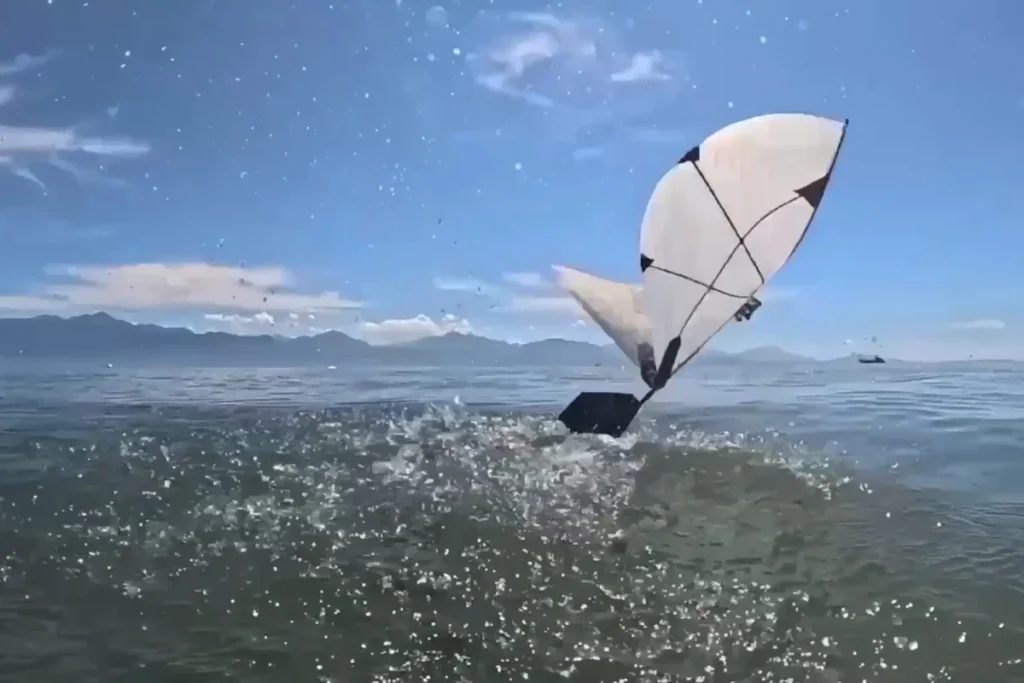
A revolutionary robotic system, dubbed the "flapping-wing aerial-aquatic vehicle" (FAAV), has been developed by a collaborative team of engineers from the Massachusetts Institute of Technology (MIT) and EPFL in Lausanne, Switzerland, demonstrating an unprecedented ability to both fly through the air and swim underwater, mimicking the extraordinary dual-medium capabilities of diving birds. This innovative robot, weighing less than 300 grams, represents a significant leap forward in bio-inspired robotics, promising to unlock new avenues for scientific research and environmental monitoring, particularly in challenging marine environments. The findings of this pioneering research were formally published today in the prestigious journal Science, marking a critical milestone in the development of truly amphibious robotic platforms.
Inspired by Nature’s Dual Aviators: The Genesis of the FAAV
The inspiration for the FAAV stems from a remarkable group of approximately 100 bird species—including familiar figures like loons, gulls, puffins, and petrels—that have evolved the unique physiological and mechanical adaptations to navigate both the sky and the sea. These avian marvels can plunge into the water with astonishing speed, propelled by their wings to pursue prey beneath the surface, only to then burst forth and take flight, soaring through the air. This extraordinary versatility in mediums with vastly different physical properties has long captivated biologists and engineers alike, presenting a formidable challenge for robotic emulation. The MIT and EPFL team, led by Raphael Zufferey, an assistant professor of mechanical engineering at MIT, sought to decode and replicate these natural mechanics in a mobile robotic system, a feat previously considered highly complex.
The project began with an intensive study of avian biomechanics, delving into existing scientific literature to understand how diving birds such as puffins, petrels, and kingfishers execute their dual-medium locomotion. Researchers observed critical differences in flapping frequencies: smaller birds typically flap their wings around 10 times per second when airborne but reduce this to approximately four times per second when swimming. Larger birds, owing to their greater wingspans, generally exhibit slightly lower flapping frequencies in both environments. This foundational understanding of biological adaptations became the blueprint for the FAAV’s design, emphasizing the need for a system that could dynamically adjust its propulsion strategy to efficiently transition between water and air.
Engineering the Amphibious Robot: Design and Mechanics
The FAAV is an elegant piece of engineering, minimalist in its design yet complex in its functional capabilities. Its core components include a central body, or fuselage, housing the necessary electronics and power source; two flexible, flapping wings; and a steerable tail. A key design feature is the modularity of its wings and tail, which can be easily swapped out for different sizes, allowing for experimental flexibility and optimization. The fuselage encases a battery and a waterproof electric motor that drives a crankshaft, which in turn orchestrates the rhythmic up-and-down motion of the wings at precisely controlled frequencies. The wings themselves are crafted from thin, flexible membranes, further enhanced with hydrophobic nanoparticles. This specialized coating is crucial for repelling water, enabling the wings to shed moisture rapidly upon exiting the water, thereby reducing drag and facilitating immediate aerial flight. The tail, also motorized, can adjust its angle, providing essential pitch control for both underwater maneuvering and aerial stability.
The inherent challenge in designing a vehicle capable of operating in both air and water lies in the drastic differences in their physical properties. Water is approximately 1,000 times denser than air, meaning that the forces of drag and resistance are significantly amplified underwater. Propulsion mechanisms optimized for air are often highly inefficient in water, and vice versa. Traditional wisdom suggested that entirely different mechanical approaches would be required for each medium. However, the existence of diving birds provided a compelling counter-narrative, demonstrating that a single, adaptable system could indeed achieve proficiency in both. "You have to do some adaptation to make that transition work. But there’s a solution that exists in nature," Zufferey explained. "Birds like puffins can fly very fast through the air, and can dive and swim through water at speeds of 3 meters per second. They’re able to do pretty amazing things. So we knew it was possible. Just no one had tried this in a mobile robotic system."
Rigorous Testing and Performance Validation: From Tank to Lake
The development of the FAAV involved a methodical and rigorous testing regimen, progressing from controlled laboratory environments to more realistic field conditions. Initial experiments were conducted in a dedicated water tank, allowing the engineers to precisely control variables and observe the robot’s behavior in a contained setting. Following successful tank trials, the team moved to Lake Geneva in Switzerland, providing a naturalistic environment to validate the robot’s performance under more complex, real-world scenarios.
During these experiments, three distinct sets of wings—small (60 centimeters wide), medium (80 centimeters), and large (100 centimeters)—were fabricated and tested. The robot was submerged approximately half a meter below the surface, and its wings were programmed to flap at varying frequencies, while the motorized tail adjusted to different pitch angles. The engineers meticulously observed and documented the conditions under which the FAAV could successfully transition from swimming upwards through the water, break through the surface, and achieve sustained flight in the air.
The comprehensive data collected revealed that the medium-sized wings (80 centimeters) consistently offered the most reliable performance across all phases of operation: swimming, transitioning, and flying. The flexibility of these wings proved to be a critical factor, needing to be pliable enough to minimize resistance and accommodate the higher density of water during underwater propulsion, yet firm enough to generate sufficient lift and maintain stability in the air. The researchers discovered that the robot could achieve swimming speeds of nearly 1 meter per second when flapping its wings at approximately 5 Hertz (five flaps per second). Crucially, the same flapping frequency enabled the robot to fly through the air at an impressive speed of about 6 meters per second. These speeds and flapping frequencies closely align with those observed in actual diving birds, underscoring the biomimetic fidelity of the FAAV.
A particularly intriguing finding related to the water-to-air transition. The team determined that for a smooth and efficient launch into the air, the robot needed to be pitched at a relatively steep angle of 70 degrees. This specific angle proved optimal for ensuring that the wingtips did not inadvertently touch the water’s surface during the critical moments of liftoff, which would otherwise disrupt the airflow and potentially cause the robot to tip back into the water.
The "No Feet" Revelation: Challenging Avian Assumptions
Perhaps one of the most surprising discoveries during the FAAV’s development was that the robot did not require the use of supplementary "feet" or paddling maneuvers to launch itself from the water’s surface. Many diving birds, such as puffins and ducks, employ a combination of wing flapping, tail pitching, and vigorous foot paddling to gain the necessary momentum and lift for takeoff from water. The FAAV, however, achieved successful transitions solely through the coordinated action of its wings and tail. "If you look at birds, most birds need to paddle at the surface to take off. And the question was, do we need the same for robots? And it turns out we don’t," Zufferey noted. This finding is significant as it suggests that, at least in a robotic context, the fundamental mechanics of water-to-air transition might be simpler than previously assumed, potentially simplifying future designs for amphibious vehicles. It opens new questions for ornithologists regarding the precise role of foot-paddling in avian takeoffs.
Broader Implications and Future Horizons
The successful development and testing of the FAAV hold profound implications, extending far beyond the realm of specialized robotics. Primarily, it offers scientists an unprecedented tool to study the intricate mechanics that enable diving birds to adapt their locomotion between vastly different mediums—air and water. By systematically varying parameters on the robot, researchers can gain deeper insights into the biomechanical principles at play, potentially informing our understanding of avian evolution and adaptation.
Beyond fundamental science, the FAAV is poised to launch a new class of aerial-aquatic drones and vehicles, with transformative potential across numerous applications. The researchers envision these winged robots playing a crucial role in oceanography and marine biology. Traditional ocean vessels face significant limitations, particularly when it comes to accessing hazardous, remote, or dynamically changing aquatic regions. Areas around icebergs, treacherous coastal facilities, or even specific locations within a pod of whales can be too dangerous or logistically challenging for human-crewed ships.
"Our dream vision is for oceanographers, marine biologists, and members of coastal communities to launch this robot from a boat, or from shore, and it would fly close to the area of interest, such as an iceberg or a port facility, or over a pod of whales," says Raphael Zufferey. "It would dive into the water to take a measurement or collect a sample, and fly back to deliver the data at a fraction of the cost of traditional methods. Then it could go back out to dive for more."
The economic advantages of such a system are substantial. Deploying traditional research vessels, especially in remote or hazardous areas, incurs enormous costs in terms of fuel, crew, equipment, and logistical support. A fleet of FAAV-like drones could perform frequent, targeted data collection missions at a fraction of this expense, democratizing access to critical oceanographic data. This capability could revolutionize monitoring efforts for climate change impacts (e.g., glacier melt, ocean acidification), marine pollution, harmful algal blooms, and the health of marine ecosystems. For example, a FAAV could fly over an oil spill, dive into specific areas to collect samples, and return with data on contaminant concentrations, providing rapid and localized information that is difficult to obtain otherwise.
Furthermore, the FAAV’s ability to operate in both air and water makes it ideal for surveillance and reconnaissance in environments where both perspectives are needed. Imagine monitoring coastal erosion where aerial views can map shoreline changes, while aquatic dives assess underwater sediment movement. Or, tracking marine species where an aerial perspective identifies patterns of movement and diving capabilities allow for close-up observation and environmental sampling within their habitat.
The interdisciplinary nature of this project, involving collaborators from MIT, EPFL, and Northwest Indian College, highlights the power of diverse expertise in tackling complex engineering challenges. Such international and multi-institutional collaborations are increasingly vital for pushing the boundaries of scientific discovery. The funding support from a Marie Skłodowska-Curie Actions fellowship further underscores the global recognition of this research’s potential.
Looking ahead, the team has outlined several ambitious goals for the FAAV’s continued development. One immediate focus is to enhance the wing design, allowing for more sophisticated turning maneuvers in addition to the current flapping motion. This would significantly improve the robot’s agility and control in both mediums. Another critical area of research involves testing the robot’s performance under turbulent conditions, such as navigating choppy waters during take-off or maintaining stability in strong winds during flight. These real-world environmental challenges are paramount for transitioning the FAAV from a research prototype to a robust, deployable system.
Ultimately, the vision articulated by Zufferey is clear: to empower ocean science with unprecedented data collection capabilities. "One of the major challenges in ocean science is collecting data both frequently and across many locations, which is something this robot could do in the future," he stated. "You could send this out not just every week, but every hour. It could fly out at high speeds, dive in, fly back, deliver its data, and go back out, multiple times." This continuous, high-frequency data stream promises to unlock new insights into dynamic ocean processes, providing a more comprehensive and timely understanding of our planet’s vital aquatic ecosystems. The FAAV stands as a testament to the ingenuity of bio-inspired engineering and offers a tantalizing glimpse into a future where autonomous robots seamlessly traverse our world’s most challenging environments.