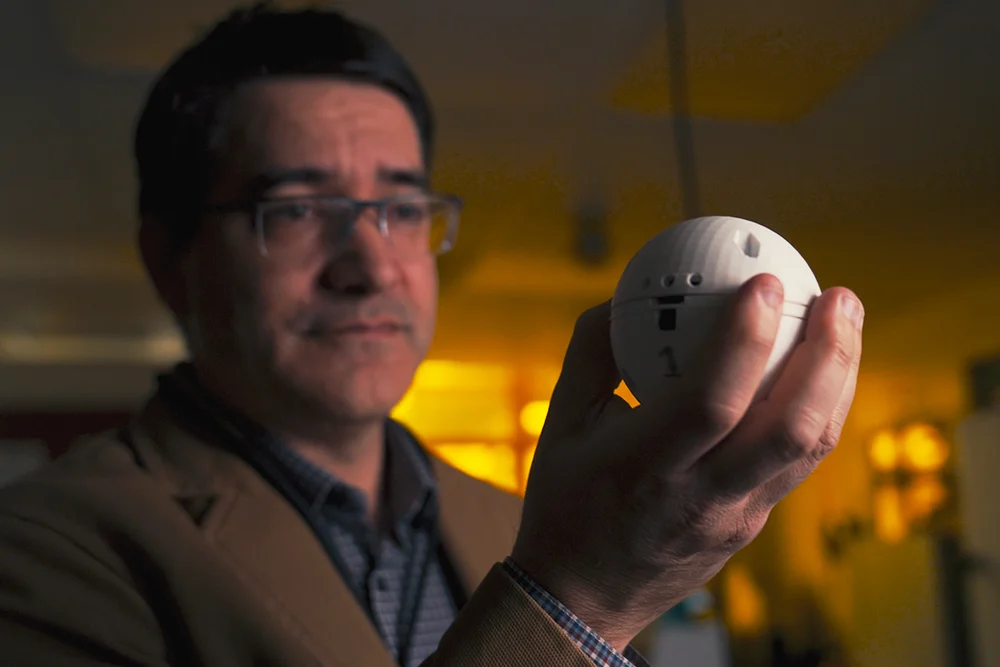
Researchers at MIT Lincoln Laboratory have developed a revolutionary new device, dubbed the Tactical Optical Spherical Sensor for Interrogating Threats (TOSSIT), a throwable, baseball-sized sensor capable of remotely detecting a wide spectrum of hazardous vapors and aerosols. This groundbreaking technology is poised to significantly enhance the safety and situational awareness of military service members, first responders, and law enforcement personnel when confronting chemical threats.
A New Era of Chemical Threat Detection
The TOSSIT device represents a significant leap forward in portable chemical detection. Unlike existing technologies that often require direct proximity or complex deployment, TOSSIT offers an intuitive and rapid method for assessing dangerous airborne substances. Its spherical design and compact size allow it to be easily tossed, deployed via drone, or even launched into areas where immediate human entry would be too perilous. This capability is crucial in scenarios ranging from potential terrorist attacks involving nerve or blister agents to industrial chemical accidents and the clandestine handling of substances like fentanyl.
The core functionality of TOSSIT relies on a clever integration of optical sensing and chemical reactivity. Upon deployment, the sensor actively samples the surrounding air. A key component is a removable dye card housed within the device. When specific hazardous chemicals are present in the air, they interact with the dye on the card, causing a visible color change. An internal camera then meticulously observes these color alterations. This visual data is processed to identify the presence and potentially the type of chemical threat.
Once a threat is detected, TOSSIT provides immediate alerts to users through a dedicated mobile application or directly via audible alarms integrated into the sensor itself. This real-time notification system empowers personnel to make informed decisions rapidly, whether it involves initiating evacuation procedures, deploying protective gear, or undertaking specialized containment protocols. The low-cost nature of the TOSSIT sensor, as highlighted by its developers, further amplifies its potential impact, making advanced chemical detection more accessible across a broader range of operational contexts.
Background and Development Context
The genesis of the TOSSIT project stems from a recognized gap in current chemical detection capabilities. While sophisticated laboratory equipment and personal protective gear are standard in many hazardous environments, the ability to quickly and safely survey an unknown area for immediate chemical threats has remained a challenge. Traditional methods can be time-consuming, labor-intensive, or expose personnel to unnecessary risk.
MIT Lincoln Laboratory, a federally funded research and development center, has a long-standing history of developing advanced technologies for national security and public safety. The TOSSIT initiative aligns with this mission, addressing the evolving landscape of threats that increasingly involve chemical agents. The development process likely involved extensive research into novel chemical indicators, miniaturization of sensing and imaging technologies, and the creation of robust communication protocols for transmitting alert data.
The projectile nature of TOSSIT, allowing it to be "tossed," is a testament to its design for rapid deployment in dynamic situations. This is particularly relevant for military operations where swift reconnaissance of potentially contaminated zones is paramount. For first responders, it offers a means to assess the safety of a scene before committing personnel, thereby mitigating risks associated with unknown chemical releases.
The Science Behind the Sensor
At the heart of TOSSIT’s efficacy is its reliance on chromogenic detection. This method utilizes chemical compounds that exhibit a color change in response to specific analytes. The dye cards used in TOSSIT are engineered to react with a range of dangerous substances. For instance, they might be sensitive to the presence of organophosphates, which are common in nerve agents, or volatile organic compounds (VOCs) that could indicate industrial spills.
The internal camera’s role is critical in translating the physical change on the dye card into actionable data. Sophisticated image processing algorithms are employed to accurately interpret the color shifts, distinguishing between normal environmental variations and genuine chemical reactions. This ensures a high degree of accuracy and minimizes the occurrence of false alarms, a crucial factor in high-stakes operational environments.
Furthermore, the sensor’s ability to detect both vapors and aerosols is significant. Aerosols, which are fine solid particles or liquid droplets suspended in the air, can pose a distinct hazard, especially in cases like the dispersal of toxic dust or powdered chemical agents. TOSSIT’s design accommodates this by being able to sample and analyze airborne particulate matter that may carry hazardous chemical compounds.
Unmet Needs and Strategic Importance
Richard Kingsborough, the principal investigator for the TOSSIT project, emphasized the device’s role in addressing "an unmet need." He specifically pointed to its capability in detecting "vapors and solid aerosol threats – think toxic dust particles – that would otherwise not be detectable by small deployed sensor systems." This statement underscores the limitations of existing portable sensors, which may be optimized for gaseous threats but struggle with particulate hazards.
The strategic importance of TOSSIT cannot be overstated. In military contexts, it can provide early warning of chemical ambushes or contaminated battlefields, allowing for rapid countermeasures and the preservation of force integrity. For civilian emergency services, it offers a vital tool for managing incidents involving hazardous materials, enhancing public safety and protecting emergency personnel. The potential application in detecting illicit substances like fentanyl dust is also a significant public health consideration, as accidental exposure to even minute quantities can be lethal.
Field Testing and Transition to Military Use
The successful development of TOSSIT has been accompanied by rigorous field testing. These trials are essential to validate the sensor’s performance under real-world conditions, which often involve complex environmental factors such as varying temperatures, humidity, and atmospheric interference. The fact that the technology is now undergoing transfer to the U.S. military suggests that these tests have yielded highly satisfactory results, demonstrating the device’s reliability and effectiveness.
This transition phase typically involves further refinement, scaling up production, and integrating the technology into existing military protocols and equipment. The U.S. military’s adoption of TOSSIT signals a strong endorsement of its capabilities and its potential to significantly augment the safety and operational effectiveness of its personnel in chemical warfare or hazardous environment scenarios.
Broader Implications and Future Outlook
The implications of the TOSSIT device extend beyond its immediate military and first responder applications. Its underlying technology could potentially be adapted for a variety of other uses. For instance, in industrial settings, it could be used to monitor for leaks of toxic chemicals, ensuring worker safety and preventing environmental contamination. In public health, similar sensors might be developed for monitoring air quality in urban environments or detecting airborne pathogens.
The development of TOSSIT also highlights the ongoing innovation in miniaturized sensor technology and artificial intelligence for threat detection. As these fields continue to advance, we can expect to see even more sophisticated and versatile detection systems emerge, further enhancing our ability to protect individuals and communities from a wide range of hazards.
The future outlook for TOSSIT appears promising. With its proven efficacy, successful field trials, and impending military deployment, the device is poised to become a critical component of threat assessment and personnel protection strategies. Its low-cost profile suggests widespread adoption, making advanced chemical threat detection a more ubiquitous capability. The continued collaboration between research institutions like MIT Lincoln Laboratory and operational agencies will undoubtedly drive further advancements in this vital area of technology. The ability to quickly and safely identify airborne dangers is not just a technological achievement; it is a significant step towards a safer world for those who serve on the front lines of danger.