The Accutron Tuning Fork Spaceview 314 marks a significant return for a pioneering electronic watch movement, aiming to recapture the essence of its 1960s predecessors while embracing modern manufacturing techniques. This contemporary interpretation of the tuning fork watch, a technology that once revolutionized timekeeping, now stands as a testament to Accutron’s commitment to preserving and redeveloping groundbreaking horological engineering. The revival of the tuning fork movement, a complex and labor-intensive endeavor, underscores a niche but passionate segment of the watch market that values unique mechanical principles over mass-produced digital solutions.
A Legacy Reborn: The Genesis of the Tuning Fork Movement
The journey of the Accutron tuning fork watch began in the late 1950s and early 1960s, a period of intense innovation in timekeeping. Mechanical watches, the standard for decades, faced growing competition from increasingly sophisticated electronic alternatives. Bulova, then a leading American watch manufacturer, spearheaded this revolution with its Accutron line. The core of this innovation was the tuning fork movement, a radical departure from the escapement mechanisms that powered traditional mechanical watches.

Instead of a balance wheel oscillating back and forth, the Accutron movement utilized a tiny metal tuning fork, vibrating at an astonishing 360 hertz (Hz). This high frequency, powered by a battery, provided a level of accuracy previously unheard of in a portable timepiece, typically within two seconds per day. This was a significant leap from the typical 4Hz frequency of mechanical watches, which were more susceptible to positional variations and shocks. The tuning fork movement also produced a distinct, subtle hum, a characteristic that became synonymous with the Accutron brand and a beloved feature for enthusiasts.
The Accutron Spaceview, introduced in 1960, was designed to showcase this revolutionary technology. Its defining feature was its transparent or skeletonized dial, revealing the intricate and futuristic-looking tuning fork mechanism. This design choice positioned the Accutron not just as a timekeeping instrument but as a piece of wearable art and a symbol of the Space Age. The original Spaceview models were an instant success, captivating consumers with their advanced technology, smooth-sweeping seconds hand (a characteristic shared with mechanical watches, unlike the ticking of most quartz movements), and undeniably modern aesthetic.
The Challenges of Revival: From Caliber 214 to Caliber Y230
The initial success of the Accutron tuning fork movement waned with the advent of quartz technology in the 1970s. Quartz watches, operating at even higher frequencies (often exceeding 32,000 Hz) and offering greater accuracy, longer battery life, and lower production costs, quickly dominated the market. Bulova, like much of the industry, shifted its focus to quartz. The intricate tuning fork movements, with their specialized components and assembly processes, became largely obsolete, and the original manufacturing equipment was phased out.

However, the legacy of the tuning fork watch never truly faded. A dedicated following of enthusiasts and collectors kept the memory of the Accutron alive. Recognizing this enduring appeal, Bulova (and later, its sister brand Accutron under the Citizen Group umbrella) made attempts to reintroduce the tuning fork concept.
A notable effort occurred in 2010 with a limited edition of 42mm Accutron Spaceview timepieces. These watches featured a newly developed tuning fork movement, caliber 214, based on the original 1960s hardware. This project presented significant manufacturing hurdles. Without original tooling or machinery, the engineering team in Japan had to meticulously reverse-engineer the decades-old technology. The process of hand-winding each copper wire coil for the electromagnetic actuators proved to be exceptionally labor-intensive and inefficient, even for a limited production run. Despite the high cost of these reissues (around $4,000 USD at the time), the 1,000 units sold out rapidly, driven by strong demand from collectors eager to own a piece of horological history that was both functional and emotionally resonant.
This success paved the way for a more ambitious undertaking: the serial production of a new generation of tuning fork movements. This led to the development of the caliber Y230, which now powers the Accutron Spaceview 314. The Citizen Group reportedly invested significant resources and over a decade of research and development into re-establishing a manufacturing process capable of producing these complex movements at scale. The primary challenge, as understood from industry sources, lay in the precise and intricate creation of the copper coils, a process that still relies heavily on skilled craftsmanship, potentially involving a significant degree of handwork.

The Accutron Spaceview 314: A Modern Homage
The Accutron Spaceview 314 is not merely a reissue; it is a reimagining. While maintaining the spirit of its ancestors, it incorporates contemporary design elements and manufacturing refinements. The watch features a classic round case, measuring 39mm in diameter, deviating from the more angular designs seen in some previous Spaceview iterations. This thoughtful choice aims for broader appeal and a more traditional watch-wearing experience, though the brand has indicated that more diverse case shapes are anticipated in the future.
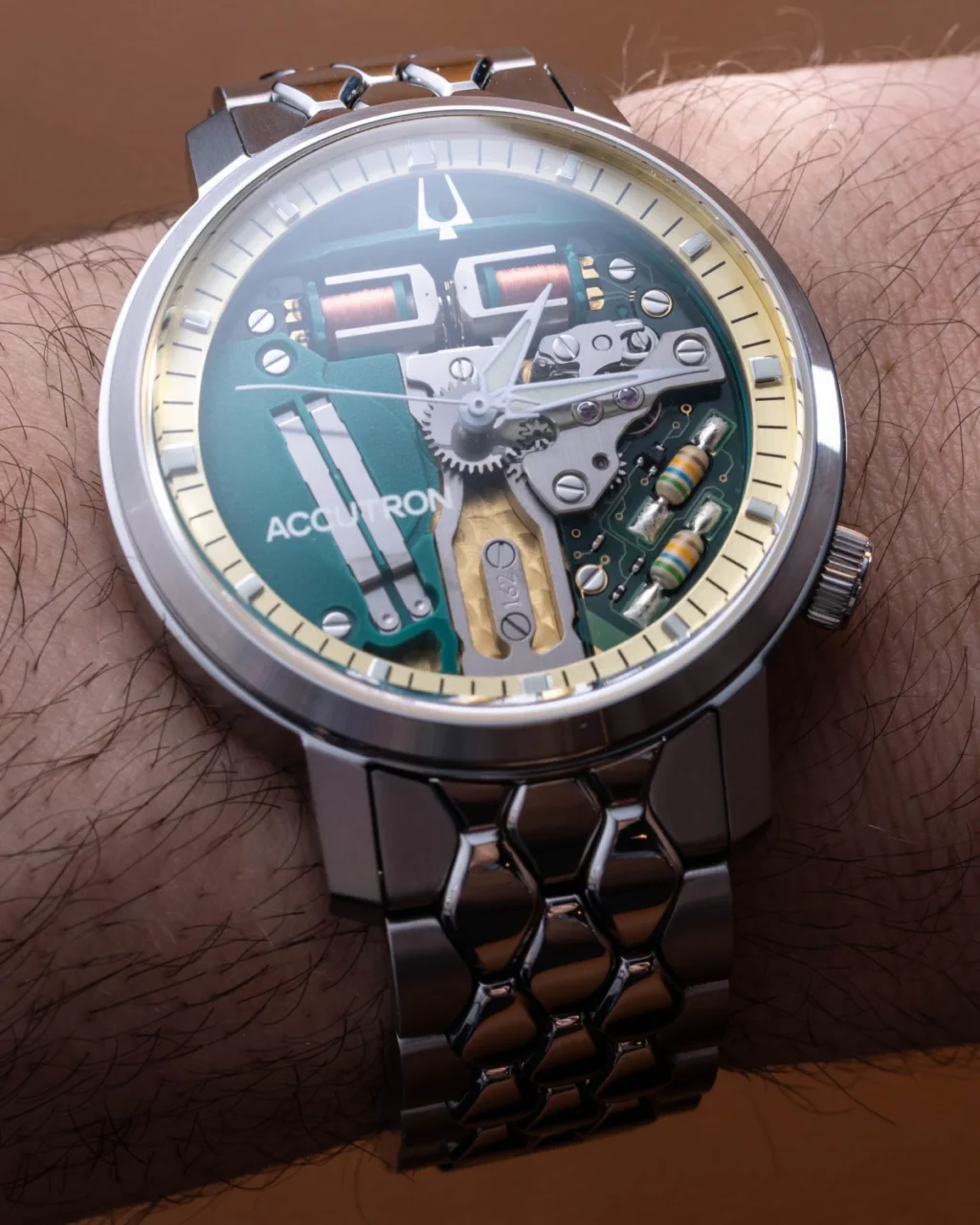
The caliber Y230 movement, the heart of the Spaceview 314, operates at the iconic 360Hz frequency, promising an accuracy of approximately two seconds per day. This level of precision rivals that of high-end mechanical chronometers from respected Swiss brands, underscoring the enduring relevance of advanced electronic timekeeping. The movement’s distinctive tuning fork and electromagnetic coils are visible through the watch’s dial, continuing the Spaceview tradition of showcasing its internal mechanics as a key design element.
Accutron has introduced the Spaceview 314 in several material options to cater to different preferences and price points. These include stainless steel and titanium versions, available on either a strap or a matching bracelet. A more luxurious variant is offered in 18k yellow gold, presented in a slightly smaller 37mm case for a more classic proportion. However, it is important to note that the water resistance rating for these timepieces is limited to "splash resistant," indicating they are not intended for aquatic activities and are primarily designed for dress and casual wear.

Design and Craftsmanship: Strengths and Areas for Enhancement
The design of the Accutron Spaceview 314 is a delicate balance between historical homage and modern aesthetics. The visible tuning fork movement remains the star of the show, offering a captivating glimpse into the intricate workings of this unique technology. The use of a domed, anti-reflective sapphire crystal protects the dial and enhances legibility.
One area where Accutron’s presentation of its technology could be improved is in the explanation of its complex movements. As observed in previous reviews of Accutron’s innovative electrostatic movement in the Spaceview 2020, the brand’s website often falls short of providing comprehensive details about its groundbreaking technologies. For the Spaceview 314, a more in-depth explanation of the tuning fork mechanism, its performance metrics, and expected battery life would significantly enhance consumer understanding and appreciation. Educating the public about the rarity and ingenuity of these movements is crucial for fostering wider interest and market growth.
Regarding the physical construction, while much of the caliber Y230 movement is finished to a high standard, some components appear to be made from plastic. While these materials may be chosen for engineering reasons, such as achieving specific colors or insulation properties, they can detract from the overall perceived luxury of a high-end timepiece. The use of plastic for certain dial elements, while perhaps enabling the signature green hue, can sometimes exhibit visible machining marks or an aesthetic that doesn’t quite align with the premium positioning of the watch. For instance, the green epoxy resin solder mask on the circuit board, which is partially visible, possesses an attractive texture and color that could potentially serve as an inspiration for other dial components, aiming for a more cohesive and luxurious appearance. The hands, while historically accurate in their shorter length reminiscent of 1960s models, could be considered for a slight increase in length to improve readability, though this is a minor point in the context of the overall design.

Distinguishing Accutron’s Electronic Movement Families: Tuning Fork vs. Precisionist
It is important to distinguish the Accutron Tuning Fork Spaceview 314 from other advanced electronic movements developed by Bulova and Accutron. For example, the Bulova Accutron II Alpha watches, released in previous years, featured a similar aesthetic to vintage Spaceview models but utilized the brand’s "Precisionist" quartz movement. The Precisionist, also known as UHF (Ultra High Frequency), is a highly accurate quartz system operating at an astonishing 262,000 Hz, powered by a three-pronged quartz crystal. These movements offer remarkable accuracy of about 10 seconds per year and typically have a battery life of around two years.
While the Precisionist movement offers superior accuracy and a lower price point compared to the tuning fork, the Accutron Tuning Fork Spaceview 314 is designed to offer a different kind of appeal. It prioritizes the unique mechanical principle, the nostalgic hum, and the visual complexity of the tuning fork, providing a more elegant and historically significant wearing experience. The Y230 movement, though not as hyper-accurate as the Precisionist, is engineered to be aesthetically pleasing and to evoke the rich heritage of Accutron’s electronic innovations.
The Allure of "Dumb Electronic" Watches in a Smartwatch Era
In an age increasingly dominated by connected, software-driven smartwatches, the appeal of "dumb electronic" watches like the Accutron Tuning Fork Spaceview 314 is poised to grow. These timepieces, much like traditional mechanical watches, offer a tangible and understandable mechanical experience. They operate on principles that can be fully grasped without delving into lines of code or expecting future software upgrades.

The enemy of mechanical watches in the mid-20th century was the superior accuracy and ease of use of electronic timekeeping. Today, the landscape has shifted. The perceived threat to both mechanical and traditional analog quartz watches comes from the complexity and planned obsolescence of smartwatches. Analog electronic watches, whether powered by a tuning fork or a quartz crystal, represent a steadfast commitment to enduring functionality and a purer form of timekeeping. They are designed for longevity, free from the constant pressure of software updates and data connectivity. This focus on timeless engineering and a distinct horological experience is what positions the Accutron Spaceview 314 as a compelling choice for discerning collectors and watch enthusiasts.
Pricing and Market Positioning
The Accutron Tuning Fork Spaceview 314 is positioned as a premium offering, reflecting the significant investment in its development and manufacturing. The pricing reflects its niche status and the complexity of its movement. The steel models on a strap start at $5,900 USD, while the titanium variant on a strap is priced at $6,200 USD. The flagship 18k yellow gold model commands a price of $31,500 USD.
These price points place the Accutron Tuning Fork Spaceview 314 in direct competition with entry-level to mid-tier luxury mechanical watches. The value proposition, therefore, rests not just on the accuracy or materials but on the historical significance, the unique engineering, and the distinct horological narrative that Accutron offers. The brand’s success in justifying this investment will hinge on its ability to effectively communicate the story and technological prowess behind the caliber Y230 movement and to cultivate a deeper appreciation for this resurrected electronic icon within the broader watch community. The future of high-end electronic watches may well depend on brands like Accutron continuing to champion such innovative and historically significant technologies.