TOKYO – A groundbreaking collaboration has been announced that is set to revolutionize industrial manufacturing through the widespread adoption of physical AI. Information and communications technology giant Fujitsu has partnered with leading AI chip maker Nvidia and three of the world’s foremost robot original equipment manufacturers (OEMs) – FANUC Corp., Yaskawa Electric Corp., and Kawasaki Heavy Industries – to fast-track the real-world deployment of physical AI across factory floors globally. This powerful alliance signifies a pivotal moment in the evolution of automation, promising unprecedented levels of intelligence and adaptability for industrial robots.
This strategic partnership aims to bridge the gap between advanced artificial intelligence capabilities and the complex, dynamic environments of modern manufacturing. Physical AI represents a paradigm shift from traditional, rigidly programmed industrial robots, enabling machines to perceive, understand, and interact with the physical world in a far more sophisticated manner. By autonomously determining optimal actions based on real-time data and executing them with precision, robots equipped with physical AI can move beyond repetitive, pre-defined tasks. This capability unlocks significant potential for automating previously intractable processes, dramatically improving productivity, ensuring consistent quality, and expanding the scope of automation to a vast array of new and complex applications that were once considered beyond the reach of machines.
Understanding Physical AI: A New Era for Industrial Robotics
Physical AI is fundamentally about empowering robots with cognitive abilities to operate intelligently in unstructured or semi-structured environments. Unlike conventional industrial robots that meticulously follow pre-programmed instructions for specific, repeatable tasks, physical AI-driven robots can learn from their surroundings, adapt to variations, and make real-time decisions. This intelligence is derived from a combination of advanced sensors (vision, force, tactile), sophisticated AI algorithms (machine learning, deep learning, reinforcement learning), and powerful computational hardware.
The core tenets of physical AI include:
- Perception: Robots can interpret sensory data from cameras, lidar, force sensors, and other inputs to create a rich understanding of their environment, including object recognition, localization, and hazard detection.
- Cognition and Reasoning: AI models enable robots to process perceived information, understand context, predict outcomes, and plan actions. This includes tasks like autonomously determining optimal grasping points, path planning in dynamic environments, and reacting to unexpected events.
- Action and Manipulation: With enhanced perception and cognition, robots can execute complex manipulation tasks with greater dexterity, precision, and adaptability, such as assembly of varied parts, intricate kitting operations, and flexible material handling.
- Learning and Adaptation: Through continuous interaction with their environment and data feedback loops, physical AI robots can learn new skills, refine existing ones, and adapt to changes in production lines or product variations without extensive re-programming.
The advent of physical AI is particularly crucial in an era demanding greater manufacturing flexibility, resilience, and customization. Traditional automation excels in high-volume, low-mix production. However, as markets shift towards mass customization and shorter product lifecycles, the rigidity of conventional robots becomes a bottleneck. Physical AI offers a solution by enabling robots to handle a wider variety of tasks and products with minimal human intervention for reprogramming, thus making manufacturing processes more agile and responsive.
The Collaborative Framework: Roles and Synergies
Fujitsu’s role in this alliance is central to establishing a cohesive ecosystem for physical AI. The company is developing robust software and hardware interfaces designed to serve as a common platform, seamlessly linking advanced AI capabilities with existing and future automation technology. This platform is envisioned as the connective tissue that will integrate diverse data sources from the factory floor – including sensor data, operational parameters, and business application insights – to provide a unified control and optimization layer for AI-driven automation. Fujitsu’s expertise in enterprise IT, cloud computing, and data integration positions it uniquely to create the necessary infrastructure for this complex data orchestration.
Nvidia, a global leader in AI computing, brings its unparalleled prowess in GPU-accelerated computing and AI software platforms to the partnership. The deployment of physical AI demands immense computational power for real-time perception, decision-making, and simulation. Nvidia’s specialized AI chips, such as its Jetson platforms for edge AI and its powerful data center GPUs, will provide the computational backbone necessary for these intelligent robots. Furthermore, Nvidia’s extensive software ecosystem, including tools like Isaac Sim for robot simulation and Omniverse for digital twins, will be instrumental in developing, testing, and deploying AI models for physical AI applications. This allows for rapid iteration and validation of robot behaviors in virtual environments before physical deployment, significantly reducing development time and costs.
The three robot OEMs – FANUC Corp., Yaskawa Electric Corp., and Kawasaki Heavy Industries – are indispensable to this alliance, contributing their deep domain expertise in industrial robotics and their extensive installed base of machines worldwide. These companies are not just hardware providers; they are pioneers in robot mechanics, control systems, and industrial integration. Their interest in physical AI stems from the desire to make their machines more adaptable, easier to program, and capable of handling a broader spectrum of tasks.
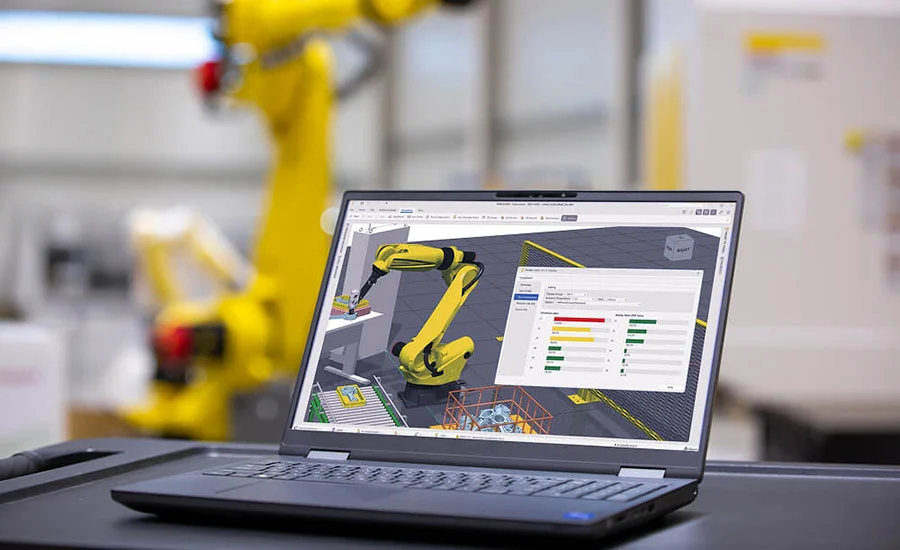
FANUC, for instance, has been a vocal proponent and early adopter of physical AI concepts. At the International Robot Exhibition (iREX) held last December, FANUC unveiled its open-platform physical AI system, demonstrating capabilities that underscore the transformative potential of this technology. These demonstrations included robots that could be directed with spoken instructions, a significant leap towards more intuitive human-robot interaction, and robots autonomously performing parts kitting using AI agents – a complex task requiring object recognition, manipulation, and decision-making under varying conditions. FANUC is actively exploring how its advanced robotic systems can integrate with Fujitsu’s AI infrastructure, leveraging shop floor data to enhance automation control and unlock new levels of efficiency and flexibility.
Similarly, Yaskawa Electric and Kawasaki Heavy Industries, both titans in the industrial robotics landscape, are poised to integrate these advanced AI capabilities into their respective robot lines. Yaskawa, known for its Motoman robots and integrated automation solutions, and Kawasaki, with its robust industrial robots and expertise in heavy machinery, will bring their unique perspectives and application knowledge to the table. Their involvement ensures that the physical AI platform developed by Fujitsu and powered by Nvidia will be robust, scalable, and adaptable across a wide range of industrial applications, from automotive manufacturing to electronics assembly and logistics.
Chronology and Context: The Evolution of Smart Manufacturing
The current push for physical AI is the culmination of decades of advancements in robotics and artificial intelligence. Industrial robotics emerged in the 1960s with early manipulators designed for repetitive, hazardous tasks. The 1980s saw significant growth with improved control systems and vision capabilities, primarily for tasks like welding and painting. The turn of the millennium brought increased precision, speed, and the introduction of collaborative robots (cobots) in the 2010s, designed to work safely alongside humans.
Parallel to this, AI has progressed from symbolic AI in the 1980s to machine learning algorithms in the 1990s and, more recently, to deep learning and neural networks that have fueled breakthroughs in computer vision and natural language processing. The convergence of these two fields – advanced robotics and powerful AI – has laid the groundwork for physical AI.
Key milestones leading to this partnership include:
- Early 2010s: Increased focus on "Industry 4.0" and smart factories, emphasizing connectivity, data exchange, and automation. This created the demand for more intelligent and flexible manufacturing systems.
- Mid-2010s: Emergence of powerful GPU architectures from Nvidia, making deep learning models computationally feasible for real-time applications.
- Late 2010s: Development of sophisticated robot operating systems (ROS) and simulation environments, allowing for faster prototyping and testing of robot behaviors.
- December 2023: FANUC showcases its open-platform physical AI system at the International Robot Exhibition, signaling a major step towards commercial deployment. This event likely served as a catalyst, demonstrating the tangible benefits and readiness of the technology for broader industry adoption, thus paving the way for this multi-party alliance.
This partnership, therefore, represents a strategic alignment of leaders across hardware, software, and industrial applications, aiming to accelerate a trend that has been building for years.
Official Responses and Strategic Vision
Takahito Tokita, president and CEO of Fujitsu, articulated the ambitious vision behind this collaboration. "By merging the technologies of both companies and seamlessly connecting robots, equipment, people and business applications across the factory floor, we aim to optimize and enable autonomous operations across the entire manufacturing life cycle, from production planning and manufacturing to quality management and maintenance operations," Tokita stated. He further emphasized the profound impact: "By tightly integrating robots operating in the physical world with data accumulated and analyzed in the digital world, we can improve productivity, increase operational agility and strengthen sustainable competitiveness in an ever-changing business environment."
While specific statements from Nvidia, FANUC, Yaskawa, and Kawasaki were not detailed in the initial announcement, their participation speaks volumes. It can be logically inferred that:
- Nvidia would highlight its commitment to powering the next generation of intelligent machines, emphasizing how its AI platforms democratize advanced robotics and provide the computational muscle for real-time decision-making and perception. They would likely underscore the transformative potential of their AI chips and software in enabling robots to perform tasks with unprecedented levels of autonomy and flexibility.
- FANUC, Yaskawa, and Kawasaki would likely express their enthusiasm for integrating cutting-edge AI into their robust robotic platforms. Their focus would be on how this partnership enhances their robots’ capabilities, making them more versatile, easier to deploy, and more responsive to dynamic production needs. They would likely foresee increased market penetration and new application areas for their machines, moving beyond traditional automation into more complex and adaptive manufacturing processes. Their statements would probably underscore the value proposition for their customers: higher productivity, improved quality, and the ability to navigate increasingly complex production demands.
Broader Impact and Implications for Global Manufacturing
The implications of this alliance extend far beyond individual factory floors, promising to reshape the global manufacturing landscape in several fundamental ways:
- Enhanced Productivity and Efficiency: Physical AI robots can perform tasks faster, more accurately, and with greater consistency than human operators, leading to significant increases in throughput and reductions in waste. Their ability to work autonomously for extended periods, even in challenging environments, will further boost overall equipment effectiveness (OEE).
- Improved Quality and Reduced Defects: By leveraging advanced perception and real-time decision-making, physical AI robots can identify and correct anomalies in production processes instantly, leading to a dramatic reduction in manufacturing defects and an improvement in product quality consistency.
- Increased Flexibility and Customization: The adaptability of physical AI robots enables manufacturers to easily switch between producing different product variants or even entirely different product lines without extensive retooling or reprogramming. This is crucial for meeting consumer demand for personalized products and navigating rapidly changing market trends.
- Expansion of Automation to New Applications: Previously, tasks requiring fine motor skills, complex decision-making, or interaction with highly variable objects were difficult to automate. Physical AI opens up these frontiers, allowing for automation in areas like intricate assembly, delicate material handling, and even quality inspection tasks that require human-like discernment.
- Supply Chain Resilience: By making manufacturing more agile and adaptable, physical AI can contribute to more resilient supply chains, allowing companies to quickly pivot production in response to disruptions, trade shifts, or unforeseen events.
- Shifting Labor Dynamics: While concerns about job displacement often arise with automation, physical AI is also expected to create new roles and demands for a skilled workforce capable of programming, maintaining, and overseeing these advanced systems. It will free human workers from repetitive, dangerous, or monotonous tasks, allowing them to focus on higher-value activities such as system optimization, innovation, and strategic planning. This will necessitate significant investment in workforce training and upskilling.
- Competitive Advantage: Manufacturers who adopt physical AI early and effectively will gain a significant competitive edge, characterized by lower operational costs, higher product quality, faster time-to-market, and greater responsiveness to customer needs. This could lead to a re-evaluation of global manufacturing footprints, potentially bringing production closer to end markets.
- Data-Driven Decision Making: The Fujitsu platform’s ability to integrate shop floor data with AI and business applications will create a comprehensive digital twin of the manufacturing process. This wealth of data, combined with advanced analytics, will provide unprecedented insights into operations, enabling predictive maintenance, optimized resource allocation, and continuous process improvement.
Challenges and the Road Ahead
Despite its immense promise, the widespread deployment of physical AI also presents challenges. Cybersecurity will be paramount, as intelligent, connected robots represent potential new attack vectors. Ethical considerations around AI decision-making and human-robot interaction will need careful navigation. The cost of initial investment, while offset by long-term gains, could be a barrier for some smaller manufacturers. Furthermore, the standardization of interfaces and protocols will be crucial for seamless integration across diverse hardware and software platforms.
However, this powerful alliance of Fujitsu, Nvidia, FANUC, Yaskawa, and Kawasaki is uniquely positioned to address these challenges. By combining their respective strengths in platform development, AI computing, and industrial robotics, they are creating a robust and scalable ecosystem designed to accelerate the adoption of physical AI. This collaboration is not merely about incremental improvements; it represents a fundamental shift in how manufacturing will operate, ushering in an era of truly intelligent, autonomous, and adaptable production systems that will define the factories of the future. The partnership signals a clear intent to move beyond theoretical concepts and deliver tangible, real-world solutions that will reshape industries and economies worldwide.