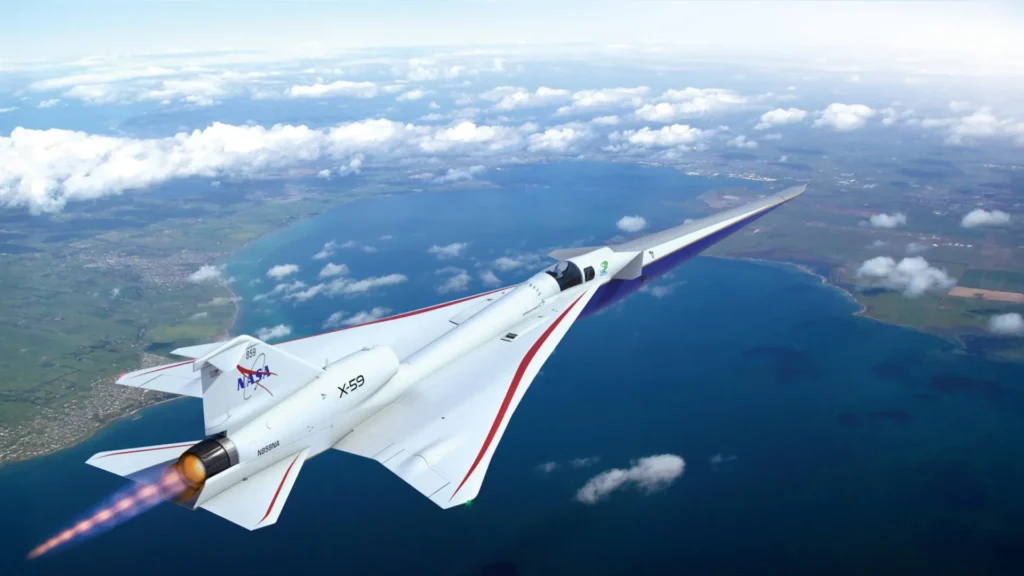
NASA’s X-59 quiet supersonic research aircraft is approaching one of the most pivotal stages of its development, with a new series of test flights set to commence in early June. This experimental X-plane will undertake its inaugural journey beyond the speed of sound, a critical step toward validating its revolutionary design aimed at mitigating the disruptive sonic boom. These flights are not merely technical exercises; they represent a significant stride in NASA’s Quesst mission, a program designed to unlock the future of overland supersonic flight by collecting crucial data on quiet supersonic acoustics and public perception.
The Quest for Quiet Supersonic Flight: A Historical Context
The dream of supersonic passenger travel, once embodied by iconic aircraft like the Concorde and the Tupolev Tu-144, was ultimately curtailed by a single, pervasive issue: the sonic boom. This thunderous noise, generated when an aircraft exceeds the speed of sound, created a shockwave that could rattle windows, disturb communities, and even cause minor structural damage. The public outcry led to stringent regulations, most notably the Federal Aviation Administration’s (FAA) ban on commercial supersonic flight over land in 1973, effectively grounding the potential for widespread adoption of high-speed air travel. The Concorde, for instance, was limited to supersonic speeds only over oceans, severely restricting its operational flexibility and economic viability.
For decades, this regulatory barrier stifled innovation in commercial supersonic aviation. However, the scientific community, particularly NASA, recognized the potential societal benefits of drastically reduced travel times. The solution, they hypothesized, lay not in avoiding the sonic boom, but in reshaping it. The X-59 QueSST (Quiet Supersonic Technology) program was conceived to tackle this challenge head-on. Launched in 2018 with Lockheed Martin Skunk Works as the primary contractor, the X-59 project aims to demonstrate that a specially designed aircraft can reduce the intense "N-wave" sonic boom to a mere "sonic thump" – a sound so quiet it might be perceived as a distant thud, or even not heard at all, from the ground. This fundamental shift from boom to thump is crucial for potentially overturning existing overland flight restrictions and ushering in a new era of faster-than-sound commercial air travel.
X-59 QueSST: Engineering a Silent Breakthrough
The X-59 QueSST is a marvel of aerodynamic engineering, specifically crafted to manipulate the shockwaves typically responsible for the loud sonic boom. Its distinctive design features an extraordinarily long and slender nose, extending nearly a third of its 99.7-foot (30.4-meter) length, which gradually compresses the air ahead of the aircraft, preventing the shockwaves from coalescing into a powerful boom. The aircraft also boasts an inverted V-tail and strategically placed canards, all contributing to the precise shaping of its supersonic pressure waves.
Beyond its external contours, the X-59 incorporates several advanced systems. One of the most notable is the eXternal Vision System (XVS). Due to the elongated nose blocking the pilot’s forward view, a traditional windshield is absent. Instead, the XVS uses a forward-facing camera and terrain-mapping software to project a real-time, augmented reality view onto a 4K display inside the cockpit, providing pilots with crucial situational awareness during takeoff, landing, and flight. This innovative solution not only accommodates the unique aerodynamic requirements but also showcases NASA’s commitment to integrating cutting-edge technology into every aspect of the aircraft’s design. The X-59 is powered by a single General Electric F414-GE-100 engine, a derivative of the engine used in the F/A-18 Super Hornet, providing the necessary thrust for its supersonic endeavors.
Imminent Supersonic Milestones: The Path to Mach 1.4
The upcoming test campaign represents a critical juncture for the X-59. "What comes next is the first time this one-of-a-kind aircraft will fly supersonic," stated Cathy Bahm, project manager for NASA’s Low Boom Flight Demonstrator. "We are starting toward the mission conditions test point that X-59 was designed for." Following months of meticulous flight testing and a comprehensive progress review in late May, the team is now poised to expand the aircraft’s flight envelope to greater altitudes and higher speeds.
NASA anticipates the X-59 will surpass the speed of sound for the first time during test flights scheduled for early June. The initial supersonic foray is expected to see the aircraft achieve speeds exceeding 630 mph (approximately Mach 1.0) at an altitude of about 43,000 feet (13,100 meters). This achievement will mark a significant engineering and operational milestone for the program, validating the aircraft’s basic supersonic capabilities.
Following these initial breakthroughs, the aircraft will attempt a "mission conditions" flight, aiming to reach Mach 1.4 (approximately 925 mph or 1,490 km/h) at an altitude of around 55,000 feet (16,760 meters). These performance targets are strategically important as they directly correspond to the conditions NASA plans to replicate when flying the X-59 over U.S. communities in a later phase of the Quesst mission. During those future flights, researchers will meticulously gather public feedback on the aircraft’s quieter sonic "thump" and evaluate how people respond to it. This data will be instrumental in informing future regulatory changes.
It is crucial to note that while the X-59 is designed to minimize disruptive sonic booms, these initial supersonic flights are primarily intended to demonstrate the aircraft’s performance and airworthiness under supersonic conditions, not its quiet boom capability. A conventional supersonic chase aircraft, such as a NASA F-15, will accompany the X-59 during these tests. The louder sonic booms generated by the chase plane will deliberately mask any quieter sound produced by the experimental jet, allowing engineers to focus purely on the X-59’s aerodynamic performance. Additionally, during supersonic testing this summer, the chase aircraft will carry a specialized shock-sensing probe designed to collect the first direct measurements of the X-59’s unique shockwave signatures, providing vital data for validating its low-boom design. The X-59 is also expected to eventually achieve its top planned performance targets during this testing phase, including a maximum speed of Mach 1.6 (1,218 mph or 1,960 km/h) and a maximum altitude of 60,000 feet (18,288 meters).
A Rigorous Testing Regimen: Learnings from Earlier Flights
The journey to these imminent supersonic flights has been built upon a rigorous and successful first phase of testing. After its maiden flight in October 2025, the X-59 underwent a planned maintenance period, a standard procedure for new experimental aircraft to allow for detailed inspections and system checks. It returned to flight testing in March 2026, and since then, the aircraft has completed 14 additional flights, accumulating valuable data and achieving several notable milestones.
During these initial flights, engineers meticulously evaluated key systems critical to the aircraft’s operation. This included comprehensive assessments of the fuel delivery system, hydraulic controls, environmental control systems, and the innovative eXternal Vision System (XVS). The XVS, which provides the pilot with a live, augmented reality display in place of a traditional forward-facing windshield, was a particular focus, given its novelty and importance to pilot situational awareness. Teams also closely monitored the X-59’s performance during various flight operations, including takeoffs, landings, and subsonic cruising. Strain gauges strategically installed throughout the airframe provided continuous measurements of structural loads, recording how the aircraft’s composite and metallic structure responded to the forces encountered during testing. This extensive data collection has been vital for validating the aircraft’s structural integrity and overall design.
"The 15 X-59 flights we’ve accomplished since March have been everything to this team and the mission," Bahm reflected, quoting aviation pioneer Otto Lilienthal: "To design a flying machine is nothing. To build one is something. But to fly is everything." She emphasized, "Every flight has pushed the boundaries of what’s possible, steadily expanding the envelope and strengthening our confidence in the aircraft." This methodical expansion of the flight envelope, gradually increasing speed and altitude, is fundamental to ensuring safety and gathering comprehensive performance data.
Paving the Way for Quesst Phase 2: Public Perception and Regulatory Reform
All flights completed to date, including the upcoming supersonic test campaign, constitute Phase 1 of NASA’s Quesst mission. This initial stage is singularly focused on proving the aircraft’s performance, airworthiness, and its ability to achieve stable supersonic flight with the intended shockwave signature. The early use of specialized equipment, such as the shock-sensing probe mounted on a NASA F-15 research aircraft, is designed to gather preliminary measurements of the X-59’s unique shock wave.
The information collected during these early measurement flights will be instrumental in preparing for Quesst Phase 2, which is slated to begin later this year. During Phase 2, the mission will shift its focus from internal validation to external verification. Teams will directly measure the aircraft’s supersonic flight signature over communities to confirm that it is indeed producing the quiet supersonic "thump" it was designed to generate. This will involve flying the X-59 at supersonic speeds over designated ground test sites equipped with an array of sensitive microphones, as well as over selected U.S. communities where residents will be asked to provide feedback on the sound they perceive, or don’t perceive.
This public perception data is the linchpin of the entire Quesst mission. NASA intends to provide this invaluable information to U.S. and international regulatory bodies, such as the FAA and the International Civil Aviation Organization (ICAO). The ultimate goal is to provide regulators with a robust dataset that demonstrates the viability of quiet supersonic flight, potentially leading to the revision or repeal of existing overland supersonic flight bans. Such a regulatory shift would open up vast new opportunities for commercial aviation, allowing for significantly reduced travel times across continents.
The Broader Implications: A New Era of Air Travel?
The successful demonstration of quiet supersonic technology by the X-59 holds profound implications for the future of air travel. Should the data from the Quesst mission convince regulators to lift the overland supersonic flight ban, it could pave the way for a resurgence in commercial supersonic passenger jets. Companies like Boom Supersonic, with its Overture jet, and others are actively developing concepts for future supersonic aircraft, but their market potential is heavily reliant on the ability to fly supersonically over land. The X-59 is the critical enabler for this industry.
A return to commercial supersonic travel would drastically cut flight times, transforming global connectivity. A flight from New York to London could be reduced from approximately seven hours to around three or four, while transcontinental U.S. flights could be cut by half. This would have significant economic impacts, benefiting business travelers, logistics, and potentially even tourism, by making distant destinations more accessible.
However, the path forward is not without challenges. Beyond noise, future supersonic aircraft will need to address concerns regarding fuel efficiency and environmental impact, particularly carbon emissions. While the X-59 is a research platform and not a commercial prototype, the data gathered from Quesst will also inform the design and operational parameters for future greener supersonic aircraft. NASA’s role in providing foundational research and data is crucial for de-risking the technology and enabling the private sector to develop commercially viable and environmentally responsible solutions. The X-59 represents not just an engineering feat, but a potential catalyst for a new chapter in aviation history, where the speed of sound is no longer a barrier to quiet, efficient global travel.
"As we look ahead to the upcoming flights, we’re poised to open the envelope even further – moving boldly toward the mission test point this aircraft was built to achieve," Bahm concluded. "Flying supersonic and reaching these milestones isn’t just progress; it’s the realization of years of perseverance, innovation, and teamwork. Each step brings us closer to Phase 2, and to the future of commercial supersonic flight." The world watches as the X-59 prepares to redefine what’s possible in the skies above.