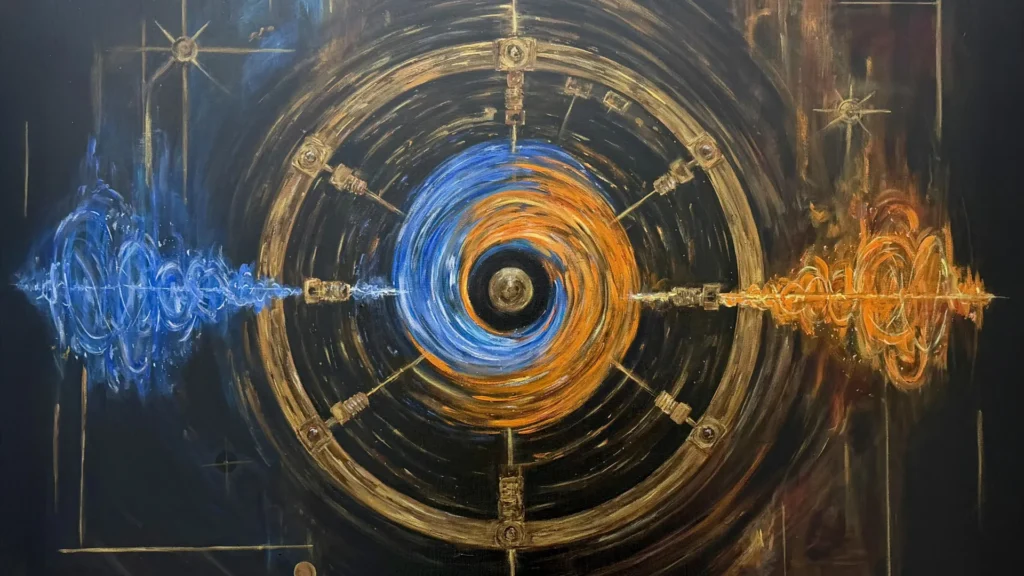
More than 50 years ago, physicist Sir Roger Penrose proposed a remarkable idea: under the right conditions, it might be possible to extract energy from a rapidly spinning black hole. In his concept, a particle entering the black hole’s ergosphere, a region where spacetime is dragged along by the object’s rotation, could split into two. One fragment would fall into the black hole while the other escaped carrying away more energy than the original particle. Later, physicist Yakov Zel’dovich expanded on this concept, predicting that waves interacting with an object rotating fast enough could also gain energy and become amplified. Now, researchers at the Advanced Science Research Center at the CUNY Graduate Center (CUNY ASRC) have demonstrated an experimental approach inspired by those long-standing theories. Writing in the journal Nature, the team showed that wave amplification can be achieved using a device that simulates extreme rotation without physically spinning, marking a significant leap from theoretical conjecture to practical scientific exploration.
The Penrose Process and Zel’dovich Effect: A Theoretical Foundation
The journey to this experimental breakthrough began in the late 1960s with Sir Roger Penrose, a towering figure in theoretical physics whose work laid much of the groundwork for our understanding of black holes. In 1969, Penrose published his seminal paper outlining a theoretical mechanism for extracting rotational energy from a Kerr black hole, which is a rotating black hole. His idea centered on the ergosphere, a fascinating region surrounding a rotating black hole. Unlike the event horizon, where escape is impossible, the ergosphere allows particles to briefly exist. However, within this region, spacetime itself is so intensely dragged by the black hole’s rotation that no object can remain stationary relative to a distant observer; it must rotate with the black hole.
Penrose proposed that a particle, if precisely aimed, could enter the ergosphere and, through an internal decay or fission process, split into two fragments. One fragment, possessing negative energy with respect to an observer at infinity, would fall into the black hole. Crucially, the other fragment, by shedding its negative-energy counterpart into the black hole, would then escape the ergosphere carrying away more energy than the original incident particle. This net gain in energy would come directly from the black hole’s rotational energy, causing the black hole to slow down infinitesimally. This process, known as the Penrose Process, was purely theoretical, requiring conditions—such as perfectly timed particle decay and the existence of negative-energy particles in that specific context—that seemed impossible to replicate in a laboratory. Penrose’s profound contributions to the understanding of black holes were later recognized with a share of the Nobel Prize in Physics in 2020.
Just two years later, in 1971, Soviet physicist Yakov Zel’dovich expanded on Penrose’s fundamental concept, shifting the focus from particles to waves. Zel’dovich theorized that if waves (such as electromagnetic or acoustic waves) were to interact with a rotating object at a sufficiently high angular velocity, they could undergo amplification, drawing energy from the object’s rotation. This phenomenon, often referred to as "superradiance," predicts that waves scattering off a rotating absorber can emerge with more energy than they initially possessed, provided the object’s rotational speed exceeds the wave’s angular frequency. While conceptually similar to the Penrose process, Zel’dovich’s insight offered a more accessible theoretical pathway for potential experimental validation, as waves are more amenable to manipulation than individual particles in a black hole’s vicinity. However, demonstrating this effect still presented immense practical challenges, primarily due to the necessity of extreme rotational speeds that far outstrip what conventional mechanical systems can achieve in a laboratory setting. For decades, both the Penrose Process and the Zel’dovich effect remained captivating theoretical constructs, awaiting a technological leap that could bridge the gap to experimental realization.
Synthetic Rotation Recreates Extreme Physics in the Lab
The CUNY ASRC research team has now provided that leap, demonstrating wave amplification inspired by these long-standing theories. Instead of attempting the physically impossible task of rotating an object mechanically at speeds equivalent to those near a black hole, the researchers engineered a novel radio frequency device. This device’s properties were rapidly and precisely changed across both space and time, creating the illusion of ultrafast rotation. This innovative approach allowed the team to achieve effective rotational speeds far beyond what conventional mechanical systems can deliver, overcoming experimental limitations that have stymied studies of extreme rotational physics for decades.
"Our approach facilitates a new method of wave-matter interaction in which waves with selected rotational properties extract energy from synthetic time-engineered rotation, producing a form of broadband selective amplification," stated Principal Investigator Andrea Alù, Distinguished Professor and Einstein Professor of Physics at the CUNY Graduate Center and founding director of the CUNY ASRC’s Photonics Initiative. This method fundamentally redefines how scientists can probe complex physical phenomena, moving beyond the constraints of traditional mechanical motion.
Lead author Hadiseh Nasari, a post-doctoral researcher with the CUNY ASRC’s Photonics Initiative, emphasized the practical transformation of the theoretical concept. "This successful experiment moves ideas about extreme rotational dynamics from theory to practice and creates a versatile experimental platform for exploring a broad range of phenomena at the intersection of astrophysics, wave physics, and quantum science," said Nasari. "The work has implications for advances in fundamental science and in communications, optics and photonics." Her statement underscores the dual impact of this research: providing a tangible tool for fundamental scientific inquiry and paving the way for advanced technological applications.
How the Experiment Worked: Engineering Spacetime-Like Dynamics
The core of the CUNY ASRC experiment revolved around a fundamental question: Could electromagnetic waves interacting with a completely stationary device behave as though they were encountering an object rotating at ultrafast speed and draw energy from that synthetic motion? To answer this, the researchers constructed a ring of electronic resonators. These resonators are essentially circuits designed to oscillate at specific frequencies. The ingenious part of the experiment involved rapidly and precisely adjusting the properties of these resonators in a carefully synchronized sequence.
Although the physical hardware of the device remained completely stationary, these timed changes in the resonators’ properties generated a traveling pattern around the ring. Imagine a ripple moving across a pond, but instead of water, it’s a dynamic adjustment of electronic characteristics. As a result, electromagnetic waves propagating through this system effectively experienced it as though it were spinning at extraordinary speeds. This "synthetic rotation" mimicked the spacetime-dragging effects found near a rotating black hole’s ergosphere, but in a controlled, tabletop environment.
"Waves with the appropriate rotational characteristics extracted energy from the system and became amplified, reproducing the essential physics of the Penrose-Zel’dovich process," explained co-lead author Hady Moussa, a former PhD student with the CUNY ASRC Photonics Initiative. Moussa further elaborated on the underlying technology: "Our approach relies on engineered metamaterials that are designed to control how waves propagate." Metamaterials are artificially structured materials engineered to possess properties not found in naturally occurring substances. By carefully designing their subwavelength structures, researchers can manipulate electromagnetic waves in unprecedented ways, making them crucial for creating the dynamic environment needed for synthetic rotation. In this context, the metamaterial-inspired design of the resonator ring enabled the precise control over wave-matter interaction necessary to simulate extreme rotational dynamics and achieve superradiant amplification. This demonstration marks a pivotal moment, as it effectively brings the exotic physics of black hole ergospheres into a measurable laboratory setting.
Implications for Science and Technology
The ability to create and control synthetic rotation has profound implications across multiple scientific and technological domains. Because synthetic rotation can imitate motion far beyond the speeds achievable by mechanical means, including scenarios that effectively mimic velocities exceeding the speed of light (in terms of wavefront propagation within the engineered medium), researchers now possess a controlled laboratory platform for exploring physical regimes that would otherwise be impossible to study directly. This opens up entirely new avenues for investigating extreme physics, not just in the context of black holes but also in other high-energy astrophysical phenomena.
Fundamental Science:
- Astrophysics: The experiment provides a tangible analogue for studying phenomena like the Penrose process and Zel’dovich effect, offering insights into energy extraction from black holes, neutron stars, and other rapidly spinning cosmic objects. It allows physicists to test theoretical predictions under controlled conditions, potentially refining our understanding of gravity in extreme environments.
- Wave Physics: The research deepens our understanding of wave propagation in complex, dynamic media. The concept of "time-engineered rotation" represents a new frontier in wave-matter interaction, potentially leading to new theories and models for wave behavior in non-uniform or time-varying systems. This could impact fields ranging from acoustics to seismology.
- Quantum Science: While the immediate experiment focuses on classical electromagnetic waves, the principles developed could be extended to quantum systems. Exploring how quantum particles or quantum fields behave in synthetically rotating environments could open new avenues for quantum gravity research or the development of novel quantum sensors. The interaction between synthetic spacetime metrics and quantum entanglement, for example, could be a fertile area for future investigation.
Technological Applications:
- Wireless Communications: The demonstrated broadband selective amplification could revolutionize wireless communication technologies. By selectively amplifying signals based on their rotational properties, it might be possible to develop more efficient, robust, and secure communication systems. This could lead to better signal-to-noise ratios, extended ranges, and improved data transmission rates, particularly in crowded frequency spectra.
- Optics and Photonics: The ability to control light through synthetic rotation offers new paradigms for optical devices. This could include novel light sources, advanced modulators, or highly sensitive optical sensors. Imagine optical components that can amplify specific rotational modes of light, enabling new forms of optical information processing or imaging. The principles could also lead to advancements in laser technology, allowing for more precise control over beam characteristics.
- Quantum Technologies: Although further research is needed, the control over wave-matter interaction demonstrated here could eventually translate into quantum technologies. For instance, creating synthetic rotational fields might enable new methods for manipulating qubits in quantum computers or developing ultra-sensitive quantum sensors that exploit rotational effects. This represents a long-term, high-impact potential for the research.
The researchers prudently note that additional work will be needed before these fundamental ideas can be translated into practical devices. The current setup is a proof-of-concept, and scaling it up or miniaturizing it for specific applications will require significant engineering efforts. However, the foundational principles established are robust. The team also believes that the same principles could be applied to photonic and quantum systems, opening new possibilities for controlling light, processing information, and studying wave behavior inspired by some of the universe’s most extreme environments.
The support for this groundbreaking research from prestigious organizations such as the U.S. Department of Defense, the U.S. National Science Foundation, and the Simons Foundation underscores the recognized potential and strategic importance of this scientific endeavor. This funding highlights the interdisciplinary nature of the work, spanning fundamental physics to potential defense and communication applications. The CUNY ASRC’s success in experimentally validating concepts that have captivated theoretical physicists for half a century represents a significant milestone, promising to reshape our understanding of extreme physics and inspire a new generation of technological innovations.






