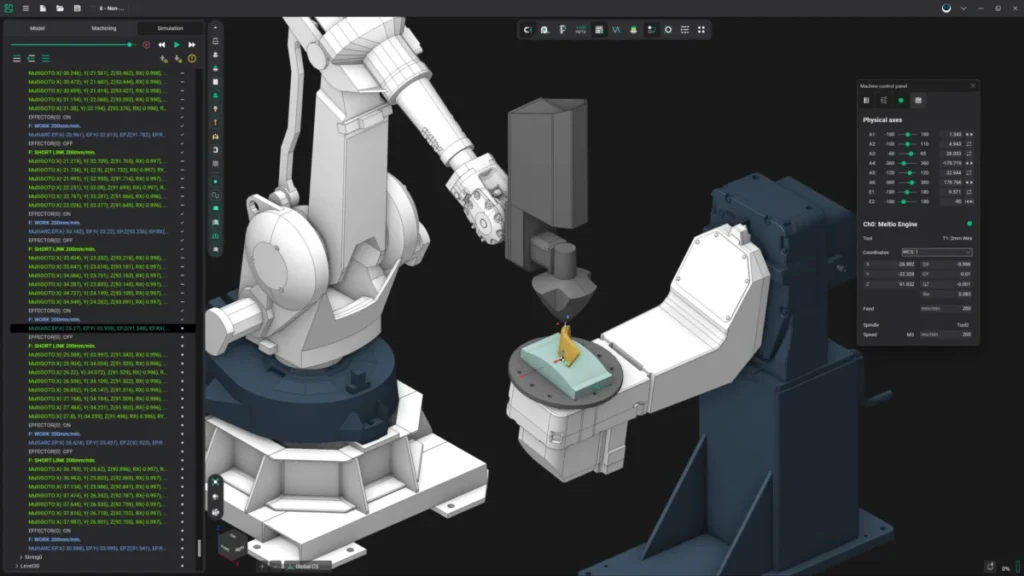
In a significant advancement for high-precision industrial automation, CNC Solutions, a prominent machine-tool provider, has unveiled a groundbreaking "Technology Package" that redefines the capabilities of robotic systems for complex manufacturing tasks. This innovative solution integrates state-of-the-art offline programming software, advanced motion control, and high-performance robotics to overcome the inherent limitations of traditional teach-in methods, particularly for CNC-class workloads such as multi-axis milling, abrasive sanding, and intricate laser or plasma cutting. The collaboration leverages the strengths of ENCY Robot software, Beckhoff motion controllers, and Stäubli industrial robots, creating a seamless workflow that promises unparalleled precision, speed, and efficiency in demanding production environments.
The Evolving Landscape of Industrial Automation and the Limitations of Traditional Methods
For decades, industrial robots have been instrumental in automating manufacturing processes, largely excelling in repetitive, pick-and-place tasks. However, the increasing complexity and precision demands of modern production have exposed the inherent limitations of conventional robot programming techniques. Traditional teach-in methods, which involve manually guiding a robot through its desired movements, prove inefficient and often inadequate for applications requiring the management of millions of motion points. Processes like milling, grinding, and high-speed trimming demand a level of path accuracy and consistency that manual teaching simply cannot deliver.
As CNC Solutions has observed over years of supporting increasingly complex projects, the sheer volume of data and the intricate trajectories involved in tasks like multi-axis machining or abrasive finishing far exceed the capacity for human intervention and manual calibration. This disparity leads to significant challenges, including extended commissioning times, inconsistent product quality, and considerable robot idle time during the programming phase. The industry has long recognized the need for a solution that bridges the gap between the flexibility of industrial robots and the deterministic precision of computer-aided manufacturing (CAM) and Computer Numerical Control (CNC) machine tools.
The Genesis of a New Paradigm: Addressing CNC-Class Workloads
The imperative for a new approach became particularly clear to CNC Solutions as their client projects evolved to include more sophisticated operations. Traditional controller-centric methods, while robust for their intended purposes, often lacked the agility and integrated intelligence required for a workflow that begins with sophisticated CAM software, accurately simulates the entire manufacturing cell, and precisely controls a robot with CNC-level fidelity. This gap necessitated a paradigm shift—moving away from robots programmed in isolation and towards an integrated system where the robot functions as a highly accurate, multi-axis machine tool.
The development of the "Technology Package" was a direct response to this market need. It represents a culmination of expertise from leading technology providers, meticulously integrated by CNC Solutions. The goal was to empower integrators and manufacturers with a robust, repeatable, and easily deployable solution that could tackle high-value applications previously considered beyond the practical scope of industrial robotics due to programming complexities and precision constraints. The solution was designed from the ground up to ensure that operators could focus on optimizing production processes rather than grappling with the intricacies of manual robot intervention or vendor-specific programming languages.
A Tripartite Core: Software, Motion Control, and Robotics Converge
At the heart of CNC Solutions’ innovative Technology Package lies a powerful integration of three core components, each selected for its market leadership and technical superiority:

-
ENCY Robot Offline Programming Software: This crucial software layer, developed by ENCY, is the brain behind the operation. It allows for comprehensive offline programming, toolpath calculation, and detailed simulation of the entire robotic cell. By performing these critical steps virtually, ENCY dramatically reduces the need for online programming, thereby converting significant commissioning time into productive time. Its capabilities extend to checking axis limits, avoiding singularities, and performing full collision control, ensuring that generated robot instructions are robust and reliable before physical execution. ENCY’s platform provides an all-in-one environment for design, technology setup, and digital twin creation, translating trusted CAM strategies directly into dependable robot instructions. Its broad functionality supports tasks from simple two-axis operations to complex multi-axis cells, offering transparent system behavior through internal management of code paths and models.
-
Beckhoff Motion Controller: Serving as the central nervous system, the Beckhoff motion controller is responsible for executing the robot’s movements with the precision and responsiveness characteristic of CNC machines. This controller operates the Stäubli robot using standard CNC commands, including feeds, modes, and frames, ensuring a familiar interface for those accustomed to traditional machine tools. Beckhoff’s expertise in PC-based control and automation technology provides the necessary processing power and deterministic real-time performance to manage the intricate motion profiles required for high-accuracy applications. The integration of a CNC-style motion layer enables precise trajectory execution, crucial for maintaining consistency in demanding processes like milling and grinding.
-
Stäubli Industrial Robots: The muscular arm of the solution, Stäubli robots are renowned for their exceptional precision, repeatability, and robust construction. Their sealed design makes them particularly suitable for harsh industrial environments, resisting the ingress of dust and debris—a critical factor in abrasive applications such as grinding and milling. Stäubli’s commitment to high-quality engineering ensures that the robot executes the complex paths generated by ENCY and commanded by the Beckhoff controller with the accuracy and reliability essential for production-grade manufacturing. The seamless integration of their kinematics into the CNC-style motion layer provided a critical foundation for the system’s performance.
A Chronology of Refinement: From Concept to Commercialization
The development of the Technology Package was an iterative process, evolving over time through continuous refinement. CNC Solutions recognized that simply combining disparate technologies would not suffice; true innovation lay in achieving a cohesive, synchronized system. The team dedicated considerable effort to fine-tuning the robot axis motions, meticulously adjusting parameters until the commissioning process yielded the consistency and predictability synonymous with high-end CNC machines. This rigorous development phase ensured that the integrated stack performed as a unified entity, capable of delivering repeatable, high-quality results.
This methodical approach allowed CNC Solutions to transition from project-specific custom integrations to a standardized, commercially viable solution. The initial conceptualization, driven by the increasing complexity of client demands, led to the careful selection of technology partners—ENCY for its comprehensive offline programming capabilities, Beckhoff for its robust and flexible motion control, and Stäubli for its precision robotics. The subsequent years involved extensive testing, calibration, and optimization, culminating in a product that not only met but exceeded the stringent requirements of modern CNC-class applications. The final commercial offering is a testament to this collaborative engineering effort, providing integrators with a validated starting point for a wide array of sophisticated manufacturing processes.
Unpacking the Features: Precision, Efficiency, and Adaptability
The Technology Package is engineered with a comprehensive suite of features designed to maximize productivity, enhance quality, and simplify integration:
- Offline Programming and Simulation (ENCY): By allowing the entire cell to be simulated virtually, ENCY eliminates the need for expensive online programming, drastically reducing robot idle time. It performs exhaustive checks for axis limits, singularities, and collisions, ensuring that validated CAM strategies are directly translated into error-free robot instructions. This approach transforms commissioning time into productive planning and optimization.
- Plug-and-Play Integration: The system boasts simplified wiring, with a single cable connecting the Stäubli robot to the Beckhoff controller, streamlining installation.
- Predefined Processes: The package includes a library of predefined and machine-tuned processes for a wide array of applications, such as milling, grinding, deburring, polishing, blasting (wet/dry), plasma and laser cutting/welding, waterjet cutting, cladding, painting, cleaning, and gluing. These provide integrators with a validated starting point, reducing development time and risk.
- CNC-Style Operation: Operators benefit from familiar CNC-style modes (Auto, Manual, Home), feed overrides, and integrated emergency-stop logic. Manual moves using encoder-wheel controls are also supported, enhancing operational flexibility.
- Real-world Adaptability: Recognizing that actual production cells often deviate from theoretical specifications, the package includes critical features that typically require extensive setup: absolute, TCP (Tool Center Point), and frame calibration, singularity management, OPC UA connectivity for plant network integration, real-time path adjustments, and tool-wear compensation. These capabilities ensure the system’s robustness and accuracy in dynamic manufacturing environments.
- Elimination of Vendor-Specific Languages: A significant advantage is that the system operates as a unified CNC axis group, eliminating the need for integrators to master multiple vendor-specific robot programming languages. This allows expertise to remain focused on core automation elements like PLCs, safety systems, fixturing, end-effectors, and process knowledge.
Market Implications and Broader Impact
The introduction of CNC Solutions’ Technology Package carries substantial implications for the industrial automation market and manufacturing sectors globally.

For Integrators: The solution significantly lowers the barrier to entry for integrators wishing to implement high-precision robotic applications. By providing a stable, pre-engineered platform, it reduces delivery risk and warranty exposure, as more project elements are reused rather than developed from scratch. The reduced "time to first good part" is a key metric, enabling integrators to accelerate project timelines and improve client satisfaction. This allows them to expand into higher-value applications like precision milling and complex trimming, which many previously avoided due to the limitations of traditional teach-in methods.
For Manufacturers: End-users stand to gain immensely from enhanced manufacturing efficiency, improved product quality consistency, and greater operational flexibility. The ability to program complex tasks offline minimizes downtime, while the CNC-level precision ensures consistent output, reducing scrap and rework. The system’s adaptability to real-world conditions, including tool wear compensation and real-time path adjustments, further optimizes production throughput and quality.
Industry Trends: This development aligns with several key industry trends:
- Convergence of Robotics and Machine Tools: The solution exemplifies the ongoing trend of blurring the lines between industrial robots and traditional CNC machine tools, enabling robots to perform tasks traditionally reserved for dedicated CNC equipment.
- Growth of Offline Programming: The emphasis on ENCY’s offline programming capabilities underscores the increasing importance of digital twins and virtual commissioning in modern manufacturing, driven by the need for faster deployment and greater efficiency.
- Demand for Higher Precision and Flexibility: As manufacturing processes become more intricate and product lifecycles shorten, there is an ever-growing demand for automation solutions that offer both high precision and the flexibility to adapt to changing production requirements.
The global industrial robotics market, valued at approximately $45 billion in 2023, is projected to grow at a compound annual growth rate (CAGR) of over 10% in the coming years, driven by increasing automation adoption across various industries. Solutions like CNC Solutions’ Technology Package are critical enablers of this growth, expanding the scope of what robots can achieve, particularly in high-value manufacturing segments where precision and consistency are paramount.
Official Responses and Future Outlook
While specific direct quotes were not provided in the initial context, industry experts and representatives from the collaborating companies would likely emphasize the transformative nature of this integrated solution. A spokesperson for CNC Solutions would undoubtedly highlight the company’s commitment to solving complex manufacturing challenges and empowering integrators with cutting-edge tools. They would stress the meticulous engineering that went into developing a "stable solution that operates such as a machine tool in various shops, industries, and applications."
Representatives from Stäubli would likely underscore the critical role of their high-precision, robust robots in executing the complex trajectories with unmatched accuracy and reliability, particularly in demanding environments. Beckhoff Automation would likely point to their motion control system as the backbone, providing the deterministic performance and CNC-style programming interface that makes the entire system so intuitive and powerful. ENCY would certainly highlight how their software’s ability to seamlessly translate CAM data into robot instructions, coupled with advanced simulation and collision avoidance, fundamentally transforms the robot programming paradigm, drastically cutting commissioning times and operational risks.
The collective sentiment would be one of excitement for a solution that truly advances the capabilities of industrial automation, making sophisticated robotic applications more accessible and efficient. The Technology Package is not merely an assembly of components; it is a testament to the power of intelligent integration, poised to unlock new levels of productivity and quality across a diverse range of manufacturing industries. As industries continue to seek greater efficiency and precision, integrated solutions like this will play a pivotal role in shaping the future of smart manufacturing and the factory of tomorrow.






