In 1985, a seemingly modest advertisement in Scientific American offered a glimpse into a future of innovative design, proposing financial support of up to $10,000 for groundbreaking prototypes in clothing, home decor, and textiles. It was a call that resonated with William Freeman, PhD ’92, an electrical engineer then at Polaroid Corporation and now a distinguished professor at MIT. Freeman, driven by a vision for materials that could dynamically change their physical properties, submitted a radical concept: a three-sided zipper. Far from its conventional use for fastening garments, Freeman’s invention was conceived as a sophisticated mechanism capable of transitioning objects like chairs, tents, and purses between soft, pliable states and rigid, stable forms, thereby revolutionizing ease of packing and assembly.
Freeman’s initial design, though rejected by the Innovative Design Fund, laid the groundwork for what would later be known as the Y-zipper. His blueprint detailed a triangular structure, akin to a conventional zipper but with three sides. Each side featured a belt mechanism designed to interlock narrow, wooden "teeth." A specialized slider, engineered to encircle the entire device, would engage these teeth, drawing the three strips together to form a stable, triangular tube. This ingenious mechanism promised a novel approach to material manipulation, offering a pathway to tunable stiffness in everyday objects. While his proposal didn’t secure immediate funding, Freeman diligently patented his prototype, preserving it in his garage with the prescient hope that its potential would eventually be realized.
Nearly four decades later, this forward-thinking concept has been revitalized by researchers at the MIT Computer Science and Artificial Intelligence Laboratory (CSAIL). The CSAIL team set out to address the longstanding challenge of creating objects with "tunable stiffness" – a property that allows materials to adapt their rigidity on demand. Previous attempts to achieve this often resulted in irreversible changes or required cumbersome manual assembly. The CSAIL researchers, however, have successfully developed an automated design tool and an adaptable fastener, christened the "Y-zipper." This sophisticated system comprises a software program that empowers users to customize three-sided zippers, which are then fabricated in-house using advanced 3D printing technology with specialized plastics. The potential applications for these adaptable fasteners are vast, ranging from camping equipment and medical devices to robotics and intricate art installations, all benefiting from enhanced convenience in assembly and functionality.
The Genesis of Dynamic Material Transformation
Jiaji Li, an MIT postdoc and CSAIL researcher, who also serves as a lead author on the open-access paper detailing this project, explained the fundamental innovation. "A regular zipper is great for closing up flat objects, like a jacket, but Freeman ideated something more dynamic," Li stated. "Using current fabrication technology, his mechanism can transform more complex items. We’ve developed a process that builds objects you can rapidly shift from flexible to rigid, and you can be confident they’ll work in the real world." This underscores the leap from a simple fastening device to a sophisticated component for dynamic structural transformation.
The inspiration drawn from Freeman’s original patent highlights a recurring theme in scientific advancement: ideas that are ahead of their time can find fertile ground years later with the advent of new technologies. The Innovative Design Fund’s initiative in 1985, though perhaps not directly funding Freeman’s invention at the time, inadvertently sowed the seeds for a breakthrough in material science and engineering. The fund, established to foster innovation across various sectors, aimed to bridge the gap between conceptual ideas and tangible prototypes, a mission that has clearly been fulfilled decades later by the CSAIL team.
Customization and "Shape-Shifting" Capabilities
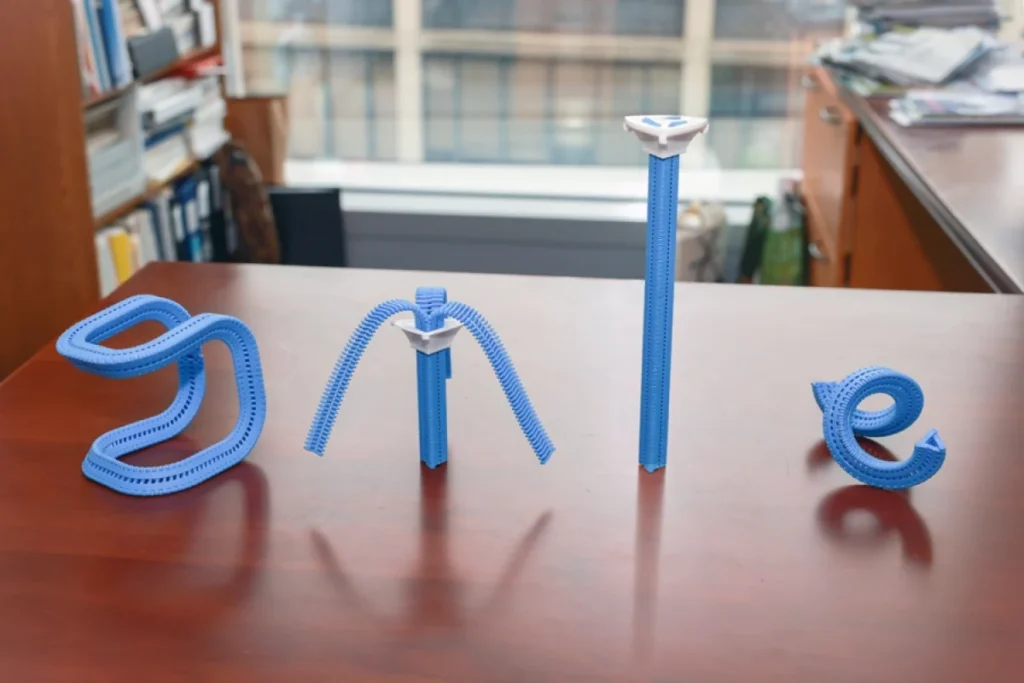
A key aspect of the Y-zipper’s design lies in its user-centric customization capabilities. The CSAIL software program allows users to tailor not only the aesthetic appearance of the fasteners when zipped but also their functional properties. Users can precisely define the length of each of the three strips and dictate the direction and angle at which they will bend. Furthermore, the software offers four distinct motion "primitives" that determine the zipper’s configuration when engaged: straight, bent (forming an arch), coiled (resembling a spring), or twisted (mimicking a screw).
This level of control enables the Y-zipper to exhibit remarkable "shape-shifting" behavior in real-world applications. When unzipped, it can unfurl into a configuration resembling a squid with multiple appendages. Upon activation, it compactly transforms into a more rigid structure, such as a rod. This inherent flexibility holds significant promise for applications where portability and efficient deployment are paramount.
Revolutionizing Outdoor Recreation: The Tent Example
Consider the practical implications for outdoor enthusiasts. Pitching a tent, often a time-consuming endeavor, can be dramatically streamlined. While traditional tent assembly might take upwards of six minutes, the Y-zipper can reduce this to a mere minute and 20 seconds. By attaching each arm of the Y-zipper to strategic points on the tent structure, particularly along the top, the mechanism can act as a deployable frame, effectively "popping" the canopy into place with minimal manual effort. This not only saves time but also simplifies the process for individuals or those with limited mobility. The ability to rapidly assemble and disassemble shelters is crucial in situations where quick deployment is essential, such as in emergency response or adventure expeditions.
Medical Applications: Enhancing Patient Comfort and Recovery
The Y-zipper’s seamless transition between states also unlocks new possibilities in wearable technology, particularly in medical scenarios. The research team demonstrated its utility by wrapping a Y-zipper around a wrist cast. This innovation allows patients to adjust the cast’s tightness throughout the day for optimal comfort and to secure it more firmly at night to prevent further injury. This adaptability transforms a typically rigid medical device into a dynamic support system that can be precisely tailored to a patient’s evolving needs, potentially improving healing outcomes and patient satisfaction.
Robotics and Art: Embodied Intelligence and Dynamic Sculptures
Beyond practical applications, the Y-zipper system can empower users to create sophisticated robotic systems and captivating art installations that respond to programmed commands. By attaching a motor to the Y-zipper after fabrication, the zipping process can be automated. This opens doors for creating adaptive robotic quadruped designs, where the robot’s legs can dynamically adjust their length – extending for taller strides or retracting for lower ground clearance. Such rapid morphological changes could enable robots to navigate complex terrains like canyons or forests with greater agility.
Similarly, actuated Y-zippers can bring dynamic sculptures to life. The CSAIL team showcased this potential by creating a long, winding flower that "bloomed" through the controlled actuation of a static motor engaging the Y-zipper. These applications highlight the Y-zipper’s capacity to facilitate intricate movements and transformations, blurring the lines between engineering, art, and interactive design.
Mastering the Material: Durability and Performance Testing
While the creative and functional potential of the Y-zipper is evident, a crucial question remained: its durability under sustained use. Li and his colleagues recognized the need to rigorously test the Y-zipper’s resilience to ensure its viability for everyday applications.
Stress Testing: PLA vs. TPU
The research team conducted a series of comprehensive stress tests to assess the material properties of common 3D printing plastics. They focused on polylactic acid (PLA) and thermoplastic polyurethane (TPU), evaluating their strength and flexibility. Using a specialized machine that subjected the Y-zippers to bending forces, they observed that PLA exhibited superior load-bearing capacity, while TPU demonstrated greater pliability. This comparative analysis provides valuable insights for selecting the appropriate material based on the specific demands of a given application. For instance, applications requiring high load resistance might favor PLA, while those needing more flexibility and impact absorption would benefit from TPU.
Endurance Trials: Cycles of Use
To gauge the Y-zipper’s lifespan, CSAIL researchers employed an actuator to repeatedly open and close the fastener, simulating continuous operation. The results were impressive: some Y-zippers withstood approximately 18,000 cycles of zipping and unzipping before eventually failing. This remarkable endurance can be attributed, in part, to the Y-zipper’s inherent elastic structure, which, according to 3D simulations, effectively distributes stress across the entire mechanism, preventing localized failure points. This robust performance suggests that the Y-zipper is capable of withstanding the rigors of frequent use in various demanding environments.
Future Horizons: Expanding the Y-Zipper’s Potential
Despite the significant advancements, the researchers envision even further enhancements to the Y-zipper technology. Li suggests the exploration of stronger, more robust materials, such as metals, to create zippers with unparalleled durability and load-carrying capabilities. Additionally, the team acknowledges the current limitations of their 3D printing platform, which restricts the scalability of the Y-zipper for larger-scale projects. Future iterations may involve developing printing techniques that can accommodate larger components, thereby expanding the range of applications to include architectural elements or large-scale structural components.
Uncharted Territories: Space Exploration and Disaster Relief
The potential applications for the Y-zipper extend into entirely novel domains. Li speculates about its utility in space exploration, where its multi-tentacled configuration could be integrated into spacecraft for precisely grabbing and collecting rock samples from distant celestial bodies. The ability to manipulate and secure objects in microgravity environments could be a significant advantage.
Furthermore, the Y-zipper’s capacity for rapid assembly makes it an invaluable tool for disaster relief efforts. By embedding these fasteners into structures, relief workers could quickly erect emergency shelters or medical tents in the aftermath of natural disasters, significantly accelerating the provision of critical aid and support to affected populations. The speed and ease of deployment offered by the Y-zipper could be a critical factor in saving lives and mitigating the impact of catastrophic events.
Expert Acclaim and Broader Implications
The innovative approach taken by the CSAIL team has garnered positive attention from experts in the field. Guanyun Wang, an assistant professor at Zhejiang University who was not involved in the research, commented on the significance of the Y-zipper: "Reimagining an everyday zipper to tackle 3D morphological transitions is a brilliant approach to dynamic assembly," Wang stated. "More importantly, it effectively bridges the gap between soft and rigid states, offering a highly scalable and innovative fabrication approach that will greatly benefit the future design of embodied intelligence." This endorsement highlights the Y-zipper’s potential to drive advancements in fields ranging from robotics to smart materials.
The research paper detailing the Y-zipper project was authored by Jiaji Li and William Freeman, alongside Tianjin University PhD student Xiang Chang. The MIT CSAIL team also included PhD student Maxine Perroni-Scharf, undergraduate Dingning Cao, and visiting researchers Mingming Li (Zhejiang University), Jeremy Mrzyglocki (Technical University of Munich), and Takumi Yamamoto (Keio University). The work was further guided by MIT Associate Professor Stefanie Mueller, a CSAIL principal investigator and senior author on the paper. The research received support from a postdoctoral research fellowship from Zhejiang University and the MIT-GIST Program.
The groundbreaking findings were presented at the ACM’s premier conference, the CHI (Computer-Human Interaction) conference on Human Factors in Computing Systems, in April, marking a significant contribution to the fields of human-computer interaction and advanced manufacturing. The Y-zipper represents a compelling example of how a simple, yet ingenious, idea from decades past can be transformed by modern technology into a powerful tool with the potential to reshape numerous industries and aspects of daily life.