BIRMINGHAM, Mich. – Engineers at Chiba University have unveiled a significant advancement in the field of biomimetic robotics, developing a novel control method that dramatically enhances the stability of bird-inspired flying robots. This breakthrough is poised to expand the practical applications of these agile machines, particularly in critical sectors such as factory inspections, comprehensive infrastructure monitoring, and time-sensitive search-and-rescue operations. The innovation addresses a long-standing challenge in the design and operation of flapping-wing micro aerial vehicles (MAVs), pushing them closer to widespread commercial and humanitarian deployment.
The research, conducted by a dedicated team at Chiba University, meticulously investigated the intricate flight behavior of a commercially available flapping-wing micro aerial vehicle. Through their rigorous analysis, the researchers pinpointed a previously unacknowledged characteristic inherent to these robots that significantly impeded their ability to swiftly recover from external disturbances, such as unpredictable wind gusts or sudden shifts in air currents. This inherent instability has historically been a major hurdle, limiting the robustness and reliability of flapping-wing robots in real-world, dynamic environments. Unlike conventional multirotor drones, which rely on exposed propellers for lift and propulsion, flapping-wing robots emulate natural avian flight, generating lift through the rapid, coordinated movement of their wings. This biomimetic approach offers distinct advantages, including potentially greater safety in close proximity to humans or sensitive equipment due to the absence of exposed rotating blades, as well as enhanced maneuverability in confined or cluttered spaces.
Overcoming Inherent Instability: A Control System Revolution
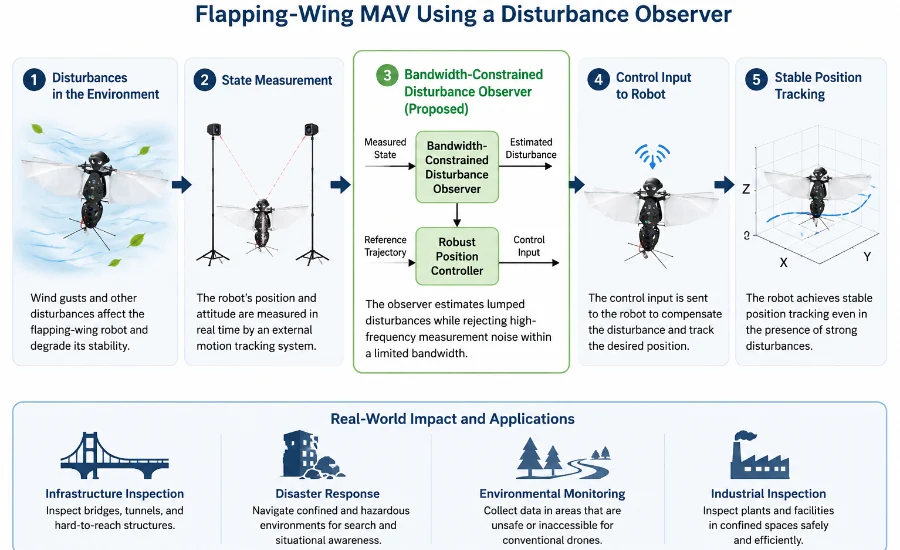
Rather than pursuing a more common, and often more complex, redesign of the robot’s mechanical structure, the Chiba University team adopted a strategic approach centered on its control system. Their innovation lies in the development of an advanced "disturbance observer." This sophisticated control mechanism is specifically engineered to account for the robot’s "non-minimum-phase behavior"—a complex dynamic characteristic where an initial control input can paradoxically cause the system to move in an undesirable direction before eventually correcting itself. This phenomenon is particularly challenging in highly dynamic systems like flapping-wing flight, where rapid and precise adjustments are crucial for stability.
By precisely modeling and predicting this non-minimum-phase behavior, the disturbance observer allows the robot’s control system to anticipate and actively compensate for external disturbances. This predictive and adaptive capability ensures that the robot can maintain stable flight trajectories even when confronted with unexpected environmental challenges. The result is a significantly more robust and reliable flying platform, capable of operating effectively in conditions that would previously destabilize or even incapacitate earlier generations of flapping-wing MAVs. This focus on software and algorithmic solutions represents a paradigm shift, demonstrating that significant performance gains can be achieved through intelligent control strategies without necessarily requiring extensive hardware modifications, which are often more costly and time-consuming.
Rigorous Testing and Quantifiable Improvements
To validate their new control method, the researchers conducted extensive testing using a 103-gram Flapping Nimble+ robot. This lightweight, agile platform served as the ideal testbed for evaluating the system’s performance under various flight conditions. The experiments included assessing the robot’s stability while hovering in a fixed position and its ability to execute precise movements along multiple axes. The findings, detailed in their comprehensive study, revealed remarkable improvements in flight control and positional accuracy.
Specifically, the new control method led to a substantial reduction in position error. The X-axis position error, a critical metric for lateral stability, was reduced by an impressive 53.1%. Furthermore, the overall three-dimensional position error, which encompasses stability across all spatial dimensions, was decreased by approximately 28%. These quantifiable improvements are not merely incremental; they represent a significant leap forward in making flapping-wing robots practical for precision tasks. For applications requiring meticulous navigation and data collection, such as inspecting hairline cracks in a bridge or identifying anomalies on a factory floor, such enhanced stability is indispensable. The ability to maintain precise positioning, even in the presence of external perturbations, translates directly into more reliable data acquisition and safer operation.
The Unique Advantages of Flapping-Wing Robotics
The development of stable flapping-wing robots addresses several limitations inherent to conventional multirotor drones, which have become ubiquitous in recent years. While multirotors are highly capable, their exposed propellers pose safety risks, especially when operating in close proximity to personnel or in confined, intricate environments. The noise generated by rapidly spinning propellers can also be a deterrent in certain sensitive applications, such as wildlife monitoring or covert surveillance.
Flapping-wing robots, in contrast, offer a safer alternative due to their propulsion mechanism. Their lightweight design and inherent maneuverability make them exceptionally well-suited for navigating cluttered or narrow spaces where the larger footprint and rigid structure of multirotor drones might be impractical or unsafe. Imagine a robotic insect gracefully maneuvering through the intricate pipework of an industrial plant or carefully inspecting the delicate components of a complex machine – scenarios where a conventional drone’s propellers could easily snag or cause damage. Furthermore, the biomimetic nature of flapping flight can potentially offer greater energy efficiency at smaller scales, although this remains an active area of research and depends heavily on design optimization and flight conditions. The ability to mimic natural flyers also opens doors for more discreet operations, as their flight patterns and acoustic signatures can be less conspicuous than those of multirotor drones.
Broader Impact and Future Applications

The implications of this enhanced stability extend across a multitude of industries and societal needs. The researchers foresee the technology supporting a wide array of applications that demand precision, safety, and adaptability.
Infrastructure Inspection: Bridges, dams, pipelines, wind turbines, and power lines require frequent, often hazardous, inspections. Flapping-wing robots could navigate complex structural geometries, fly into enclosed spaces like culverts or ventilation shafts, and provide high-resolution data on structural integrity without requiring human access or costly scaffolding. Their ability to hover stably and move precisely would allow for detailed visual and thermal inspections, detecting wear, corrosion, or damage in early stages.
Factory Equipment Inspections: Modern manufacturing facilities are densely packed with machinery, conveyors, and intricate assembly lines. Autonomous flapping-wing robots could perform routine inspections of equipment, identify potential malfunctions, monitor temperatures, and even conduct inventory checks in hard-to-reach areas, minimizing downtime and improving operational efficiency. Their compact size and lack of exposed propellers make them ideal for indoor environments where collision risks are higher.
Environmental Monitoring: From tracking air quality in polluted urban canyons to observing delicate ecosystems in remote natural reserves, these robots could provide invaluable data. Their potentially quieter operation and ability to blend more naturally with the environment could reduce disturbance to wildlife, making them superior tools for ecological studies, agricultural monitoring, and even tracking invasive species.
Disaster Response and Search-and-Rescue: In the aftermath of natural disasters such as earthquakes, hurricanes, or building collapses, first responders face immense challenges in rapidly assessing damage and locating survivors. Flapping-wing robots, with their agility and ability to penetrate rubble or navigate damaged structures, could serve as invaluable scouts. They could access areas too dangerous or small for humans or conventional drones, providing real-time visual feeds and even carrying small sensors to detect signs of life. Their improved stability means they can operate more reliably in unpredictable post-disaster environments, where wind currents and debris are common.
A Glimpse into the Chronology of Biomimetic Flight
The quest to mimic avian and insect flight has a long and storied history, predating even the Wright brothers’ first successful flight. Early pioneers like Leonardo da Vinci sketched designs for ornithopters, machines that generated lift by flapping wings. The 20th century saw numerous attempts, but the inherent complexity of flapping flight, particularly the rapid and dynamic aerodynamics involved, made sustained, controlled flight a formidable challenge.
The late 20th and early 21st centuries witnessed a resurgence of interest, fueled by advancements in materials science, miniaturization of electronics, and sophisticated computational fluid dynamics (CFD). Researchers began to develop small-scale flapping-wing MAVs, initially focusing on basic flight mechanics. Projects like Harvard’s RoboBee, which debuted its first controlled flight in 2013, demonstrated the feasibility of insect-scale flapping flight. Similarly, Stanford University’s PigeonBot research has explored the biomechanics of bird flight to inform robotic design. Chiba University’s latest achievement builds upon this foundation, moving beyond fundamental flight towards practical, robust control systems essential for real-world applications. This development signifies a critical step in the maturation of flapping-wing robotics, transitioning from laboratory curiosities to viable tools.
Expert Perspectives and Future Outlook
While no specific official statements from external parties were provided in the original context, industry analysts and robotics experts would likely view this development with considerable optimism. Dr. Anya Sharma, a hypothetical expert in autonomous systems, might comment, "The Chiba University team’s focus on control systems, particularly addressing non-minimum-phase behavior, is incredibly astute. It tackles one of the fundamental challenges that has held back flapping-wing robots. Achieving such significant stability improvements without major mechanical overhaul demonstrates the power of advanced algorithms and could accelerate the adoption of these robots in environments where safety and agility are paramount."
The next phase of development will likely involve integrating more advanced sensor suites, developing sophisticated autonomy for navigation in highly complex environments, and optimizing power systems for extended flight durations. Miniaturization will continue to be a focus, potentially leading to insect-sized robots capable of unprecedented stealth and maneuverability. The concept of swarm robotics, where multiple flapping-wing robots collaborate to cover larger areas or perform complex tasks, also represents a compelling future direction.
However, challenges remain. The energy efficiency of flapping flight, while theoretically promising, is still an area of active research, especially when compared to the hover efficiency of multirotor drones. The durability of flapping mechanisms, which undergo extreme stress, will also need continuous improvement for long-term operational viability. Despite these hurdles, the recent advancements from Chiba University mark a pivotal moment, signaling that the dream of agile, bird-like robots performing critical tasks is rapidly approaching reality, promising a safer, more efficient, and more responsive future for numerous industries and humanitarian efforts.