The Massachusetts Institute of Technology’s renowned course 2.72/2.270, "Elements of Mechanical Design," stands as a pivotal experience for both undergraduate and graduate students, offering an immersive journey into the advanced study of modeling, design, and integration. This capstone course delves deep into best practices for the precise application and understanding of fundamental machine elements such as bearings, bolts, belts, flexures, and gears, bridging the often-abstract theoretical knowledge acquired in earlier coursework with the tangible demands of real-world engineering. The curriculum is meticulously crafted to transform students into highly capable and resilient engineers, equipped to tackle the most complex challenges in modern mechanical design and manufacturing.
Professor Martin Culpepper, the esteemed Ralph E. and Eloise F. Cross Professor in Manufacturing and professor of mechanical engineering (MechE) at MIT, succinctly characterizes the course’s ambition: "Students learn how to use basically everything from the MechE undergraduate curriculum to build hardcore advanced machines." This statement underscores the course’s role as a crucible where years of foundational learning are synthesized and applied, pushing students to the very limits of their technical prowess and creative problem-solving abilities.
A Pedagogy Rooted in Rigor and Practical Application
The core of 2.72/2.270’s pedagogical approach lies in its seamless integration of rigorous theoretical analysis with intensive practical application. Students engage in modeling and analysis exercises that demand the exacting application of physics, mathematics, and core mechanical engineering principles. These theoretical explorations are not left in isolation but are immediately reinforced through extensive lab experiences, culminating in a comprehensive mechanical system design project. This iterative process ensures that students not only grasp the ‘how’ but deeply understand the ‘why’ behind every design choice and engineering decision.
Culpepper, affectionately known as Marty by his students and colleagues, articulates a primary goal for the course: "to make students into stronger engineers." His teaching methodology transcends traditional instruction, blending direct teaching with a coaching approach that actively encourages students to explore the boundaries of what is conventionally considered possible. This ethos is perhaps best captured by a maxim he frequently shares, as recounted by teaching assistant Yasin Hamed: "Marty likes to say that ‘as long as something doesn’t break the laws of physics, it’s possible. You just have to figure out how to engineer it.’" This philosophical cornerstone imbues students with an invaluable sense of agency and an unwavering belief in their capacity to innovate, pushing them to devise ingenious solutions to seemingly intractable problems.
The Ultimate Design Challenge: Crafting a Precision Lathe
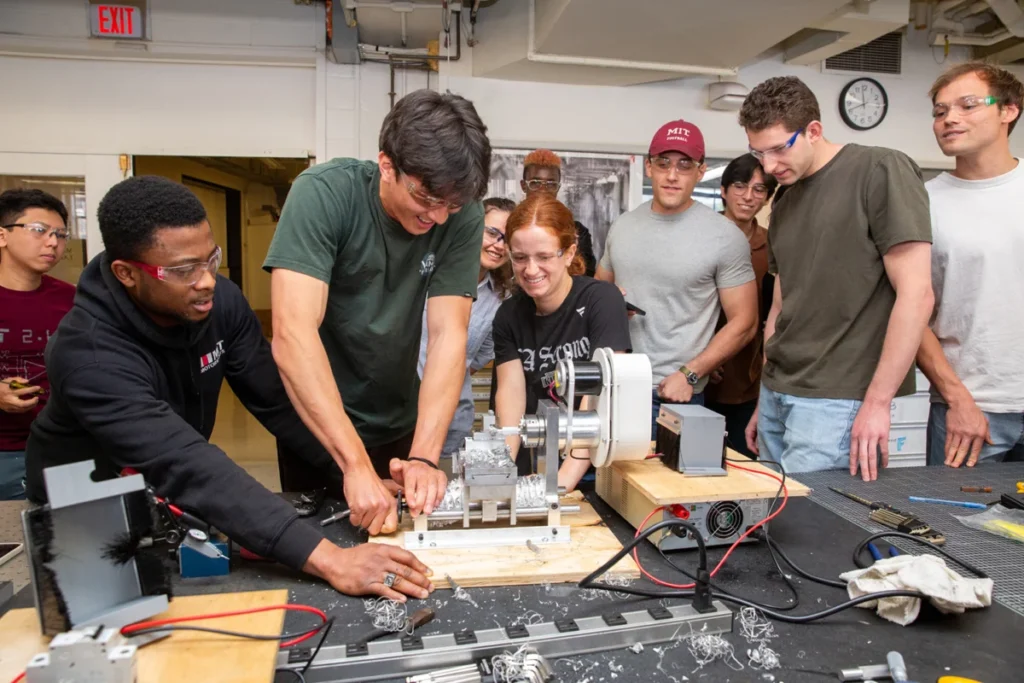
The culminating experience of 2.72/2.270 is a demanding system design project: the construction of a functional lathe. This is no ordinary workshop exercise; the student-designed and built lathes must meet stringent repeatability, accuracy, and functional requirements. A lathe, a fundamental machine tool in manufacturing, serves as an ideal platform for this project, requiring students to master principles of kinematics, structural rigidity, vibration damping, power transmission, and precision motion control. The complexity involved in designing and fabricating a machine capable of precise material removal forces students to confront the intricate interplay of various mechanical components and systems.
The project is structured around a series of escalating challenges, designed to systematically test and refine the students’ engineering capabilities. The initial hurdles focus on the core performance metrics of a machine tool: precision and material removal efficiency.
Precision Engineering: The 50-Micron Mandate
"All of our lathes are required to cut to within 50 microns of precision," explains graduate student Amber Velez. To contextualize this requirement, 50 microns (or 0.05 millimeters) is approximately half the thickness of a human hair. Achieving such a tight tolerance in a student-built machine demands a profound understanding of metrology, material science, thermal effects, and structural mechanics. Students must consider factors like bearing runout, lead screw accuracy, tool deflection, and the thermal stability of their chosen materials. They employ advanced measurement techniques and meticulous assembly processes, often involving iterative design and calibration, to meet this exacting standard. This challenge instills a deep appreciation for the subtle nuances of precision engineering, a skill paramount in industries ranging from aerospace and biomedical devices to microelectronics and advanced manufacturing.
Material Removal Rate Competition: The Race Against the Clock
Following the precision challenge, students face the material removal rate competition. Here, teams vie to demonstrate the efficiency and robustness of their lathe designs by turning down a piece of stock by one inch in the fastest possible time. This competition pushes students to optimize power transmission, cutting tool geometry, machine rigidity, and control strategies to maximize material removal without compromising surface finish or machine integrity. Velez’s team, for instance, achieved an impressive feat, completing this task in approximately 27 seconds – a testament to the high-performance capabilities they engineered into their machine. Such a challenge mirrors real-world manufacturing scenarios where efficiency and throughput are critical drivers of productivity and cost-effectiveness.
The "Marty’s Death Test": A Lesson in Resilience and Robustness
The ultimate trial for the student-designed lathes is famously known as "Marty’s death test." Graduate student Sarah Stoops describes it with a mix of apprehension and respect: "Marty takes all our lathes and drops them and hits them with a hammer, and if they explode, you don’t pass the class." While seemingly harsh, this unconventional final examination serves a profound pedagogical purpose. As Amber Velez further elaborates, it’s a brutal yet effective way to assess the robustness, durability, and fault tolerance of the designs.
This "death test" goes beyond mere destruction; it simulates extreme operational conditions and forces students to consider failure modes and design for resilience. In the real world, machines are subjected to stresses, vibrations, and occasional impacts. An engineer’s ability to anticipate and mitigate these factors is crucial for creating reliable and long-lasting products. The experience, while intense, instills critical lessons in material selection, joint design, structural integrity, and the importance of over-engineering for critical components.
Hannah Gazdus, another teaching assistant for the course, highlights the invaluable skills fostered by this demanding process: "The students are very resilient. They learn to persevere and take some time to try and figure things out, and through that process… you learn so much." This sentiment underscores that the test is not just about the machine’s survival but about the students’ growth in the face of adversity, developing mental toughness and a problem-solving mindset that will serve them throughout their careers.
Bridging Theory and Practice: The Confidence of a Working Engineer
The overarching goal of 2.72/2.270 is to bridge the gap between theoretical knowledge and practical application, a challenge often faced in traditional engineering curricula. Yasin Hamed eloquently articulates this: "The core classes are important – things like mechanics, materials, dynamics, controls – but many of them have a degree of abstraction that separates the content within those courses from the mechanical elements that you use in designing an actual machine." He continues, "I feel like this class serves very well to bridge that [and] inspire that confidence as working engineers."
This course acts as a vital integrator, demonstrating how the fundamental principles learned in separate disciplines converge in the design and construction of a functional machine. Students learn to apply complex equations of motion to select appropriate bearings, to calculate stress concentrations in bolted joints, to design gear trains for specific speed and torque requirements, and to understand the compliant behavior of flexures for precision alignment. This holistic approach is crucial for cultivating engineers who are not just academically proficient but also practically competent and confident in their abilities to bring theoretical concepts to life.
The Broader Impact: Cultivating the Next Generation of Innovators
The "Elements of Mechanical Design" course at MIT is more than just an advanced technical class; it is a microcosm of real-world engineering challenges, designed to forge the next generation of innovators and problem-solvers. The skills honed in 2.72/2.270 — precision engineering, robust design, rapid prototyping, iterative development, and the resilience to overcome failure — are highly sought after across a spectrum of industries. Graduates of this course are uniquely prepared for roles in advanced manufacturing, robotics, aerospace, automotive, medical device development, and sustainable energy systems, where the ability to design, build, and test complex machines is paramount.
The emphasis on hands-on learning, combined with a rigorous theoretical foundation, reflects MIT’s enduring commitment to "mens et manus" (mind and hand). This philosophy, central to the Institute since its founding in 1861, champions the integration of intellectual inquiry with practical application. In an era of rapid technological advancement, the demand for engineers who can translate abstract concepts into tangible, high-performing machines is greater than ever. Courses like 2.72/2.270 ensure that MIT continues to produce graduates who are not just knowledgeable, but truly capable of engineering the future. The experience of designing, building, and ultimately defending a machine against "Marty’s death test" instills a profound sense of accomplishment and an unwavering confidence that extends far beyond the classroom, preparing students for the rigors and rewards of a professional engineering career.