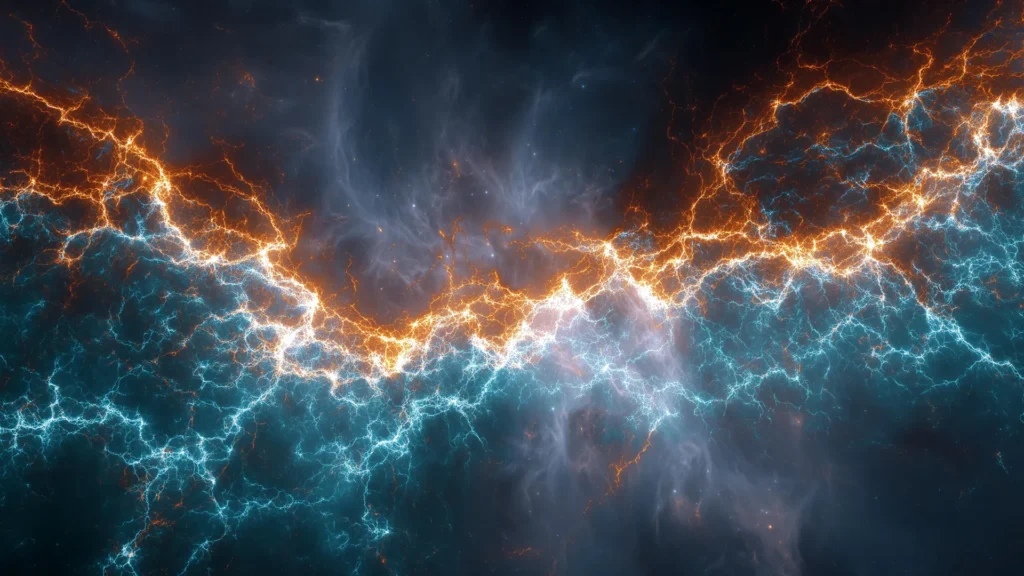
The vast expanse of the cosmos is permeated by magnetic fields, invisible yet potent forces that govern the behavior of matter from the smallest subatomic particles to the largest galactic clusters. These fields are foundational to the architecture of the universe, influencing the birth of stars, the violent accretion of matter around black holes, and the trajectory of high-energy cosmic rays. However, for more than seven decades, a fundamental paradox has perplexed the scientific community: if the universe is dominated by turbulent, chaotic motion, how do the massive, highly organized magnetic fields observed by astronomers come into existence?
A groundbreaking study led by researchers at the University of Wisconsin–Madison, published recently in the journal Nature, suggests that the answer lies in the way turbulent plasma develops organized, jet-like flows. By utilizing some of the world’s most powerful supercomputers to simulate the intricate dance of plasma, the team has identified a "missing piece" of the cosmic puzzle. This discovery provides a long-sought explanation for the "dynamo effect" at a universal scale, offering new insights into the evolution of galaxies and the mechanisms behind space weather that can disrupt technology on Earth.
The Mystery of the Cosmic Dynamo
The study of magnetic field generation, known in physics as the dynamo problem, dates back to the early 20th century. Scientists have long understood that the motion of conducting fluids—such as the molten iron in Earth’s core or the ionized gas (plasma) that makes up stars—can generate magnetic fields. This process converts mechanical energy from motion into magnetic energy.
However, theoretical models have historically struggled to align with physical observations. While turbulence is excellent at generating small, tangled, and short-lived magnetic fields, it is naturally a destructive force. In most simulations, turbulence tends to break down large structures rather than build them. Astronomers, conversely, observe magnetic fields that are remarkably stable and span thousands of light-years across galaxies.
"Magnetic fields across the cosmos are large-scale and ordered, but our understanding of how these fields are generated is that they come from some kind of turbulent motion," explains Bindesh Tripathi, the study’s lead author and a postdoctoral researcher at Columbia University who conducted the research as a graduate student at UW–Madison. "Given that turbulence is known to be a destructive agent, the question remains: how does it create a constructive, large-scale field?"
The disconnect between the chaotic nature of plasma and the orderly nature of cosmic magnetism has been one of the most significant "frustrating results" in astrophysics, according to Paul Terry, a physics professor at UW–Madison and senior author of the study. For 70 years, the fields generated in models almost always ended up at small scales and highly disordered, failing to mirror the reality of the deep sky.
A Breakthrough in Three Dimensions
The path to this discovery began with a shift in perspective. Tripathi’s earlier work focused on two-dimensional (2D) magnetic fields and fluid flows. While 2D models are computationally easier to manage, they often miss the complex "twisting" and "folding" dynamics essential to 3D magnetic field generation. Upon examining high-resolution visualizations of 3D magnetic turbulence, Tripathi noticed a recurring pattern: the largest magnetic structures seemed to mirror the shapes of large-scale flows within the plasma.
To test this observation, the research team had to overcome immense computational hurdles. Simulating magnetic fields in a 3D environment requires solving complex magnetohydrodynamic (MHD) equations across billions of points in space and time. To achieve the necessary level of detail, the team turned to the Anvil supercomputer at Purdue University.
The scope of the simulation was unprecedented. The researchers utilized 137 billion grid points in a 3D volume, performing roughly 90 individual simulations. This massive undertaking consumed nearly 100 million CPU hours and generated 0.25 petabytes of data—equivalent to roughly 250,000 gigabytes. This level of granularity allowed the researchers to observe the transition from micro-scale chaos to macro-scale order in real-time.
The Role of Velocity Gradients
The "secret ingredient" identified by the UW–Madison team was the presence of a steady, large-scale velocity gradient. A velocity gradient exists when different layers of a fluid or plasma move at different speeds. In the vacuum of space, these gradients are ubiquitous; they are found in the differential rotation of stars, the swirling disks around black holes, and the massive flows of gas within galaxies.
To illustrate the concept, Tripathi uses the analogy of a cyclist. If a cyclist hits a curb, the bike stops abruptly, but the rider’s body continues forward. This sudden difference in speed between the bike and the rider creates a sharp velocity gradient. In the cosmos, these gradients act as an organizing force.
The team’s simulations began with a flow containing a velocity gradient, into which they introduced "tiny perturbations"—infinitesimal movements of fluid particles. Initially, these perturbations triggered small-scale turbulence and disorganized magnetic fluctuations. However, as the simulation progressed, the velocity gradient acted as a template. The turbulence did not simply dissipate; it organized itself into "jet-like flows." These jets, in turn, acted as the scaffolding upon which large-scale, ordered magnetic fields could grow.
Crucially, when the researchers ran the same simulations without the large-scale velocity gradient, the order never emerged. The system remained a chaotic "soup" of small-scale magnetic noise. This confirmed that the gradient is the essential catalyst for transforming destructive turbulence into a constructive architect of cosmic order.
Chronology of Research and Experimental Validation
The journey toward this conclusion was marked by several key milestones in both theoretical and experimental physics:
- 1950s–2010s: The "Dynamo Theory" remains the primary explanation for celestial magnetism, but models consistently fail to produce large-scale fields from turbulent inputs.
- 2012: Experiments at the Wisconsin Plasma Physics Laboratory (WiPPL) observe unexpected magnetic behaviors in lab-controlled plasma. Existing theories cannot account for the level of organization seen in the experiments.
- 2020–2023: Tripathi and the UW–Madison team begin massive 3D simulations on the Anvil supercomputer, specifically looking for the link between velocity gradients and magnetic structure.
- 2024: The team publishes their findings in Nature, demonstrating that the "jet-like flows" driven by velocity gradients are the primary drivers of large-scale magnetic fields.
While these findings were derived from computer models, they are supported by physical evidence. The researchers noted that their new model aligns closely with the puzzling data recorded during the 2012 WiPPL experiments. This bridge between laboratory plasma physics and theoretical astrophysics provides a robust validation of the team’s conclusions.
Implications for the Future of Astrophysics
The discovery has far-reaching implications for several branches of science, most notably in the emerging field of multimessenger astronomy.
Black Holes and Neutron Stars
When neutron stars merge or when matter falls into a black hole, the resulting environment is incredibly turbulent and governed by extreme gravity. These events produce gravitational waves and electromagnetic radiation. Understanding how magnetic fields organize themselves in these high-energy environments is critical for interpreting the signals received by Earth-based detectors like LIGO and Virgo. The UW–Madison study provides a framework for predicting how magnetic fields behave during these violent cosmic mergers.
Space Weather and Solar Dynamics
Closer to home, the study offers a better understanding of the Sun’s magnetic cycle. The Sun is a massive ball of plasma with significant velocity gradients. These gradients drive the solar dynamo, which creates sunspots and solar flares. When the Sun ejects massive clouds of plasma (Coronal Mass Ejections) toward Earth, they can damage satellites, disrupt GPS, and threaten power grids. By understanding how large-scale fields form within the Sun, scientists can improve early-warning systems for space weather.
Galactic Evolution
On a grander scale, magnetic fields play a role in "galactic feedback"—the process by which energy from stars and black holes influences the formation of new stars. If magnetic fields are as organized as this study suggests, they likely play a much larger role in directing the flow of gas within galaxies than previously thought, potentially altering our understanding of how the universe evolved over billions of years.
Conclusion
The research, supported by the National Science Foundation and the U.S. Department of Energy, marks a turning point in a 70-year scientific quest. By proving that order can emerge from chaos through the simple presence of a velocity gradient, Tripathi and his colleagues have solved a fundamental mystery of the night sky.
"This work potentially resolves a long-standing issue," says Paul Terry. As astronomers continue to map the magnetic web of the universe, they now have a theoretical map that finally matches the reality of the cosmos. The "invisible hands" that shape the stars are no longer quite so mysterious, revealing a universe where even the most violent turbulence contains the seeds of profound order.