Designers, engineers, manufacturers, and hobbyists alike have come to rely on the transformative power of 3D printing for rapid prototyping. This technology allows for the swift creation of functional objects, ranging from intricate movie props and custom medical implants to architectural models and bespoke consumer goods. However, a persistent challenge in the 3D printing workflow has been the disconnect between the digital preview of a design and its final physical manifestation. Traditional software often prioritizes functional accuracy, leaving users to guess how the chosen material will truly appear in terms of color, texture, gloss, and translucency. This discrepancy frequently leads to costly and time-consuming reprints, contributing significantly to material waste and project delays.
Addressing this critical gap, researchers from the Massachusetts Institute of Technology (MIT) and collaborating institutions have unveiled VisiPrint, an innovative, artificial intelligence-powered tool designed to revolutionize the 3D printing preview experience by placing aesthetic realism at the forefront. This groundbreaking system empowers users to achieve a far more accurate visual representation of their intended creations, significantly reducing the likelihood of unexpected material outcomes and subsequent reprints.
The Genesis of VisiPrint: Addressing a Persistent Problem
The journey to VisiPrint began with a clear recognition of a pervasive issue within the 3D printing community. Studies have indicated that a substantial portion of 3D printing material, sometimes as high as one-third, ends up in landfills, often as discarded prototypes that failed to meet aesthetic expectations. Maxine Perroni-Scharf, an electrical engineering and computer science (EECS) graduate student at MIT and lead author of the research paper detailing VisiPrint, emphasized the environmental and economic imperative behind their work. "3D printing can be a very wasteful process," Perroni-Scharf stated. "To make 3D printing more sustainable, we want to reduce the number of tries it takes to get the prototype you want. The user shouldn’t have to try out every printing material they have before they settle on a design."
The development of VisiPrint is a direct response to this call for greater efficiency and sustainability in additive manufacturing. The research, presented at the prestigious ACM CHI Conference on Human Factors in Computing Systems, represents a significant leap forward in bridging the gap between digital design and physical reality.
How VisiPrint Works: An AI-Powered Aesthetic Engine
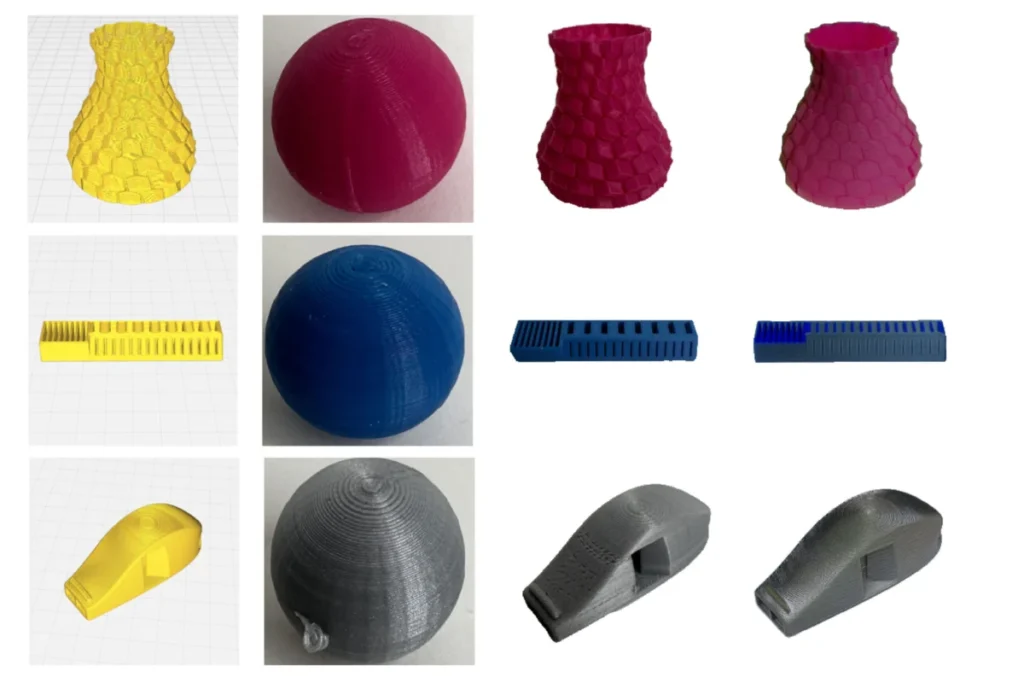
At its core, VisiPrint leverages the power of artificial intelligence to generate highly realistic previews of 3D printed objects. The system operates on a user-friendly input mechanism, requiring two primary components: a screenshot of the object’s digital design as generated by standard 3D printing "slicer" software, and a single image of the intended print material. This material image can be sourced from online databases or captured directly from a physical sample.
Once these inputs are provided, VisiPrint’s sophisticated AI models spring into action. A computer vision model meticulously analyzes the material sample, extracting key visual characteristics that dictate its aesthetic properties. These extracted features, which include not only the base color but also nuanced aspects like glossiness, translucency, and inherent texture, are then fed into a generative AI model. This generative model then constructs a realistic rendering of the final object, meticulously accounting for the specific geometry of the design and, crucially, the precise "slicing" pattern—the layer-by-layer path the 3D printer’s nozzle will follow during fabrication.
The key to VisiPrint’s success lies in its unique "conditioning" method. This advanced technique involves carefully fine-tuning the AI models to ensure they adhere strictly to the constraints of the 3D printing process. The researchers developed a specialized approach that utilizes a depth map to preserve the object’s shape and shading, alongside an edge map that highlights internal contours and structural boundaries. This dual-map conditioning is vital for achieving both accurate geometry and a faithful representation of the material’s behavior under the stresses of the printing process.
"If you don’t have the right balance of these two things, you could end up with bad geometry or an incorrect slicing pattern. We had to be careful to combine them in the right way," explained Perroni-Scharf, underscoring the technical intricacies involved in ensuring both functional and aesthetic fidelity.
Beyond Color: Capturing Material Nuances
A significant challenge in 3D printing previews is that the material itself often undergoes a transformation during the printing process, particularly in common methods like Fused Deposition Modeling (FDM). In FDM, thermoplastic filament is melted and extruded layer by layer. This melting and extrusion process, combined with the height of each deposited layer and the precise path of the nozzle, can alter a material’s inherent appearance. VisiPrint’s AI is designed to account for these transformations, predicting how the material will look after it has been printed, not just as a raw filament.
The system’s ability to consider factors beyond simple color is a critical differentiator. It analyzes and replicates how a material’s glossiness will manifest, how its translucency will affect light interaction, and how the subtle variations in layer deposition can influence the overall visual texture. This holistic approach ensures that the generated preview is a far more reliable indicator of the final product’s appearance than anything currently available in standard 3D printing software.
Applications Across Industries: From Dentistry to Architecture
The implications of VisiPrint are far-reaching, with potential applications across a diverse range of sectors. In the field of dentistry, for instance, clinicians frequently create temporary crowns and bridges using 3D printing. Ensuring these temporary restorations aesthetically match a patient’s natural teeth is paramount for patient satisfaction and confidence. VisiPrint could enable dentists to visualize how a specific tooth-colored resin will appear before printing, guaranteeing a better match and reducing the need for reprints.
Similarly, in architecture, 3D printed models are indispensable for visualizing designs and presenting them to clients. The visual impact of a proposed building or urban development can be significantly influenced by the materials used in its model. VisiPrint could allow architects to preview how different filament colors and finishes will affect the perceived texture and overall aesthetic of their scale models, leading to more informed design decisions and more compelling presentations.
Other potential applications include:
- Consumer Product Design: Allowing designers to accurately predict how materials will look on final products, from electronics casings to home decor items.
- Art and Sculpture: Enabling artists to preview the final surface finish and color of their 3D printed artworks.
- Education: Providing students with a more intuitive understanding of material properties and their impact on 3D printed objects.
A User-Centric Interface and Evaluation
Recognizing that advanced AI capabilities must be coupled with user-friendliness, the VisiPrint research team also developed an intuitive interface. This platform allows users to easily upload their design and material images, review the generated previews, and even fine-tune certain parameters. For more advanced users, VisiPrint offers the ability to adjust settings that influence how specific colors or material properties affect the final appearance.
It is important to note that VisiPrint is designed to complement, rather than replace, existing functional previews provided by slicer software. While VisiPrint excels at predicting aesthetics, it does not assess printability, mechanical feasibility, or the likelihood of print failures. This dual-preview approach—functional from the slicer, aesthetic from VisiPrint—provides users with a comprehensive understanding of their impending print.
To validate the effectiveness of VisiPrint, the researchers conducted a user study that pitted the system against other preview methods. The results were overwhelmingly positive. Nearly all participants reported that VisiPrint provided superior overall appearance and a more accurate textural similarity to actual printed objects. Furthermore, the preview generation process was remarkably efficient, averaging around one minute—more than twice as fast as competing AI-based methods.
"VisiPrint really shined when compared to other AI interfaces," remarked Perroni-Scharf. "If you give a more general AI model the same screenshots, it might randomly change the shape or use the wrong slicing pattern because it had no direct conditioning." This highlights the targeted nature of VisiPrint’s AI, specifically engineered for the nuances of 3D printing.
The Future of VisiPrint and Sustainable Manufacturing
Looking ahead, the VisiPrint team has ambitious plans for further development. They aim to address potential artifacts that can arise when rendering extremely fine details in model previews. Additionally, they intend to expand the system’s capabilities to allow users to optimize aspects of the printing process beyond just material color, potentially including surface finish and other fabrication-specific properties.
"It is important to think about the way that we fabricate objects," Perroni-Scharf concluded. "We need to continue striving to develop methods that reduce waste. To that end, this marriage of AI with the physical making process is an exciting area of future work."
The sentiment is echoed by Patrick Baudisch, a professor of computer science at the Hasso Plattner Institute, who was not involved in the research but offered his perspective. "‘What you see is what you get’ has been the main thing that made desktop publishing ‘happen’ in the 1980s, as it allowed users to get what they wanted at first try. It is time to get WYSIWYG for 3D printing as well. VisiPrint is a great step in this direction."
This groundbreaking work was made possible through generous funding from sources including an MIT Morningside Academy for Design Fellowship and an MIT MathWorks Fellowship, underscoring the institutional support for pioneering research in this critical field. VisiPrint represents not just an advancement in 3D printing technology, but a significant stride towards more sustainable, efficient, and visually predictable manufacturing processes.
Broader Implications and the Path Forward
The development of VisiPrint signals a potential paradigm shift in how we approach 3D printing. By prioritizing aesthetic accuracy, the technology directly tackles a significant source of waste and inefficiency. This has profound implications for the economic viability of 3D printing, particularly for small businesses and individual makers who operate with tighter budgets. Reducing the number of failed prints translates directly into lower material costs, less labor, and faster turnaround times, making 3D printing more accessible and competitive.
Furthermore, the increased predictability offered by VisiPrint could foster greater innovation. When designers can reliably envision the final appearance of their creations, they may be more inclined to experiment with novel materials and complex geometries, pushing the boundaries of what is possible with additive manufacturing. This could lead to the development of entirely new product categories and solutions across various industries.
The research also highlights the growing synergy between artificial intelligence and physical manufacturing processes. As AI models become more sophisticated and better integrated with real-world systems, we can expect to see further innovations that bridge the digital and physical realms. VisiPrint serves as a compelling example of how AI can be applied to solve practical, long-standing problems, making complex technologies more intuitive and effective for a wider audience. The journey towards truly "what you see is what you get" in 3D printing is well underway, with VisiPrint paving the way for a more visually accurate and environmentally conscious future for making.