In 1985, a modest advertisement in the pages of Scientific American by the Innovative Design Fund offered a tantalizing opportunity: up to $10,000 to support the development of "clever prototypes" across a spectrum of everyday objects, from wearable fashion to home furnishings and textiles. This call to innovation resonated with William Freeman, then an electrical engineer at Polaroid and a graduate of MIT (Class of ’92). Freeman, now a distinguished professor at MIT, envisioned a radical departure from the ubiquitous two-sided zipper. His proposal was for a three-sided zipper, a mechanism designed not for closure in the traditional sense, but as a transformative switch. This novel device, he theorized, could seamlessly transition objects like chairs, tents, and purses between a soft, pliable state and a rigid, structured form, dramatically simplifying packing and assembly processes.
Freeman’s initial design, detailed in a patent application, bore a striking resemblance to a conventional zipper but with a crucial triangular twist. Each of the three sides was equipped with a belt system that engaged with narrow, wooden "teeth." A specialized slider, designed to encircle the entire apparatus, could be moved to interlock these three strips, effectively forming a rigid triangular tube. Despite the ingenuity of his concept, Freeman’s proposal did not secure funding from the Innovative Design Fund. Undeterred, he proceeded to patent his prototype and stored it in his garage, a testament to his belief in its future utility.
Nearly four decades later, this forgotten invention has been resurrected by researchers at the Massachusetts Institute of Technology’s Computer Science and Artificial Intelligence Laboratory (CSAIL). The CSAIL team, driven by a desire to create objects with "tunable stiffness"—that is, the ability to dynamically alter their rigidity—has transformed Freeman’s concept into a sophisticated, digitally controlled system. Previous attempts to achieve variable stiffness in objects often proved difficult to reverse, required manual manipulation, or were simply not practical for widespread application. The CSAIL researchers have addressed these limitations by developing an automated design tool and an adaptable fastener, christened the "Y-zipper."
The Genesis of the Y-Zipper: From Garage to Lab
The journey of the Y-zipper began with William Freeman’s innovative spirit. In the mid-1980s, the landscape of product design and materials science was different. While early forms of adjustable structures existed, the idea of a single, integrated mechanism that could fundamentally alter an object’s form factor in a reversible manner was groundbreaking. Freeman’s insight was to leverage the familiar mechanics of a zipper and adapt them to a three-dimensional configuration, enabling a more complex and dynamic transformation.
Timeline of Development:
- 1985: William Freeman conceives of and patents a three-sided zipper mechanism. His proposal to the Innovative Design Fund, seeking up to $10,000, is rejected.
- Late 1980s – Early 2000s: Freeman’s patented design remains in storage, awaiting technological advancements that could bring it to fruition.
- Early 2020s: MIT CSAIL researchers, aiming to develop materials with tunable stiffness, rediscover Freeman’s patent and concept.
- 2020s: The CSAIL team develops an automated design tool and the "Y-zipper," a digitally controlled, 3D-printable version of Freeman’s idea.
- April [Year of Publication]: The research on the Y-zipper is presented at the ACM’s Computer-Human Interaction (CHI) conference on Human Factors in Computing Systems.
The Technological Leap: Automation and Adaptability
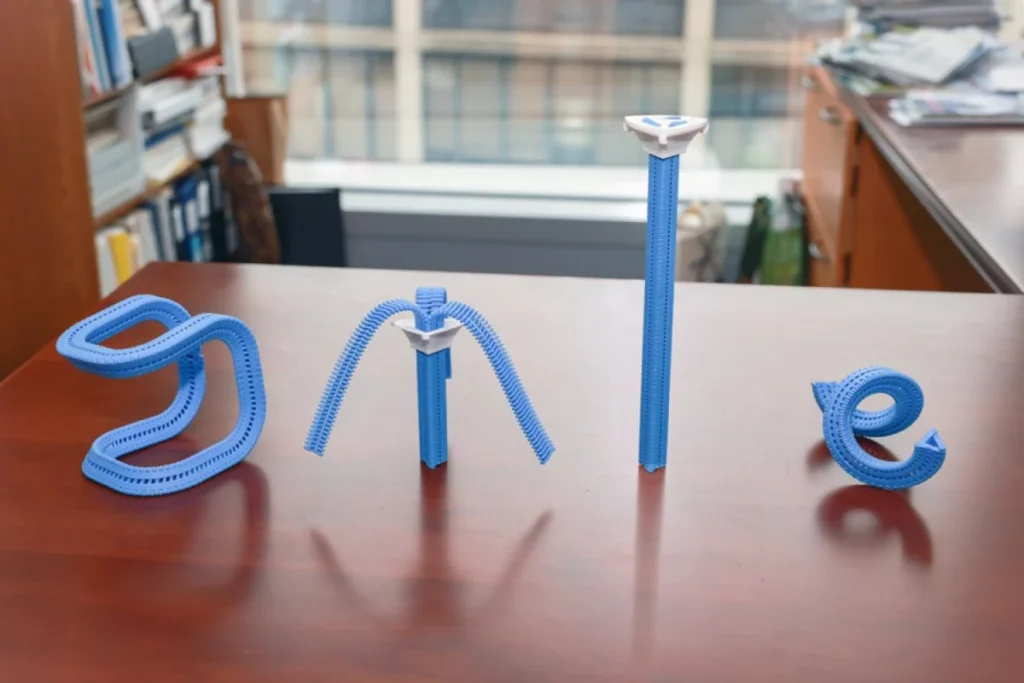
The core of the CSAIL team’s innovation lies in its sophisticated software program, which empowers users to customize their own three-sided zippers. This digital tool allows for precise control over various design parameters. Users can specify the length of each of the three zipper strips and dictate the precise direction and angle at which they will bend when fastened. This level of customization extends to the very "motion primitives" the zipper can achieve, offering four distinct forms when zipped: straight, bent (resembling an arch), coiled (like a spring), or twisted (mimicking a screw).
Once designed, these custom Y-zippers are brought to life through advanced 3D printing technology, utilizing a range of plastics. The resulting devices are not merely functional fasteners; they are integrated components capable of transforming the very nature of the objects they are attached to or embedded within. Potential applications span a wide array of fields, including camping equipment, medical gear, robotics, and even artistic installations, promising unprecedented ease of assembly and enhanced functionality.
Jiaji Li, an MIT postdoc and CSAIL researcher and a lead author on the open-access paper detailing this project, elaborates on the significance of this development. "A regular zipper is great for closing up flat objects, like a jacket, but Freeman ideated something more dynamic," Li stated. "Using current fabrication technology, his mechanism can transform more complex items. We’ve developed a process that builds objects you can rapidly shift from flexible to rigid, and you can be confident they’ll work in the real world."
The "Shape-Shifting" Capabilities of the Y-Zipper
The Y-zipper’s ability to transition between states allows for remarkable "shape-shifting" capabilities in real-world applications. When unzipped, it can adopt an organic, almost tentacle-like form, reminiscent of a squid. Conversely, when zipped, it consolidates into a more compact and rigid structure, such as a rod. This inherent flexibility has profound implications for practicality, particularly in scenarios demanding efficiency and ease of use.
Consider the task of pitching a tent. Traditional methods can be time-consuming and require multiple steps. With the Y-zipper, this process could be revolutionized. By attaching each of the zipper’s arms to the tent’s structure, the Y-zipper could act as an integral support system. When actuated, it would seemingly "pop" the canopy into place, transforming a potentially laborious setup that might take six minutes into a swift, 1 minute and 20-second operation. This is a significant time saving, especially in challenging outdoor conditions or during urgent situations.
Medical and Robotic Applications: Precision and Adaptability
Beyond outdoor gear, the Y-zipper’s seamless transition between states holds immense promise for medical applications, particularly in the realm of wearables. Imagine a wrist cast designed for injury recovery. A Y-zipper integrated into the cast could allow a patient to loosen the support during the day for comfort and then tighten it at night to prevent further injury or promote healing. This adaptability moves beyond rigid, static medical devices, offering a more dynamic and patient-centric approach to care. The ability to adjust a seemingly stiff device to meet individual needs enhances comfort and potentially improves therapeutic outcomes.
The system also opens doors for creating technology that can adapt its form at the push of a button. By attaching a motor to the Y-zipper, the zipping process can be automated, enabling the construction of dynamic robotic systems. One compelling example is an adaptive robotic quadruped. Such a robot could dynamically alter the size of its legs, extending them for taller stances or retracting them for a lower profile. This rapid adjustment capability would be invaluable for navigating complex and uneven terrains, such as canyons or forests, allowing the robot to explore environments that are currently inaccessible to many existing robotic platforms.
Furthermore, actuated Y-zippers can be employed to create captivating dynamic art installations. The research team has demonstrated this potential by constructing a long, winding flower sculpture that "blooms" and changes form as a static motor actuates the Y-zipper mechanism. This fusion of engineering and art showcases the Y-zipper’s versatility beyond purely functional applications.
Mastering the Material: Durability and Future Potential
While the creative and functional potential of the Y-zipper is undeniable, a critical question remained: its durability. Could these 3D-printed mechanisms withstand the rigors of daily use? The CSAIL team undertook a series of rigorous stress tests to answer this.
Material Testing and Durability:
The researchers began by evaluating the strength and flexibility of two common 3D printing plastics: polylactic acid (PLA) and thermoplastic polyurethane (TPU). Using a specialized machine that subjected the Y-zippers to bending forces, they determined that PLA exhibited superior load-bearing capacity, while TPU offered greater pliability.
To assess the zipper’s lifespan under repeated use, CSAIL researchers employed an actuator to continuously cycle the Y-zipper open and closed. The results were impressive: the devices endured approximately 18,000 cycles before eventually failing. This remarkable longevity is attributed, in part, to the Y-zipper’s inherent elastic structure, which effectively distributes stress across the entire mechanism, preventing localized points of failure.
Looking ahead, Jiaji Li envisions further advancements. The team aims to develop even more durable three-sided zippers by exploring stronger materials, such as metals. Scaling up the Y-zipper for larger projects is another future objective, though this currently presents challenges for their existing 3D printing platform.
Broader Implications and Unexplored Frontiers
The implications of the Y-zipper extend far beyond its current demonstrated applications. Li points to the potential for space exploration, where Y-zipper tentacles could be integrated into spacecraft to deftly grasp nearby rock samples. The ability to rapidly assemble structures is also a critical advantage in disaster relief scenarios. Imagine embedded Y-zippers enabling relief workers to quickly erect shelters or medical tents in the wake of natural disasters or during rescue operations, significantly reducing setup time and improving the efficiency of aid delivery.
Guanyun Wang, an assistant professor at Zhejiang University who was not involved in the research but has reviewed the findings, lauded the innovative approach. "Reimagining an everyday zipper to tackle 3D morphological transitions is a brilliant approach to dynamic assembly," Wang commented. "More importantly, it effectively bridges the gap between soft and rigid states, offering a highly scalable and innovative fabrication approach that will greatly benefit the future design of embodied intelligence." This sentiment underscores the Y-zipper’s potential as a foundational technology for future advancements in robotics, adaptive materials, and intelligent systems.
The research paper detailing the Y-zipper was authored by Jiaji Li and William Freeman, alongside Tianjin University PhD student Xiang Chang. Contributing to the paper from MIT CSAIL were PhD student Maxine Perroni-Scharf, undergraduate Dingning Cao, and recent visiting researchers Mingming Li (Zhejiang University), Jeremy Mrzyglocki (Technical University of Munich), and Takumi Yamamoto (Keio University). The work was also overseen by MIT Associate Professor Stefanie Mueller, a CSAIL principal investigator and senior author on the publication. The research received support from a postdoctoral research fellowship from Zhejiang University and the MIT-GIST Program.
The groundbreaking work on the Y-zipper was formally presented to the scientific community in April at the ACM’s premier Computer-Human Interaction (CHI) conference on Human Factors in Computing Systems, marking a significant milestone in the evolution of adaptable and dynamic material design. This project, born from a forgotten patent and brought to life by cutting-edge research, represents a profound leap forward in how we conceive, construct, and interact with the physical world around us.