The global construction industry, a cornerstone of human development, faces a critical environmental challenge: the pervasive use of concrete, the world’s most consumed material after water. Concrete production accounts for an estimated 8% of global carbon dioxide emissions, a significant contributor to climate change. In a pivotal development poised to reshape sustainable construction, a team of researchers at the Massachusetts Institute of Technology (MIT) has pioneered a groundbreaking framework that bridges the gap between theoretical structural perfection and the practical realities of large-scale 3D concrete printing. This innovative approach embeds the physical limitations of robotic printers directly into the design process, enabling the creation of complex, material-efficient structures that are both mathematically optimal and readily manufacturable.
This advancement, detailed in a recent publication in the esteemed journal Additive Manufacturing, addresses a long-standing hurdle in the field of additive manufacturing for construction. While computational tools like topology optimization excel at identifying the most structurally sound designs using the least amount of material—often resulting in intricate, lattice-like geometries—these mathematically idealized forms have historically been beyond the capabilities of existing concrete printing hardware. The limitations stem from the inherent constraints of these large-scale robotic systems, including the thickness of the extruded concrete material, the restricted maneuverability of the printing nozzle, and the critical requirement for a continuous printing motion. These practical considerations have often rendered the most efficient computer-generated designs unbuildable without extensive manual intervention and redesign.
The MIT team’s framework tackles this "design-to-manufacture" disconnect head-on. By incorporating the real-world fabrication constraints of concrete printers directly into the optimization algorithms, the system generates designs that machines can reliably produce. This eliminates the time-consuming and often inefficient process of post-design modification, allowing for the creation of printable structures with minimal or no manual rework.
"We were encountering a significant disconnect when trying to translate these highly optimized designs into something that could actually be manufactured," explained Hajin Kim-Tackowiak, a postdoctoral researcher in MIT’s Department of Civil and Environmental Engineering (CEE) and a co-first author of the study. "The mathematically ideal shapes, while beautiful in their efficiency, often contained sharp angles or intricate details that our large-scale printers simply couldn’t replicate. These weren’t just minor imperfections; they were like chasms preventing us from building."
Designing for the Real World: A Collaborative Approach
To meticulously identify and quantify these practical limitations, the MIT researchers actively engaged with experts in the field through the Autodesk Research Residency Program. This collaboration provided direct access to the cutting-edge large-scale printing machines at Autodesk’s Technology Center in Boston, offering invaluable insights into the nuances of robotic concrete extrusion.
"The engineers operating the machines were instrumental," Kim-Tackowiak noted. "They would point to specific design elements, like sharp internal angles, and express concerns about the structural integrity and feasibility of printing such features. Their feedback was crucial in defining the boundaries of what is currently possible."
Through these direct interactions, three primary constraints emerged as critical: the minimum required thickness of each extruded bead of concrete, the maximum permissible turning radius of the printing nozzle, and the necessity for a single, uninterrupted printing path. The research team then translated each of these physical limitations into precise mathematical rules that were integrated into their optimization framework.
This integrated approach represents a significant departure from traditional methods, which often involve optimizing a shape first and then attempting to adapt it for manufacturing. Such sequential processes can be exceptionally time-consuming, with topology optimization alone potentially taking days to run and requiring substantial post-processing. In contrast, the MIT team’s framework can generate fully printable designs in a matter of minutes – approximately two minutes on a standard laptop. This rapid iteration capability proved invaluable when the team needed to make minor adjustments to their bridge design on the day of printing; rerunning the optimization yielded an updated, printable design in under ten minutes.
"Achieving this level of speed is a relatively recent breakthrough in the field," commented Zane Schemmer, a PhD student in CEE and another co-first author of the study. "The underlying mathematical technique, known as mixed-integer optimization, was historically considered too computationally intensive for such complex problems. Even just a few years ago, the solvers we rely on today would have struggled to handle these calculations." Schemmer emphasized that the field has largely shied away from these advanced optimization methods due to perceived computational barriers. "But with the development of new algorithms and increased computational resources, these approaches are now becoming viable pathways for solving complex design and manufacturing challenges."
A Landmark Bridge Reveals the True Bottleneck
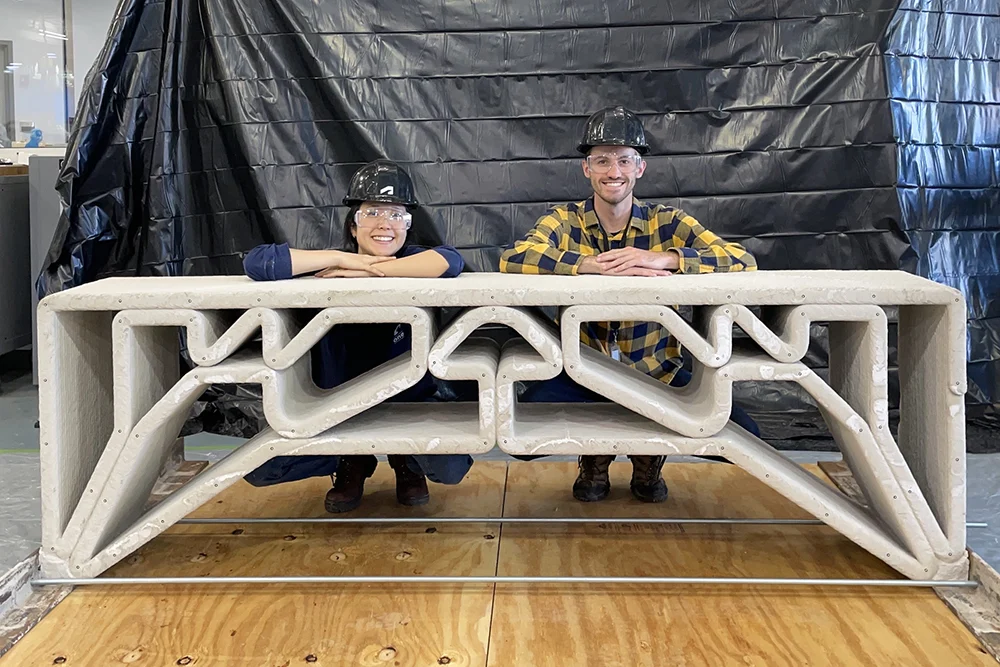
To rigorously validate their novel framework, the researchers embarked on a significant project: the design and printing of a 2.3-meter-long concrete bridge. This undertaking provided a tangible demonstration of their methodology and an opportunity to test the structural performance of a 3D-printed concrete element.
"The bridge was printed in approximately 30 minutes using readily available mortar," stated Josephine Carstensen, the senior author of the study and the Gilbert W. Winslow (1937) Career Development Professor in Civil Engineering. "The entire process, from design to print, was remarkably efficient."
The load-testing phase yielded impressive results. The approximately 900-pound bridge structure withstood a distributed load exceeding 2,000 pounds with minimal observable deflection, a performance that closely aligned with the team’s computer simulations. However, the testing also unveiled a surprising insight into the primary drivers of structural efficiency in current 3D concrete printing.
"What we discovered was that our design was significantly over-engineered due to the constraints of the printing hardware," Kim-Tackowiak revealed. "Essentially, from the initial stages of loading all the way up to 200,000 pounds, the design choices were dictated almost entirely by the ‘can I build it or not’ limitations of the printer. Only after exceeding that threshold could we begin to consider the pure physics of the material’s strength." This finding underscored that, at present, the capabilities of the printing technology, rather than the inherent material properties of concrete, were the limiting factor in achieving lighter, more efficient structures.
A Blueprint for Enhanced Printing Technology
The MIT framework’s ability to identify the mathematically optimal design allows for a precise quantification of the material cost associated with each hardware limitation. This data provides a clear roadmap for future advancements in 3D concrete printing technology.
"With mixed-integer optimization, we can pinpoint the global optimum – the absolute best possible solution – rather than settling for a merely good one," Carstensen explained. "Knowing we have found the optimal solution allows us to quantify the potential benefits of future hardware improvements. If a machine could overcome certain limitations, we can precisely calculate the resulting material savings."
The analysis revealed that the width of the printed bead was the most significant factor influencing material efficiency. The bridge was printed using a 4-centimeter bead. The researchers’ analysis indicated that a machine capable of extruding a 1-centimeter bead could reduce material consumption by as much as 76%, while still maintaining robust safety margins. This finding was particularly striking for Carstensen, who had initially anticipated that the constraint of continuous printing paths would have a greater impact. "The bead width proved to be the most influential factor, not the continuous path requirement," she stated.
The results offer concrete guidance to printer manufacturers, highlighting that even modest improvements in hardware capabilities could unlock substantial gains in structural efficiency and significantly reduce the environmental footprint of concrete construction.
A key aspect of the bridge’s design was its compression-only nature. "Concrete performs exceptionally well under compression – when it’s being squeezed – but poorly under tension – when it’s being pulled apart," Schemmer elaborated. "Our design methodology ensures that every component of the concrete structure is subjected to compression, effectively eliminating any tensile forces."
The material savings are twofold: reduced concrete usage and the complete elimination of formwork, a traditional component that adds cost and complexity, especially for unique or one-off structures. Carstensen sees immediate potential for this technology in disaster relief scenarios. "In the aftermath of a disaster, we can rapidly deploy new infrastructure without the need for extensive and time-consuming formwork construction," she suggested.
The bridge’s structural behavior during testing further illustrated the principle of compression-only design. While it withstood immense compressive loads, it fractured when a worker attempted to lift one corner to clear debris from underneath. This failure was not indicative of a design flaw but rather a demonstration of concrete’s inherent weakness in tension. The act of lifting placed parts of the bridge in tension, forces for which it was never designed. "It was optimal in one specific way, but clearly not in every conceivable scenario," Kim-Tackowiak acknowledged.
This observation points to the team’s next research frontier: reinforced concrete. "We recognize that a pure concrete structure may not always be the most versatile or robust solution. Therefore, we are progressing towards incorporating reinforcement, bringing our work more in line with contemporary construction practices," Kim-Tackowiak explained. However, she noted that integrating reinforcement, such as rebar, into the 3D printing process presents its own unique set of engineering challenges.
The research was supported by the National Science Foundation and the MIT Center for Advanced Production Technologies. The Additive Manufacturing paper lists Pittipat Wongsittikan, a PhD student in the MIT Building Technology Architecture program, and Jackson Jewett, a former MIT postdoc, as co-authors alongside Kim-Tackowiak, Schemmer, and Carstensen. This collaborative effort represents a significant step forward in making 3D concrete printing a more sustainable, efficient, and widely applicable construction technology.