The author’s reflections on the Rolex Milgauss Z Blue, initially a symbol of aspirational luxury, evolve into an exploration of how specific environments can redefine a timepiece’s perceived value and aesthetic appeal, particularly within the opulent context of a high-end hotel pool. This piece delves into the author’s personal journey with his watch, tracing his initial admiration, subsequent disillusionment due to practical concerns, and a surprising rediscovery of its charm in an unexpected setting.
A Nostalgic Glimpse into Luxury’s Past
The narrative opens with a vivid evocation of the quintessential five-star hotel experience. The author paints a sensory picture of hushed lobbies, the melodic backdrop of a piano, the discreet sounds of affluent movement – clinking teacups, the echo of dress shoes on marble, the hum of luggage wheels. This meticulously crafted atmosphere sets the stage for a deeper dive into the author’s personal connection with luxury watches, particularly as observed in such exclusive environments. He recounts childhood memories of poolside scenes in Dubai, where the wrists of the wealthy displayed an array of horological icons.
"Fat cats soaked in Speedos and Day-Dates, shapely concubines hanging from their elbows," the author recalls, painting a scene of unbridled indulgence. This era, he notes, was characterized by overt displays of wealth and a specific set of coveted timepieces. Russian playboys sported Hublot Big Bangs, young Khaleeji princes favored Audemars Piguet Royal Oak Offshores, while older generations opted for Patek Philippe Nautiluses. British expatriates were seen with Breitlings, and the presence of a Corum Admiral Cup suggested a more yuppie demographic. Mystery men wore Panerai Radiomirs, airline pilots sported Rolex GMTs, and eccentrics donned Ulysse Nardins. This "cornucopia of gilt, glam, and excess" notably lacked Apple Watches or watches worn "ironically." It was, in the author’s view, a "simpler time" of unadulterated appreciation for high-grade metal.
The Milgauss: A Complicated Relationship
At approximately twenty years old, the author developed a profound desire for a luxury watch, an ambition that seemed almost unattainable. Today, he possesses "a handful," each cherished. However, one particular timepiece, the Z Blue Rolex Milgauss, has become an exception to this rule of affection. The author admits to having "fallen out of love with" this particular watch.
The primary reason for this waning enthusiasm is its physical presence on his wrist. The Milgauss, in his assessment, is "too big and too thick," particularly ill-suited for his "flimsy, 16-centimeter wrist." While it technically fits, the fit is far from ideal, leading to a feeling of being "top-heavy." The watch tends to "flap out" when his hand is down and conversely when raised, creating a sense of self-consciousness. He feels he "can’t quite pull it off."
Despite these reservations, the author has continued to wear the Milgauss, adhering to the principle that "these things are meant to be worn." However, the accumulation of "scuffs and scratches" from frequent use began to detract from the ownership experience, leading to a dampened sense of enjoyment and a growing sense of dissatisfaction.
Shifting Perceptions: The Pool as a Catalyst
The author’s initial investment in the Milgauss, purchased new in 2019 for "a tad over $7k," was partly motivated by a belief in its potential to appreciate in value beyond its peers. This financial expectation proved incorrect, adding another layer to his growing disillusionment. He admits to wearing it "mostly under the cuff, lest I attract stabby thieves," questioning the "fun" in such cautious ownership. The initial allure, the "dew," had indeed "off the rose."
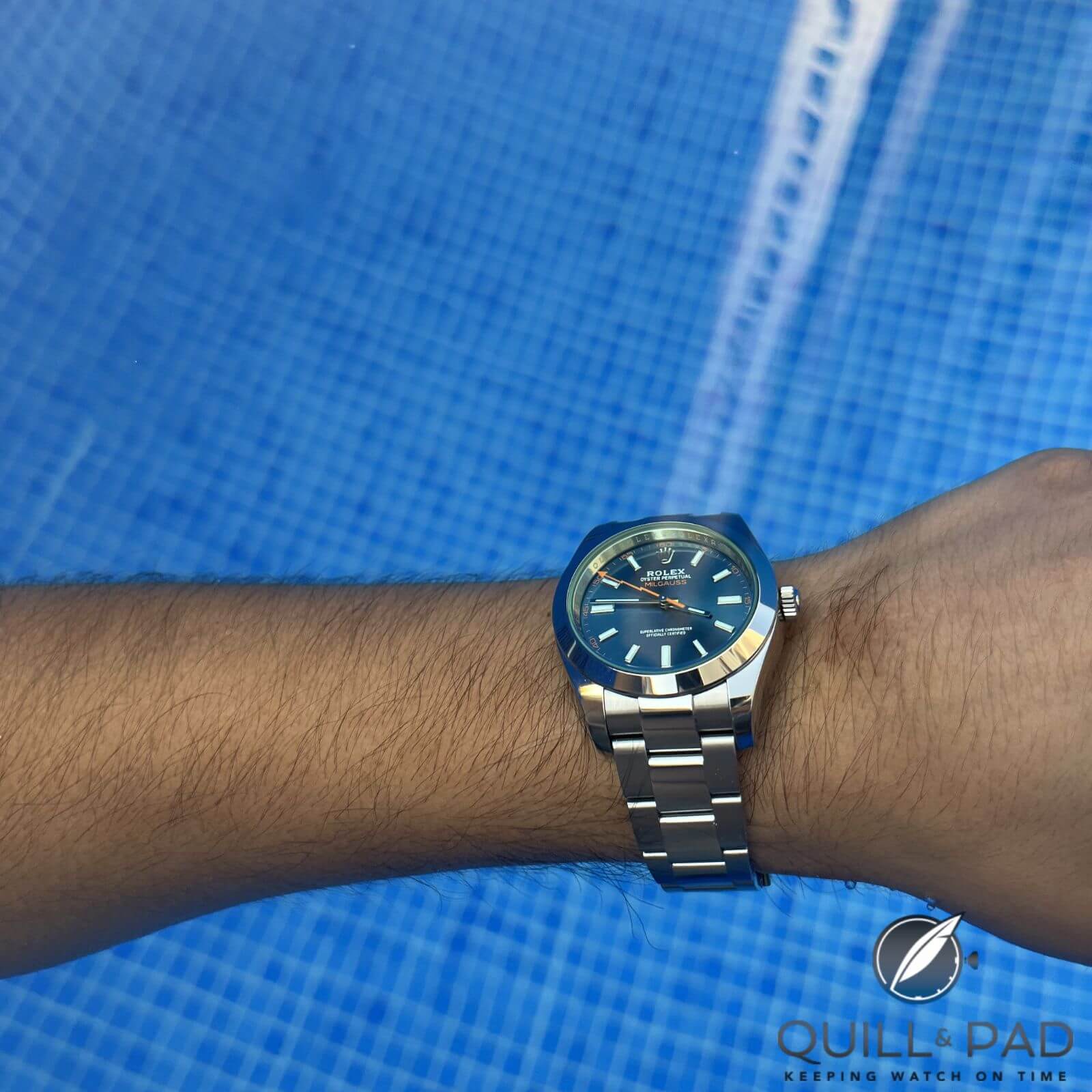
The turning point, however, arrives with a specific scenario: taking the Milgauss for a dip in a hotel pool. The author vividly describes an idyllic scene at a Four Seasons pool during "magic hour." Shedding his inhibitions and his shirt, he enters the water, finding a secluded corner to relax. As he floats, his mind drifts through a series of casual observations and thoughts: assessing fellow pool-goers, wondering about his frequent flyer miles, contemplating the cost of a boat, and reflecting on his career prospects.
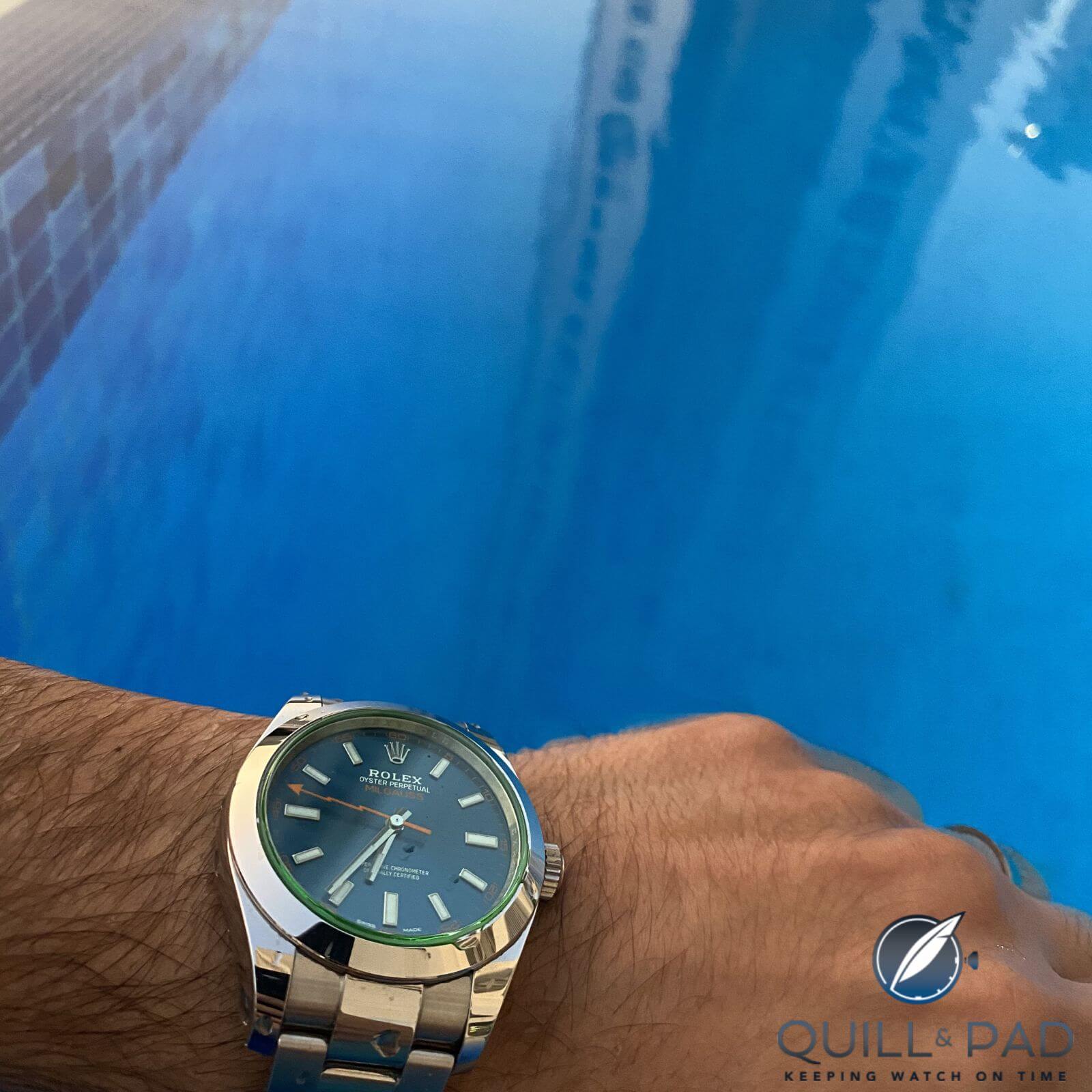
It is in this relaxed, almost meditative state that he turns his attention to his Milgauss. A droplet of water rolls down the crystal, momentarily resembling a "missing, runaway cyclops lens." He isn’t checking the time; instead, he finds himself "marveling at it, falling in love all over again." The ambient conditions – "warm sunlight filters through swaying palms," a "light breeze," and the suggestion of Lana Del Rey playing – create a perfect sensory backdrop.
The Z Blue Milgauss Reimagined
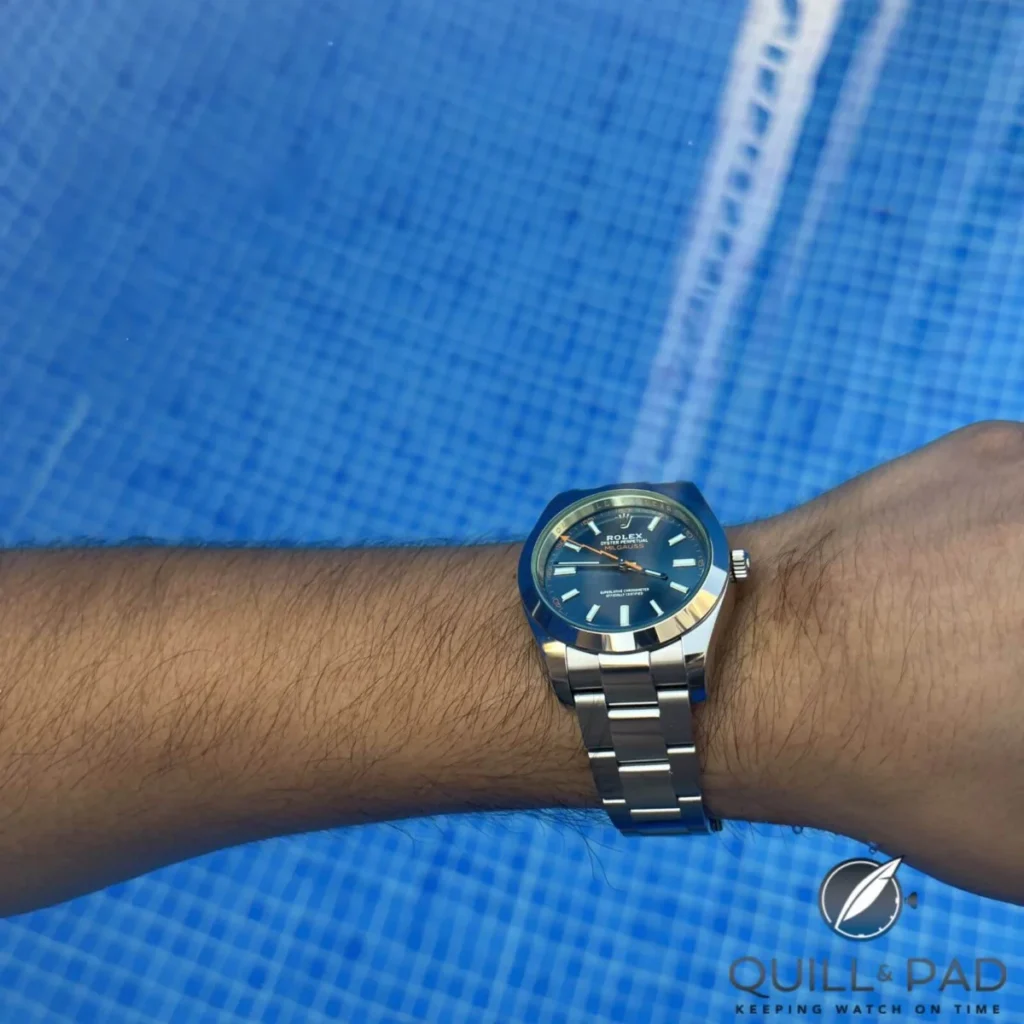
Under the influence of the water and the sun, the Milgauss undergoes a transformation. The author is captivated by the "light show on my wrist, a vivid plume of jade and aquamarine bursting from the center of the dial and bouncing back against the rippling blue void underneath." This visual spectacle evokes a sense of nostalgia, a "déjà vu quality," reminding him of childhood experiences like "chalky skateparks, school trips to the aquarium, toothpaste marbles, glass bricks, Fisherman’s Friends mints."
He elaborates on the watch’s aesthetic appeal in this context. The green crystal, viewed at an angle, "pops against the mosaic tiling, like a thin menthol strip jutting out of the bezel." Head-on, its "round edge glows like a radioactive halo." The dial, a "prism-lit disc," displays metallic blues that "shift and shiver iridescently," complemented by a bright-orange, "lightning bolt" shaped seconds hand. The author concludes that plunging this watch into "a clear, sun-dappled body of chlorinated water is to run a current through it." It is "where the watch comes alive, in the confines of the swimming pool." Crucially, "the scratches that scar its case fade away when wet."
Furthermore, when worn with just swimming shorts, the fit of the watch improves. The wearer, now more comfortable and less self-conscious, "compares himself to no one" and "covets nothing." The market value becomes irrelevant, and the author asserts that "no one here, it’s safe to say, will try to steal my watch." In this setting, "all’s right with the world."
The Return to Mundanity: Post-Swim Realities
The enchantment, however, is ephemeral. As the author dries off, so does the watch, and with it, its renewed luster. The setting sun and, more significantly, the artificial lighting of the indoor environment, diminish the watch’s appeal. "Indoors, the watch hangs off my wrist like a clunky, inelegant piece of man-jewelry." The poor fit is amplified by the presence of clothing. The crystal and dial, under dim, artificial light, appear timid, failing to showcase their vibrancy. The seconds hand loses its "cool" factor, becoming merely "jagged and jarring." The watch, "bone dry," is perceived as being "out of its element." It "needs a splash of water, a sunny day, a blue backdrop."
The "Pool Watch" Concept: Redefining Purpose
The author posits that while the Milgauss was originally engineered for CERN, its "Z Blue configuration" is, in fact, a "pool watch." He acknowledges that none of the Milgauss models were explicitly marketed as aquatic timepieces, despite their depth ratings. However, he argues that wearing a watch in its "natural habitat" is not always the most effective way to appreciate it. This sentiment is echoed by owners of iconic "tool watches" like the Breitling Cosmonaut or the Omega Speedmaster Moonwatch, and even F1-themed watches, whose intended environments are rarely experienced by the average owner.
He draws parallels to other items where their "natural habitat" doesn’t always translate to their most visually striking or contextually appropriate presentation. A peacock, while naturally found in forests, is most striking on a manicured lawn. Timberland boots, designed for construction sites, are often seen as fashionable on urban dwellers. Blue jeans, originally for gold prospectors, have found their most iconic look on celebrities.
The Hotel Pool as a Stage for Horological Spectacle
The author extends this idea to the hotel pool environment itself. It is a space, he suggests, for "status symbols and statement pieces." It demands "glitzy icons" and "the bees’ knees." The expectation is for watches that resonate with a sense of occasion and luxury, not those that are overly technical or niche. He dismisses brands like Parmigiani, Czapek, Bremont, Carl F. Bucherer, and Sinn as mood-killers in this context, and even an Apple Watch is deemed inappropriate, suggesting a focus on the utilitarian over the aesthetic.
The author advocates for a form of horological "showmanship" at the poolside, a strategy of "give the people what they want." He likens it to attending a concert and expecting to hear the hits, not obscure "deep cuts." While normally a proponent of discovering "hidden gems" and appreciating "quirky, offbeat, slept-on" watches, he explicitly states he does not want to see these at the hotel pool. Instead, he desires "unimaginative eye rollers," "starter-kit luxury," and "old school staples" – essentially, the horological equivalent of a "Beef Wellington."
Exemplary Pool Watches
The author then provides a curated list of watches that he believes fit the "pool watch" criteria. This includes most Royal Oak Offshore and Vacheron Constantin Overseas models. A pre-Kern Breitling B01 Chronomat is also deemed suitable. The Speedmaster Moonwatch, he specifies, would qualify if rendered in yellow gold, though its swimming capability is questioned. The Rolex Daytona, particularly in yellow gold, is an emphatic "Hell yes!"
Virtually all Rolex sports models, especially two-tone "bluesies," perform well in this context. Any Richard Mille with a +10-bar water resistance rating is also a strong contender, as are Hublot Big Bang models, which he considers a "cheaper alternative" in many respects. Similarly, most Patek Philippe Nautiluses and, to a lesser extent, Aquanauts are suitable.
He makes a critical observation: "Anything that will get you stabbed outside your hotel in London or Paris is meant for the pool that’s in it, water resistance permitting." This implies that the inherent risk associated with displaying high-value timepieces in certain urban environments makes the secure and relaxed setting of a hotel pool a more appropriate venue for their enjoyment. He suggests keeping such watches in the hotel safe when not in use for a swim, reinforcing the idea of a specific, curated experience for these luxury items.
The author concludes by challenging the notion that one shouldn’t travel with a Rolex, implying that the hotel pool provides a safe and contextually appropriate environment for such a display. The article, therefore, is not merely a personal reflection but a broader commentary on how context, environment, and personal perception can profoundly influence the appreciation and perceived value of luxury goods, particularly high-end watches. The Z Blue Milgauss, once a source of mild discontent, finds its unexpected redemption in the sun-drenched, tranquil waters of a hotel swimming pool, transforming from a burdensome accessory into a celebrated icon of leisure and understated opulence.