Graphene, often heralded as a "wonder material," has captivated the scientific and industrial communities with its extraordinary properties and promise for futuristic applications. Known for its exceptional strength, electrical conductivity, transparency, and lightweight nature, graphene has been earmarked for everything from advanced electronics and ultra-efficient batteries to sophisticated sensors and robust composites. However, the prevailing perception has been that producing useful forms of this material necessitates expensive, specialized equipment and exotic chemicals. A groundbreaking new study challenges this notion, demonstrating a surprisingly low-tech, environmentally conscious approach using readily available household items: a kitchen blender, tap water, old newspaper, and graphite recovered from electronic waste.
This innovative research, published in ACS Sustainable Resource Management, delves into the feasibility of producing graphene through a simplified version of liquid-phase exfoliation. Crucially, the team replaced conventional laboratory-grade materials and specialized apparatus with common domestic items and recycled waste products, marking a significant step towards democratizing nanoscience and fostering circular economy principles.
The Genesis of Graphene and Its Unique Properties
To fully appreciate the significance of this discovery, it is essential to understand graphene itself. Graphene is an allotrope of carbon, a single, two-dimensional layer of carbon atoms arranged in a hexagonal lattice. It is, in essence, a single atomic layer of graphite. Graphite, the familiar material found in pencil lead, is composed of countless such graphene layers stacked together. While graphite is relatively common and unremarkable in its bulk form, isolating a single layer reveals astonishing properties.
Graphene’s discovery by Andre Geim and Konstantin Novoselov at the University of Manchester in 2004 earned them the Nobel Prize in Physics in 2010. Their pioneering work showcased that graphene is the strongest material known to man, approximately 200 times stronger than steel by weight. Furthermore, it possesses remarkable electrical conductivity, surpassing copper, and excellent thermal conductivity, outperforming all other known materials. It is also nearly transparent and impermeable to gases. These attributes make it highly attractive for a vast array of applications, including:
- Electronics: High-speed transistors, flexible displays, transparent conductive electrodes for touchscreens.
- Energy Storage: Supercapacitors and next-generation batteries with faster charging times and higher capacities.
- Sensors: Ultra-sensitive detectors for gases, chemicals, and biomolecules due to its high surface area and electrical properties.
- Composites: Strengthening materials for aerospace, automotive, and sporting goods.
- Water Filtration: Advanced membranes for desalination and purification.
- Biomedicine: Drug delivery systems and biosensors.
Despite this immense potential, the high cost and complexity of producing high-quality graphene in large quantities have been major hurdles to its widespread commercialization. Traditional methods often involve chemical vapor deposition (CVD), epitaxial growth, or sophisticated liquid-phase exfoliation techniques requiring hazardous solvents and energy-intensive processes.
Turning Electronic Waste into a Resource: A Circular Economy Approach
The starting material for this low-tech graphene production is graphite. While commercially available graphite is often used in laboratory settings, the researchers focused on a more sustainable source: electronic waste (e-waste). Graphite is commonly found in electronic devices, particularly in smartphones, laptops, and other gadgets, where thin sheets act as heat spreaders, efficiently dissipating heat away from sensitive components like processors and batteries.
The global volume of e-waste is staggering and continues to grow at an alarming rate. According to the United Nations, a record 53.6 million metric tons (Mt) of e-waste was generated worldwide in 2019, an increase of 21% in just five years. Only 17.4% of this e-waste was officially documented as collected and recycled. The vast majority ends up in landfills or is informally recycled, posing significant environmental and health risks due to the presence of toxic heavy metals and persistent organic pollutants. However, e-waste also represents a valuable source of precious metals and other recoverable materials, often referred to as "urban mining."
Conor Boland, an assistant professor of materials science at Dublin City University (DCU) and a key researcher in this study, highlighted the team’s motivation in an article for The Conversation. They investigated whether this discarded graphite could be given a second life, transforming a waste product into a high-value material. The process hinges on liquid-phase exfoliation, a method where graphite is suspended in a liquid, and mechanical energy is applied to separate its stacked carbon layers into individual graphene sheets.
Instead of relying on specialized, high-power sonicators or ball mills typically used in laboratories, the DCU team opted for an ordinary kitchen blender. This choice dramatically reduces the entry barrier for experimentation. After blending, a simple kitchen sieve was employed to remove larger, unexfoliated pieces of graphite, leaving a suspension of finer carbon materials.
The Unsung Hero: Old Newspapers and Cellulose Stabilization
Separating graphite into thinner carbon sheets is only one part of the challenge in graphene production. Once individual graphene sheets are obtained, they have a strong tendency to re-stack and clump back together due to van der Waals forces, which minimize their high surface energy. Researchers typically use carefully selected solvents or chemical stabilizers (surfactants) to prevent this re-aggregation, but these often add to the cost, complexity, and environmental footprint of the process.
The DCU team sought a much simpler, more sustainable alternative: fibers from old newspapers. Newspaper contains cellulose, a naturally abundant structural material found in plant cell walls. The researchers washed and softened discarded newspaper in tap water before blending it into a fiber-rich mixture. When graphite was processed in this cellulose-infused solution, the cellulose-derived material played a crucial role in stabilizing the separated graphene sheets, helping to keep them apart.
The mechanism behind cellulose’s effectiveness lies in its ability to form hydrogen bonds with the graphene sheets and create a steric hindrance, physically preventing them from re-stacking. While not as potent as some synthetic stabilizers, the approach proved remarkably effective for a low-cost, eco-friendly alternative. Without the newspaper-derived material, the processed carbon settled out of the water within minutes. With the cellulose fibers present, the solution remained usable for several hours and could be easily re-dispersed with a simple shake, significantly improving the stability of the graphene suspension.
Verifying the "Home-Brew" Graphene
It is important to note that while the production process itself relied on remarkably accessible materials and equipment, sophisticated laboratory instruments were still required to rigorously verify that graphene had indeed been produced. Characterization techniques such as Raman spectroscopy, atomic force microscopy (AFM), transmission electron microscopy (TEM), and X-ray diffraction (XRD) are indispensable for confirming the number of layers, structural integrity, and purity of the exfoliated material. These techniques provide definitive evidence of graphene’s presence and quality, distinguishing it from multi-layered graphite flakes. The researchers confirmed that the blender, combined with the other simple ingredients, successfully yielded graphene.
A Journey Towards Accessible Nanoscience
This latest study builds upon earlier pioneering experiments by the same DCU researchers. In previous work, they demonstrated that graphene could be produced using materials including pencil lead, tap water, common soap, and even coffee filters alongside kitchen appliances. This progression highlights a deliberate trajectory towards demystifying and democratizing nanoscience.
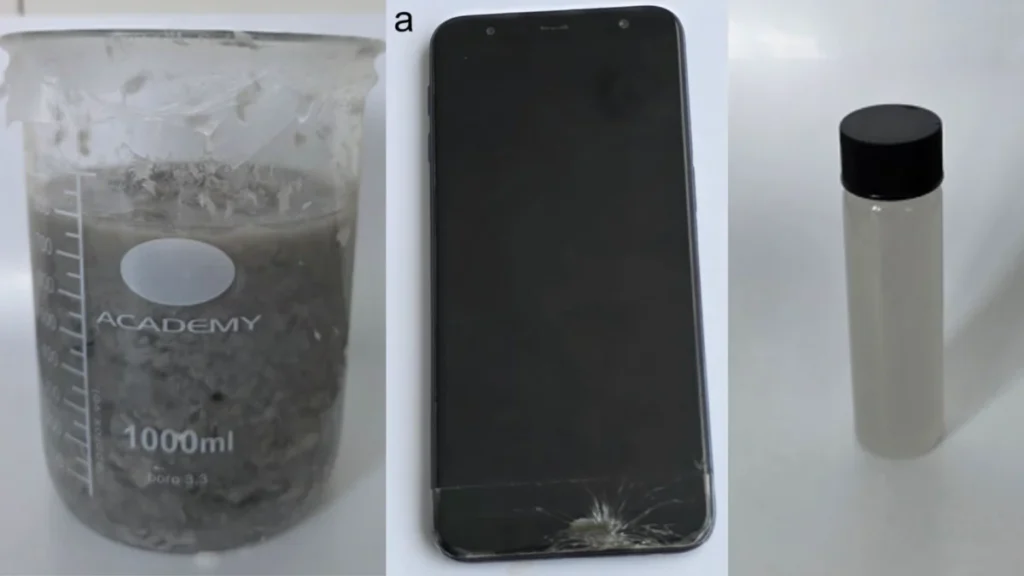
This particular study takes the concept further by asking whether both the equipment and the starting materials could come from inexpensive or discarded sources. For most of their experiments, the researchers utilized commercially available graphite heat-spreading material to ensure a consistent supply. However, they also meticulously dismantled a discarded smartphone and successfully recovered enough graphite to demonstrate that real electronic waste could indeed be processed into much thinner carbon sheets, underscoring the practical viability of their e-waste recycling premise.
It is crucial to frame this innovation within its appropriate context. The researchers are not suggesting that kitchen blenders will imminently replace industrial-scale graphene factories, which operate under stringent conditions to produce ultra-high-purity, tailor-made graphene for demanding applications. Industrial processes often aim for precise control over layer number, defect density, and flake size, which might be challenging to achieve consistently with a blender.
Instead, the work points towards a potentially more accessible model for early-stage research, educational initiatives, and proof-of-concept development. Schools, community laboratories, and smaller research groups with limited budgets could potentially perform the initial processing using these inexpensive, readily available materials. They could then rely on partnerships with universities or shared research facilities for the more advanced characterization steps, effectively lowering the barrier to entry into nanoscience experimentation.
Broader Implications for Sustainability and Education
The implications of this research extend far beyond mere material production. It offers an intriguing and powerful example of circular materials research, where waste products are repurposed to create materials for future technologies. Yesterday’s newspaper and discarded electronics, often seen as environmental burdens, could help forge a material at the forefront of tomorrow’s innovations. This embodies the core tenets of a circular economy, minimizing waste and maximizing resource utility.
- Environmental Impact: By utilizing e-waste graphite, the method contributes to reducing the ever-growing e-waste stream, mitigating its environmental hazards, and potentially recovering valuable materials. The use of tap water instead of hazardous organic solvents further reduces the ecological footprint.
- Educational Accessibility: This method can revolutionize science education. Imagine high school students or undergraduate chemistry labs experimenting with graphene production using a blender and old newspapers. This hands-on approach can ignite curiosity, make advanced materials science tangible, and inspire the next generation of scientists and engineers.
- Decentralized Innovation: The low cost and simplicity of the method could foster innovation in regions with limited access to sophisticated research infrastructure. It could enable researchers in developing countries or community-led initiatives to explore graphene applications relevant to their local needs.
- Sustainability Research: The study underscores the potential for finding sustainable alternatives in materials science, pushing the boundaries of what is considered "high-tech" and "low-tech." It encourages a re-evaluation of waste streams as potential resources.
While the "blender graphene" may not meet the exacting standards required for every high-end application, it could be perfectly suitable for a range of uses where absolute purity or precise control over layer number is not paramount. Potential applications for this accessible graphene could include conductive inks, certain composite materials, electromagnetic shielding, or even educational kits.
The most sophisticated part of this entire experiment, ironically, was not the act of making the graphene itself, but rather the rigorous scientific process of proving that the blender had actually accomplished the task. This distinction highlights the balance between innovative, accessible methods and the fundamental scientific verification required to validate such claims. The Dublin City University team’s work serves as a powerful reminder that sometimes, the most revolutionary advancements can emerge from the simplest, most unexpected combinations of resources and ingenuity. It paves the way for a future where cutting-edge materials science is not confined to elite laboratories but becomes accessible to a broader, more diverse scientific community, driving innovation from the ground up.






