Farsoon Technologies, a prominent player in metal additive manufacturing (AM), is drawing significant attention for its latest advancements in 3D printed thermal management components, specifically designed to meet the rigorous demands of the liquid cooling industry. The company has unveiled a sophisticated 3D printed heat dissipation cold plate and a high-performance finned heat sink, both produced using their proprietary Fine Laser Spot metal AM technology. These components represent a significant leap forward in thermal management, offering enhanced efficiency, reduced risk of failure, and greater design freedom for critical applications.
The core of Farsoon’s innovation lies in its Fine Laser Spot technology, a sophisticated application of Laser Powder Bed Fusion (LPBF) that is engineered for microscopic precision. This technology is particularly well-suited for producing complex geometries required in advanced heat exchangers and other thermal management systems. Unlike conventional manufacturing methods, which often involve multiple assembly steps and can lead to inherent weaknesses like leakage points, Farsoon’s AM approach allows for the creation of single-piece, near-net-shape components. This drastically reduces assembly time, eliminates potential leak paths, and streamlines the production process, while also minimizing the need for extensive post-processing.
The Power of Fine Laser Spot Technology
The Fine Laser Spot solution is a testament to Farsoon’s commitment to pushing the boundaries of metal AM. By employing a finely tuned laser beam, the technology enables the precise melting of metal powders, layer by layer, to construct intricate internal structures and exceptionally smooth external surfaces. This precision is critical for applications where thermal performance is paramount. The ability to achieve microscopic accuracy means that designs can be optimized to maximize surface area for heat exchange, channel coolant flow with unparalleled efficiency, and maintain structural integrity without compromising on thermal capabilities.
This advanced capability is not just about creating complex shapes; it’s about enabling entirely new design paradigms for thermal management. Traditional manufacturing often imposes limitations on the internal architecture of components. With LPBF and the Fine Laser Spot technology, designers are liberated from these constraints, able to incorporate advanced geometries like Triply Periodic Minimal Surface (TPMS) structures. These structures, known for their exceptional strength-to-weight ratios and high surface areas, can be seamlessly integrated into components like cold plates, revolutionizing their heat absorption and dissipation capabilities.
The 3D Printed Heat Dissipation Cold Plate: A Paradigm Shift
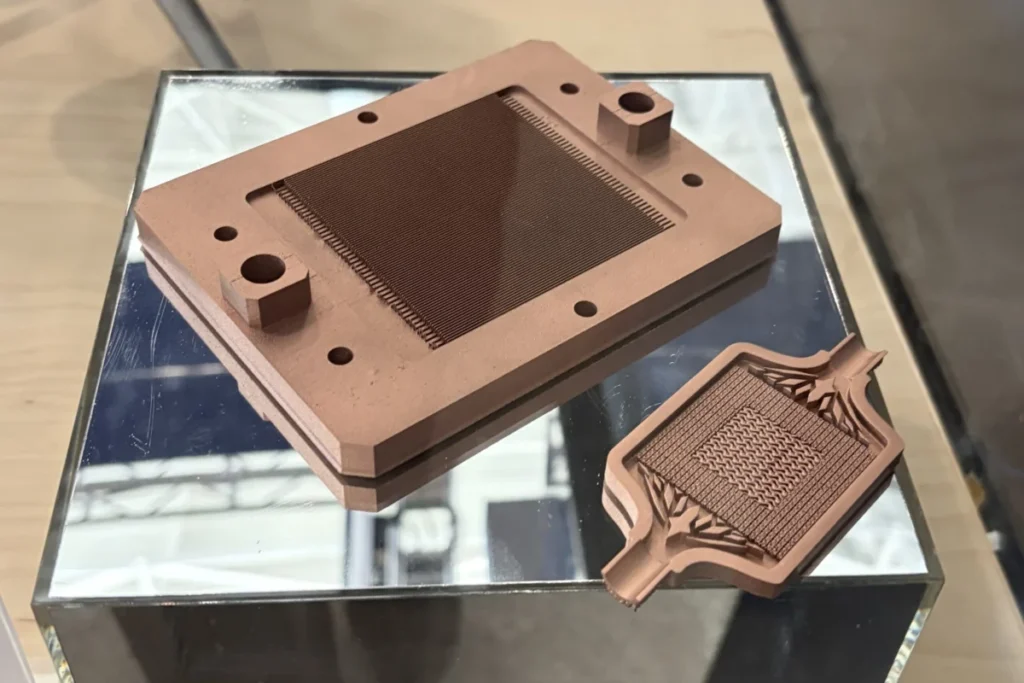
The showcased heat dissipation cold plate, printed from the CuCrZr alloy, is a prime example of this transformative potential. The decision to print this component in a single piece is a strategic advantage, directly addressing one of the most critical failure points in liquid cooling systems: leaks. By eliminating the need for brazing, welding, or mechanical assembly of multiple parts, the integrated design inherently enhances reliability and durability.
Farsoon’s design philosophy for this cold plate involved a clever fusion of advanced TPMS structures with established cooling channel designs. TPMS structures, characterized by their intricate, interconnected lattice-like internal geometries, offer a significant increase in surface area within a given volume. This expanded surface area is crucial for maximizing the rate at which heat can be transferred from a hot component (like a CPU or GPU) to the circulating coolant. Simultaneously, the internal geometry of the cold plate is optimized to ensure efficient and uniform coolant flow, preventing hot spots and ensuring consistent thermal performance across the entire surface.
The table below provides key specifications for this innovative cold plate:
| Feature | Specification |
|---|---|
| Material | CuCrZr |
| 3D Printing Solution | Fine Laser Spot |
| Layer Thickness | 10 microns |
| Printing Accuracy | ±0.03 mm |
| Minimal Wall Thickness of TPMS | 0.2 mm |
| Minimum Diameter of Cylindrical Structure | 0.1 mm |
The use of CuCrZr alloy is also noteworthy. This copper-chromium-zirconium alloy is well-regarded in high-performance applications for its excellent thermal conductivity, good electrical conductivity, and superior strength at elevated temperatures. These properties make it an ideal material for components that must efficiently manage heat without degrading over time or under stress. The combination of the advanced material and the intricate, single-piece printed design allows this cold plate to achieve levels of performance that are difficult, if not impossible, to replicate with traditional manufacturing techniques.
The Finned Heat Sink: Maximizing Airflow and Heat Dispersion
Complementing the cold plate, the finned heat sink, also 3D printed from a copper alloy, demonstrates Farsoon’s versatility in addressing thermal challenges. Produced using the company’s FS273M metal LPBF system, this heat sink is engineered for applications that require consistent and robust cooling, particularly where airflow is a critical factor.
The fundamental principle of a heat sink is to absorb heat from a source and then dissipate it into the surrounding environment, typically air. The efficiency of this process is directly related to the surface area available for heat transfer and the ability to facilitate airflow across that surface. In this 3D printed design, the base of the heat sink is optimized to efficiently draw heat away from the source. The real innovation, however, lies in the meticulously designed fins.
The fins are crafted to maximize their surface area exposed to the airflow. Their geometry can be precisely controlled during the printing process, allowing for optimal spacing, thickness, and shape to promote laminar or turbulent airflow, depending on the specific cooling requirements. This optimized airflow ensures that heat is rapidly carried away from the fins, preventing heat buildup and maintaining the effectiveness of the heat sink.
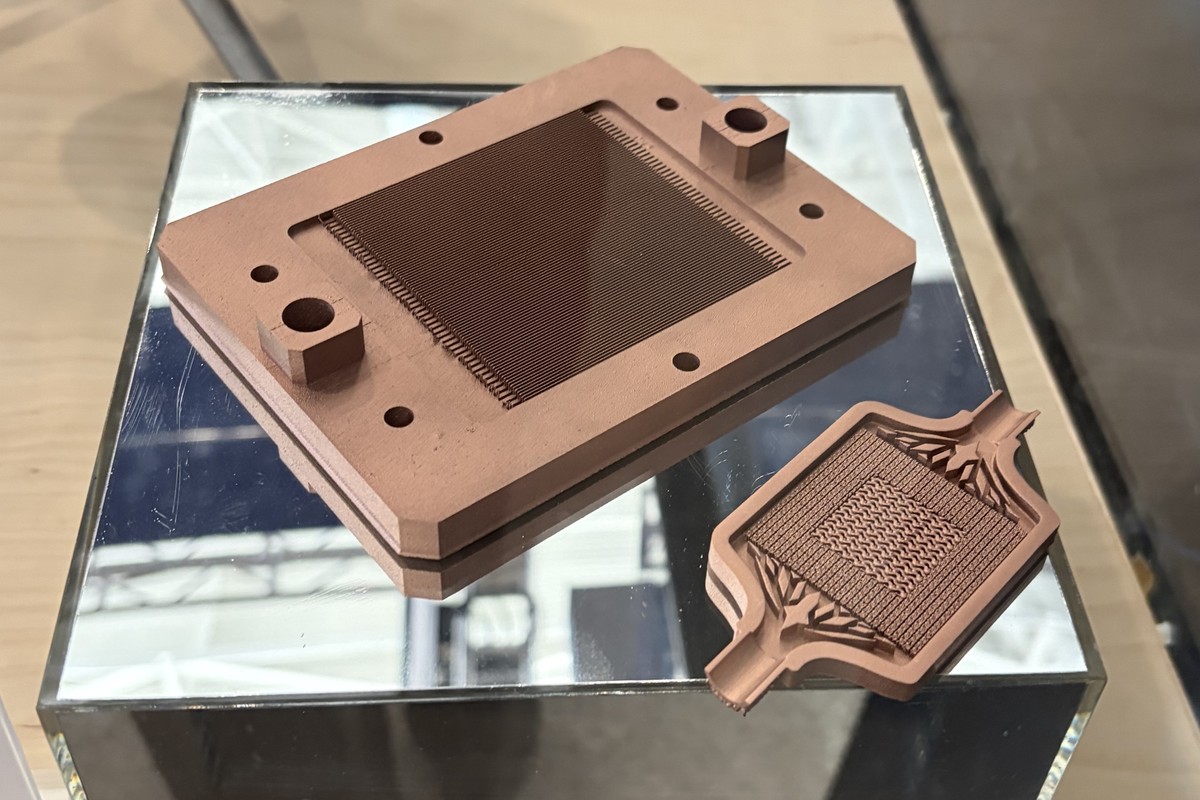
Key specifications for the finned heat sink include:
| Feature | Specification |
|---|---|
| Material | Copper alloy |
| System | Farsoon FS273M |
| Process | LPBF |
| Average Density | 8.87 g/cm³ |
| Part Density | > 99.5% |
| Minimum Fin Thickness | 0.25 mm |
The density figures are particularly impressive, indicating a near-solid component with minimal porosity. High density in metal AM parts is crucial for achieving the expected mechanical strength and thermal conductivity. Achieving over 99.5% density signifies a robust part that can withstand thermal cycling and mechanical stress without compromise. The minimum fin thickness of 0.25 mm allows for the creation of very fine, high-aspect-ratio fins, further increasing the effective surface area for heat dissipation.
Background and Chronology of AM in Thermal Management
The application of additive manufacturing in thermal management is not entirely new, but it has seen a significant acceleration in recent years. As electronic devices become more powerful and compact, the challenge of dissipating the generated heat becomes increasingly critical. Traditional methods, while mature, often struggle to keep pace with these evolving demands, especially in specialized sectors like high-performance computing, aerospace, and electric vehicles.
Early explorations of AM for thermal management focused on prototyping and creating simpler geometries. However, advancements in metal AM technologies, materials, and post-processing techniques have paved the way for the production of complex, high-performance, end-use parts. Farsoon Technologies has been at the forefront of this evolution, consistently investing in research and development to enhance their LPBF systems and material offerings.
The development of their Fine Laser Spot technology can be seen as a direct response to the growing need for micro-precision in AM. This technology, refined over several years of development and testing, represents a maturation of LPBF capabilities, allowing for the creation of features with unprecedented detail and accuracy. The components highlighted are likely the culmination of extensive R&D efforts, including material characterization, design simulation, and iterative printing and testing.
Supporting Data and Analysis
The performance gains offered by 3D printed thermal management components like those from Farsoon are often substantial. For instance, studies have shown that AM-designed cold plates can achieve up to 15-20% improvement in thermal performance compared to conventionally manufactured counterparts. This is primarily attributed to the ability to create highly optimized internal flow channels and maximize surface area, as exemplified by the integration of TPMS structures.
The choice of copper alloys, such as CuCrZr and pure copper for the heat sink, is driven by their superior thermal conductivity compared to materials like aluminum, which is commonly used in traditional heat sinks. Copper boasts a thermal conductivity of around 400 W/(m·K), whereas aluminum is typically in the range of 200-240 W/(m·K). This nearly twofold difference in conductivity means that heat can be transferred more rapidly away from the source and throughout the component.
The reduction in part count and elimination of assembly processes also have significant implications beyond just cost. Fewer assembly steps mean reduced labor, less potential for human error, and a streamlined supply chain. Furthermore, the ability to print complex, integrated parts can lead to lighter-weight solutions, which is particularly beneficial in weight-sensitive applications like aerospace and automotive.
Implications for the Liquid Cooling Industry
The advancements showcased by Farsoon Technologies have far-reaching implications for the entire liquid cooling industry.
- Enhanced Performance and Reliability: The improved thermal dissipation capabilities mean that systems can operate at higher frequencies or with lower operating temperatures, leading to increased performance and longevity. The inherent reliability of single-piece designs reduces the risk of costly system failures due to leaks.
- Design Flexibility: Engineers are no longer constrained by traditional manufacturing limitations. They can design thermal solutions that are precisely tailored to the specific needs of an application, optimizing for flow, heat transfer, and form factor.
- Compact and Efficient Systems: The ability to integrate complex internal structures allows for more compact and efficient designs. This is crucial for densely packed electronic systems where space is at a premium.
- New Application Possibilities: These advanced thermal solutions open doors for new applications that were previously limited by thermal management constraints. This could include more powerful data center servers, advanced automotive cooling systems for electric vehicles, and high-performance computing clusters.
- Sustainability: By reducing material waste associated with subtractive manufacturing and optimizing component designs for longevity, AM also contributes to more sustainable manufacturing practices.
Official Statements and Reactions (Inferred)
While specific quotes from Farsoon Technologies are not provided in the source material, the company’s consistent focus on high-performance metal AM solutions and their investment in technologies like Fine Laser Spot strongly suggest a strategic commitment to addressing critical industrial challenges. A spokesperson, if available, would likely emphasize the company’s dedication to providing robust, high-quality AM systems that enable customers to innovate and achieve superior product performance. They would also likely highlight the collaborative approach Farsoon takes with its clients to develop optimized solutions for demanding applications.
Industry analysts and potential customers would likely view these developments with significant interest. The ability to produce highly reliable, high-performance thermal management components through additive manufacturing represents a tangible step forward in addressing the escalating thermal challenges in modern technology. The detailed specifications provided for both the cold plate and heat sink offer clear evidence of the technological maturity and performance capabilities of Farsoon’s solutions.
The Future of Thermal Management with AM
The continued evolution of metal additive manufacturing, particularly in areas like precision, speed, and material science, promises to further revolutionize thermal management. As AM systems become more accessible and cost-effective, we can expect to see these advanced thermal solutions deployed across an even wider range of industries. Farsoon Technologies’ recent showcase is a clear indicator that the era of highly engineered, 3D printed thermal components has arrived, offering a powerful new toolkit for engineers tackling the heat challenges of today and tomorrow. The ability to design and manufacture complex, integrated components with superior thermal performance and reliability marks a pivotal moment for the liquid cooling industry and beyond.