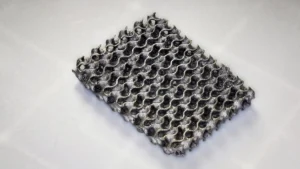
A groundbreaking discovery by an international research team, spearheaded by the University of Birmingham, has revealed that ordinary rice grains, when tightly packed, exhibit an extraordinary mechanical property under varying pressure conditions. This phenomenon, where rice grains become weaker when compressed quickly but remain relatively strong under slow compression, has led to the creation of a novel granular metamaterial. This innovation holds significant promise for advancements in soft robotics, enabling machines to automatically adjust their stiffness, and for developing protective equipment capable of dynamically responding to the force of an impact, all without the need for complex electronics or sensors. The findings of this seminal work were formally reported in the prestigious scientific journal Matter.
Unveiling the Enigma of Rice’s Mechanical Behavior
The journey to this discovery began with meticulous experiments designed to observe the mechanical responses of tightly packed granular materials. While most materials tend to stiffen or strengthen under rapid loading, exhibiting what is known as "rate hardening," the researchers observed a counter-intuitive response in rice. When subjected to higher loading speeds, the densely packed rice grains demonstrated a significant weakening, a phenomenon termed "rate softening." This characteristic is exceedingly rare in the broader spectrum of materials science, making rice an anomaly worthy of in-depth investigation.
The core of this unusual behavior, as the research team elucidated, lies in the frictional interactions between individual rice grains. Under rapid application of force, the friction between these grains experiences a sharp and sudden drop. This reduction in inter-grain friction compromises the intricate internal networks of forces that typically distribute and support external loads within the granular assembly. Consequently, the material’s structural integrity is diminished, leading to its observed weakening. This microscopic mechanism, previously largely overlooked in common granular systems, represents a fundamental shift in understanding how such materials behave under dynamic stress.
From Observation to Innovation: Designing a Self-Adapting Metamaterial
Recognizing the unique potential of this "rate softening" property, the scientists moved beyond mere observation to actively harness it as a design principle. Their ambition was to engineer a metamaterial – a composite structure specifically designed to possess properties not found in naturally occurring materials – that could leverage rice’s unusual response. Metamaterials have been a frontier of materials science for decades, with early research focusing on properties like negative refractive index, but recent efforts have increasingly explored mechanical metamaterials with tunable stiffness or shock absorption capabilities.
To achieve a self-adapting material, the researchers ingeniously combined rice-based granular units with other granular materials, such as sand. Sand, unlike rice, exhibits the more common "rate hardening" behavior, meaning it becomes stronger when subjected to rapid loading. By integrating these contrasting elements, the team successfully created a hybrid granular metamaterial. This novel composite demonstrated a dualistic response: it could react differently to slow, gradual movements versus sudden, impactful forces. This adaptability is critical because it allows the material to inherently change its mechanical properties – whether bending, buckling, or stiffening – without any external electronic intervention, sensors, or active control systems. The material’s intelligence, in essence, is embedded within its physical architecture and the intrinsic mechanics of its constituent grains.
Dr. Mingchao Liu, a lead researcher from the University of Birmingham, emphasized the paradigm shift this represents. "Rice might be best known as a staple food globally, but it’s rarely associated with advanced engineering. Our research shows that it can form the basis of a new class of functional materials," he stated. "Rather than treating this phenomenon as curiosity, we turned it into a design principle. This approach enabled us to create a material that can bend, buckle, or stiffen differently under slow movements versus sudden impacts – without electronics, sensors, or active control. Instead of telling a structure how to respond, we let physics decide: fast loads trigger one behavior, slow loads another." This philosophy underscores a broader trend in materials science to develop "smart" materials that derive their adaptability from their fundamental physical properties rather than external computational systems.
The Broader Context: Granular Materials and the Quest for Smart Systems
The study by the University of Birmingham team is significant not only for its immediate findings but also for its contribution to the wider field of granular materials science. Granular materials, comprising discrete macroscopic particles, are ubiquitous in nature and industry, ranging from sand dunes and avalanches to pharmaceutical powders and construction aggregates. Despite their commonality, their mechanical behavior remains notoriously complex and challenging to model due to the intricate interplay of friction, contact forces, and particle arrangements. This research offers a fresh perspective on how seemingly simple granular systems can harbor sophisticated mechanical properties.
Historically, the drive for adaptive materials has often focused on complex systems incorporating sensors, actuators, and control algorithms. While effective, such approaches often lead to increased cost, weight, energy consumption, and vulnerability to environmental factors. The concept of "material intelligence," where a material’s inherent structure dictates its adaptive response, represents a more elegant and potentially more robust solution. Biomimicry, drawing inspiration from nature’s designs – like the varying stiffness of a tree branch or the shock absorption of bone – has long guided researchers in this quest. The discovery in rice grains is a prime example of how even the most mundane natural materials can offer profound insights for advanced engineering.
The global metamaterials market, though nascent, is projected to grow significantly, driven by applications in electromagnetics, acoustics, and increasingly, mechanics. This growth underscores the industry’s keen interest in materials that transcend conventional limitations. The current research taps into this demand by offering a mechanically adaptive solution that is inherently passive and self-regulating, opening doors for simpler, more durable, and cost-effective smart material systems.
A Chronology of Discovery and Development
The timeline of this research, while not explicitly detailed in terms of years, generally follows a standard scientific progression:
- Initial Observation/Hypothesis (Early Stage): Researchers likely observed unusual behavior in granular materials, possibly during routine experiments or theoretical modeling, prompting a focused investigation into materials like rice.
- Experimental Design and Execution (Research Phase): A series of controlled experiments were devised to systematically test the response of packed rice grains under varying loading speeds, meticulously measuring forces and deformations.
- Data Analysis and Mechanism Elucidation (Analytical Phase): The collected data were analyzed to identify patterns, leading to the identification of "rate softening" and the subsequent investigation into the underlying frictional mechanisms.
- Concept Formulation and Metamaterial Design (Innovation Phase): Once the mechanism was understood, the idea of leveraging this property for a metamaterial was conceived. This involved selecting complementary materials (like sand) and designing the composite structure.
- Prototyping and Validation (Engineering Phase): Small-scale prototypes of the granular metamaterial were constructed and tested to validate its predicted adaptive responses under different loading conditions.
- Publication (Dissemination Phase): The culmination of these efforts was the publication in Matter, making the findings accessible to the global scientific community and setting the stage for future research and development. This publication signifies the formal validation and recognition of the breakthrough by peer review.
Far-Reaching Applications: Robotics, Safety, and Beyond
The implications of this speed-sensitive metamaterial are vast, particularly in the burgeoning fields of soft robotics and advanced protective equipment.
Soft Robotics: Traditional robots, often constructed from rigid metals and plastics, excel in precision and strength but lack inherent adaptability and safety when interacting with dynamic, unpredictable environments or human beings. Soft robotics aims to overcome these limitations by using compliant materials that can deform and interact safely. The new rice-inspired metamaterial offers a revolutionary step forward. Robots built with this material could inherently adjust their stiffness based on the task at hand or unexpected contact. For instance, a robotic arm designed for delicate assembly could remain soft and compliant during normal operation, but instantly stiffen to provide stability or absorb impact if it encounters an obstruction or carries a heavy load. This inherent adaptability, without external power or complex programming, simplifies design, reduces failure points, and significantly enhances safety. The global soft robotics market is projected to reach billions of dollars in the coming decade, driven by applications in healthcare (surgical assistance, rehabilitation), manufacturing (delicate manipulation), and exploration (operating in challenging terrains). This new material could provide a foundational technology for this growth.
Protective Equipment: The ability of the material to respond differently to varying impact speeds makes it ideal for advanced protective gear. Current protective materials, such as those used in helmets or body armor, are often designed for a specific level of impact force. However, real-world impacts vary widely in intensity. A material that can deform in a controlled way to absorb energy during a high-speed collision, while remaining flexible and comfortable during normal wear (slow movements), offers a superior solution. This could lead to a new generation of sports equipment, military armor, industrial safety gear, and even automotive safety components that dynamically adjust their protective capabilities. Imagine a helmet that is soft enough for comfort and minor bumps, but instantly stiffens and distributes force upon a severe impact, thereby significantly reducing the risk of concussion or other injuries. The passive nature of this response is a critical advantage, ensuring instantaneous protection without reliance on electronics that could fail. The protective equipment market, already substantial, is constantly seeking lighter, more effective, and more comfortable solutions, a demand this metamaterial is poised to address.
Beyond these immediate applications, the principles demonstrated by the rice-based metamaterial could inspire innovation in other areas:
- Civil Engineering: Adaptive structures that can respond to seismic activity or high winds by altering their stiffness.
- Biomedical Devices: Implants or prosthetics that mimic the body’s natural tissues, adjusting their mechanical properties in response to physiological loads.
- Consumer Products: Footwear or furniture that intelligently adapts its cushioning or support based on user movement or weight.
Future Outlook and Challenges
While the discovery is immensely promising, the path from laboratory breakthrough to widespread application typically involves several stages. Further research will likely focus on:
- Material Optimization: Exploring different types of rice grains, other granular materials, and various composite structures to fine-tune the "rate softening" effect and other mechanical properties.
- Scalability: Developing methods for manufacturing these metamaterials economically and at industrial scale.
- Durability and Longevity: Assessing the long-term performance, resistance to environmental factors, and fatigue characteristics of the materials.
- Standardization and Testing: Establishing robust testing protocols to characterize the material’s adaptive properties and ensure its reliability for critical applications.
The work by the University of Birmingham team highlights a profound truth: common materials, when examined with fresh perspectives and innovative methodologies, can reveal extraordinary properties. By demonstrating how simple granular materials can be transformed into engineered systems that respond intelligently through their own mechanical properties, this research opens a new frontier in the design of functional materials. It paves the way for a future where materials are not merely passive components but active participants in their environment, adapting and responding to challenges with an inherent intelligence derived from the very physics of their construction. This rice-inspired revolution could fundamentally reshape how we design and interact with the physical world around us.