The Open Source Hardware Association (OSHWA) has officially announced the addition of 30 new projects to its certification registry for September 2026, marking a significant milestone in the continued expansion of the open-source hardware movement. This latest cohort of certified projects brings the total number of entries in the OSHWA Certification database to 3,431 individual certifications. These certifications span a diverse array of categories, including educational scientific instruments, advanced 3D printing accessories, and sophisticated cybersecurity tools. The steady growth of this database underscores a global shift toward transparency, interoperability, and community-driven innovation in the hardware manufacturing sector.
The Role and Significance of OSHWA Certification
The OSHWA certification program serves as the gold standard for verifying that hardware products adhere to the community-defined standards of "open source." Unlike software, where open-source licenses are well-established through decades of legal precedent, hardware presents unique challenges involving physical components, schematics, and manufacturing files. OSHWA’s free certification program requires creators to affirm that their hardware complies with the Open Source Hardware Definition, which mandates that the design is made available to the public in a way that allows anyone to study, modify, distribute, make, and sell the design or hardware based on that design.
When a product displays the OSHWA certification logo, it provides a guarantee to consumers, educators, and developers that they have full access to the underlying documentation. This includes the Bill of Materials (BOM), Gerber files for printed circuit boards (PCBs), computer-aided design (CAD) files for mechanical parts, and any necessary firmware. In an era of increasing "black box" technology and planned obsolescence, this transparency is vital for the "Right to Repair" movement and long-term technological sustainability.

Advancing Science Education: The PhotogateV2 (AR000006)
One of the standout certifications for September 2026 is the PhotogateV2, registered under the UID AR000006. Developed by Marcio Aparecido Bulla Junior, this device represents a critical advancement in accessible physics education. A photogate is a timing device used in laboratory experiments to measure the speed, acceleration, and velocity of moving objects by detecting interruptions in an infrared beam.
The PhotogateV2 is built upon the ESP32 microcontroller, a versatile and low-cost platform known for its integrated Wi-Fi and Bluetooth capabilities. By utilizing an ESP32-based controller, the PhotogateV2 allows for sophisticated data collection and transmission that can be integrated into digital classroom environments. The design includes an infrared sending unit, a user-friendly interface, and 3D-printable mechanical components.
The open-source nature of the PhotogateV2 addresses a major barrier in STEM education: the high cost of proprietary laboratory equipment. Traditional photogates from major educational suppliers can be prohibitively expensive for underfunded schools. By providing a certified open-source alternative, educators can now manufacture their own high-quality sensors using affordable 3D printers and off-the-shelf electronic components. This not only reduces costs but also provides a "teachable moment" where students can learn about the electronics and mechanics of the tools they are using for their experiments.
Improving Additive Manufacturing Safety: ChamberFlux (US002855)
In the realm of digital fabrication, the ChamberFlux (UID US002855) has emerged as a significant contribution to the 3D printing community. Developed by Johnson Che, the ChamberFlux is a specialized chamber-circulation model designed to enhance air transport and filtration within enclosed 3D printers.

As 3D printing has moved from industrial settings into homes and schools, concerns regarding indoor air quality have intensified. Research has shown that various 3D printing filaments, particularly ABS and certain nylons, can emit volatile organic compounds (VOCs) and ultrafine particles (UFPs) during the melting process. While many modern printers include basic filtration, air stagnation within the enclosure can lead to uneven cooling of the printed part and an accumulation of harmful particulates.
The ChamberFlux is designed to integrate seamlessly with existing filtration systems. By optimizing air movement, it ensures that particulates are more effectively directed through filters (such as HEPA or activated carbon) rather than escaping through gaps in the printer’s casing. Because the design is open-source, users can adapt the ChamberFlux to fit various printer models, fostering a collaborative approach to safety in the maker community. This certification highlights the growing trend of using open-source hardware to solve niche technical problems that large-scale manufacturers may overlook.
Enhancing Physical Security: The Cerebus (MX000041)
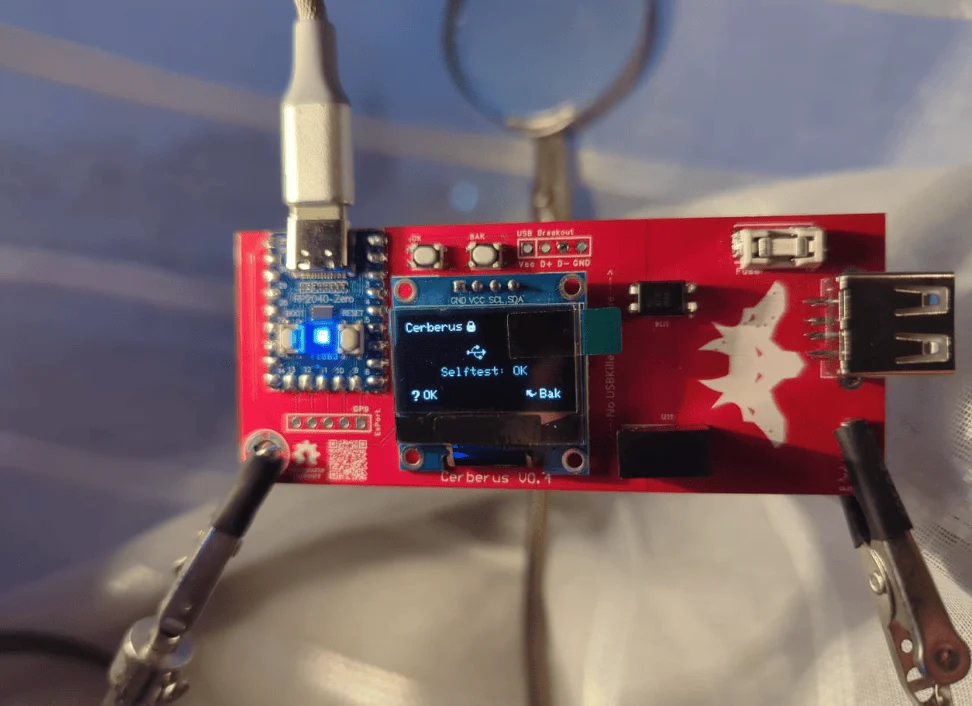
The September certification list also addresses the critical field of cybersecurity with the Cerebus (UID MX000041). Created by Erik Alcantra, the Cerebus is a pocket-sized security tool designed to inspect and analyze suspicious USB devices.
The threat posed by malicious USB devices is a well-documented challenge in information security. "BadUSB" attacks can involve devices that emulate keyboards to inject malicious keystrokes, or "USB Killers" that deliver high-voltage spikes to fry a computer’s internal components. The Cerebus acts as a protective buffer and diagnostic tool. When a suspicious USB device is plugged into the Cerebus, the tool analyzes the device’s behavior without exposing a host computer to risk.

Equipped with an OLED screen and multi-color LED indicators, the Cerebus provides real-time feedback on what the connected device is attempting to do. It can detect if a device is trying to offload files suddenly or if it is attempting to draw an unusual amount of power. By certifying this hardware as open-source, the developer allows security professionals to audit the Cerebus’s own code and hardware, ensuring that the tool itself is trustworthy. This transparency is essential for security tools, where "security through obscurity" is often viewed as a liability rather than an asset.
Chronology and Growth of the OSHWA Registry
The addition of 30 certifications in September 2026 is part of a decade-long upward trajectory for the association. OSHWA began its formal certification program in 2016 as a way to provide clarity in a market where the term "open source" was often used loosely or inaccurately.
- 2016–2018: The program launched with a focus on core hobbyist electronics, primarily from established players like Adafruit and SparkFun.
- 2019–2022: Certification rates accelerated as international creators from Europe and Asia began registering designs. The database reached its first 1,000 certifications.
- 2023–2025: The scope of certifications expanded beyond PCBs to include scientific instruments, assistive technology, and large-scale mechanical projects.
- 2026: The registry surpassed 3,400 certifications, with a notable increase in projects from Latin America (evidenced by the AR and MX prefixes) and a surge in educational and security-focused hardware.
Broader Implications for the Tech Industry
The continued success of the OSHWA certification program has several long-term implications for the broader technology industry. First, it challenges the traditional model of intellectual property (IP). By proving that successful hardware can be built on open designs, OSHWA-certified projects encourage a "commons-based" approach to innovation. This is particularly relevant in the fight against climate change, where open-source hardware can accelerate the deployment of green technologies by allowing for rapid, localized iterations of solar controllers, wind turbines, and environmental sensors.
Second, the program is fostering a more resilient global supply chain. When hardware designs are open, they are not tied to a single manufacturer. If a specific supplier goes out of business or faces logistical hurdles, other manufacturers can step in to produce the same certified hardware, ensuring that critical tools remain available to the public.

Finally, the rise of certified open-source hardware is influencing procurement policies in the public sector. Many universities and government research institutions are beginning to prioritize open-source hardware in their purchasing decisions to ensure that their investments are not lost to proprietary software "lock-in" or the discontinuation of support for legacy hardware.
Future Outlook
Looking ahead, OSHWA remains committed to expanding its reach. The association continues to provide updates through its automated certification bot on Mastodon, offering real-time notifications whenever a new project is approved. As the community moves toward the 4,000-certification milestone, the focus is expected to shift toward more complex integrated systems and the standardization of open-source documentation for sustainable manufacturing.
The September 2026 certifications—ranging from the PhotogateV2’s educational utility to the Cerebus’s security safeguards—demonstrate that the open-source hardware movement is no longer a niche interest for hobbyists. It has matured into a robust ecosystem capable of delivering professional-grade solutions to some of the most pressing challenges in education, safety, and digital security. For creators looking to join this movement, OSHWA continues to offer a streamlined application process, ensuring that the next 3,000 certifications will be as diverse and impactful as the last.