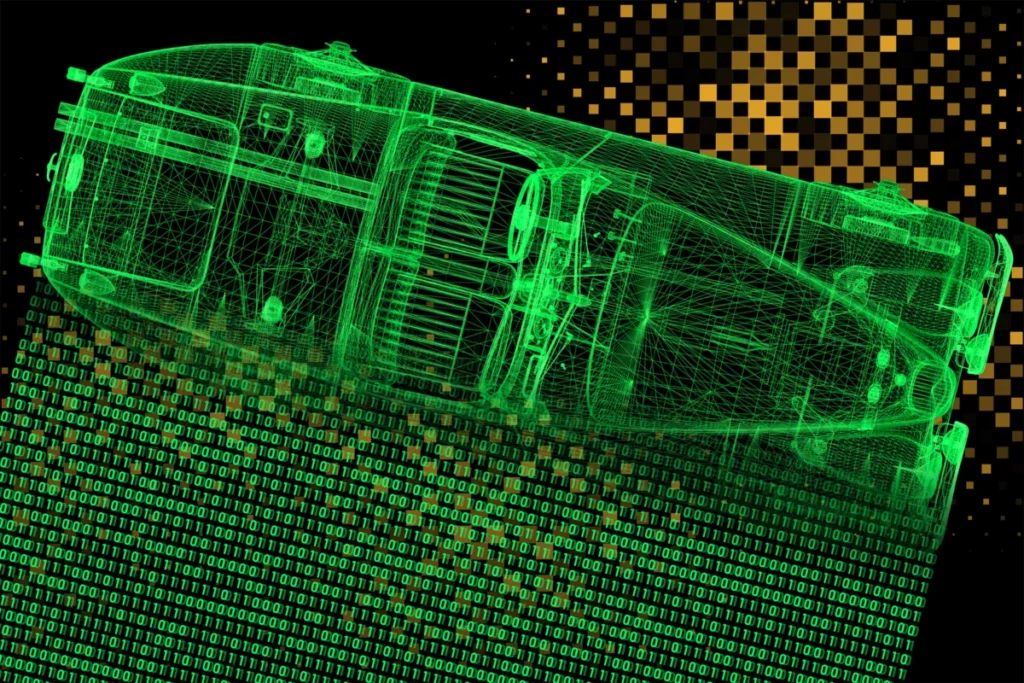
Engineers across critical sectors, from aerospace to automotive, routinely leverage vision-language models (VLMs) to conceptualize novel designs for components. These initial design sketches, often in two dimensions, represent the genesis of new products. To validate these concepts and predict their performance under real-world conditions—such as a vehicle crash or prolonged stress—engineers traditionally transition these 2D ideas into highly detailed 3D models using sophisticated computer-aided design (CAD) software. This established process, while robust, is inherently iterative and resource-intensive, requiring significant human expertise and computational power to generate functional models for virtual testing.
In a significant advancement poised to transform this foundational engineering workflow, researchers from the Massachusetts Institute of Technology (MIT) and partner institutions have developed an innovative system capable of autonomously teaching a VLM to convert 2D designs into executable CAD programs. This novel approach yields 3D models that are not only demonstrably more accurate and functionally robust than those produced by existing methods but also achieves these superior results using a mere fraction of the computational resources. The system, dubbed GIFT (Geometric Inference Feedback Tuning), marks a pivotal step toward truly intelligent and autonomous design automation.
This breakthrough, recently presented at the prestigious International Conference on Machine Learning (ICML), promises to profoundly streamline the rapid prototyping process, significantly reducing both development timelines and associated costs. Beyond mere efficiency gains, the technique holds the potential to empower engineers to explore a vastly wider design space, unearthing beneficial design choices that might otherwise remain undiscovered through conventional, human-led iteration. The core innovation lies in the system’s ability to generate its own training data by learning from its failures, a self-correcting mechanism that propels AI-driven CAD generation into a new era of performance and reliability.
The Evolution of Design Automation: From Manual Drafts to Intelligent Algorithms
The journey of engineering design has been one of continuous technological evolution. For centuries, design was a manual art, relying on skilled draftsmen and physical models. The mid-20th century saw the dawn of computer-aided design, initially with rudimentary drafting tools that digitized the manual process. Over decades, CAD software evolved into powerful platforms capable of complex parametric modeling, finite element analysis (FEA), and sophisticated simulations. Today, the global CAD software market is a multi-billion dollar industry, projected to exceed $11 billion by 2028, underscoring its indispensable role in virtually every manufacturing and engineering sector.
Despite CAD’s sophistication, a persistent bottleneck has been the translation of initial, often abstract, design concepts—frequently expressed as 2D sketches or high-level textual descriptions—into precise, executable 3D CAD models. This translation typically requires a highly skilled human operator to interpret the intent and translate it into a sequence of CAD commands. The advent of artificial intelligence, particularly in areas like computer vision and natural language processing, has opened new avenues for automating parts of this process. Generative design, for instance, uses AI algorithms to explore design permutations based on specified parameters, but still often requires significant human input for initial setup and final CAD model refinement.
Vision-language models (VLMs), which can process and interpret both visual and textual information, represent a frontier in this automation effort. These models have shown promise in understanding design intent from images and text. However, their application in high-precision engineering tasks like CAD generation has been hampered by a critical limitation: the scarcity of diverse, high-quality datasets linking 2D images or text directly to functional 3D CAD programs. Training a VLM to generate precise, executable CAD code demands vast amounts of paired data, encompassing a wide array of geometric complexities and functional requirements. Creating such datasets manually is extraordinarily time-consuming and expensive, thus becoming the primary impediment to widespread adoption of AI-driven CAD generation.
GIFT: A Self-Correcting Paradigm for CAD Generation
Recognizing this fundamental data bottleneck, the MIT-led research team focused on developing a novel data augmentation strategy. Traditional data augmentation techniques often involve randomly tweaking existing data – for example, adjusting colors, sizes, or orientations of objects in images – to create more training samples. While useful for general image recognition tasks, this approach falls short for the exacting demands of CAD generation, where minor inaccuracies can render a design unusable.
This is where GIFT (Geometric Inference Feedback Tuning) distinguishes itself. Instead of random alterations, GIFT employs a "model-aware" approach, meaning it understands the specific strengths and weaknesses of the VLM it is trying to improve. The system actively tests the VLM’s capabilities, pinpointing exactly where it struggles to convert a 2D image into a correct and executable CAD program.
The operational mechanism of GIFT is both elegant and highly effective. When tasked with a CAD generation problem, GIFT prompts the VLM to generate potential solutions (CAD code) multiple times in parallel. Crucially, it then rigorously checks the correctness and executability of these generated codes. As lead author Giorgio Giannone, a research affiliate in MIT’s Design Computation and Digital Engineering (DeCoDE) Lab and a principal research scientist at Red Hat, explains, "For a model, generating CAD query code that is almost correct is not that hard, but generating code that is perfectly correct and can be executed is much more challenging for a standard VLM."
GIFT capitalizes on these "near-misses"—the almost-correct but not quite executable solutions. For these imperfect guesses, GIFT intelligently adjusts them, transforming them into perfectly successful and executable CAD programs. These newly corrected "near-misses," alongside the VLM’s initial successful solutions, are then incorporated into a continuously expanding dataset. This unique dataset is specifically designed to teach the VLM how to overcome the very problems it initially struggled with, effectively turning its own errors into powerful learning opportunities. As Giannone notes, "We care about the in-between cases, where the model might only solve the problem 50 percent of the time." By focusing on these challenging scenarios, GIFT generates data augmentations that are both model-aware and task-aware, enabling the VLM to learn how to fix specific mistakes and tackle tricky problems it would typically struggle with independently.
Furthermore, by incorporating multiple correct solutions to the same design problem, the new data significantly broadens the VLM’s general knowledge and understanding of CAD code generation principles. This self-improving, automatic system operates without the need for human intervention to correct the model’s mistakes, representing a significant leap in AI autonomy within the design process.
Computational Efficiency and Performance Benchmarks
A critical aspect of GIFT’s innovation is its utilization of inference-time scaling. This technique allows a pre-trained VLM to generate superior outputs without the computationally expensive process of retraining the entire model from scratch. Users can dictate their desired computational budget, allowing GIFT to tailor its operations to specific time and resource constraints. This flexibility makes the system highly adaptable for various industrial applications, from small design studios to large-scale manufacturing enterprises.
In rigorous comparative evaluations, GIFT demonstrated a remarkable advantage over several competing techniques. The system consistently generated CAD programs with superior accuracy while consuming only approximately 20 percent of the computational resources required by other methods. The 3D CAD models produced by VLMs enhanced with GIFT exhibited significantly better alignment with ground-truth models, indicating a higher degree of geometric precision and functional fidelity. This efficiency and accuracy make GIFT a compelling solution for industries seeking to accelerate their design cycles without compromising on quality.
The Research Team and Collaborative Ecosystem
The development of GIFT is the result of a collaborative effort involving leading experts from academia and industry. The core research team includes Giorgio Giannone, the lead author; Anna Claire Doris, a mechanical engineering graduate student at MIT; Amin Heyrani Nobari, an MIT postdoc; Kai Xu of Red Hat; and co-senior authors Akash Srivastava, director of Core AI at IBM and a principal investigator at the MIT-IBM Computing Research Lab; and Faez Ahmed, associate professor of mechanical engineering at MIT, leader of the DeCoDE Lab, and also a principal investigator at the MIT-IBM Computing Research Lab. The research was notably funded, in part, by the MIT-IBM Computing Research Lab, highlighting the strategic importance of this work to both academic advancement and industrial application.
Faez Ahmed emphasizes the pervasive nature of CAD in modern industry: "Nearly every physical product around us, from airplanes to appliances, begins its life as a CAD model. Industry teams are eager for AI that can help speed-up the creation of these designs, but today’s models often produce simple shapes inadequate for practice." He further expressed his enthusiasm for GIFT’s self-improvement mechanism, stating, "What excites me about this work is that it gives many image-to-CAD-code models a way to improve themselves, learning from their own errors rather than waiting for more human-made data — and that brings trustworthy AI design tools much closer to everyday engineering." This sentiment underscores the critical need for AI tools that can reliably integrate into existing engineering workflows and build trust through their performance.
Akash Srivastava’s involvement from IBM underscores the strategic significance of this research for the broader AI landscape and its potential to accelerate digital transformation. IBM’s focus on enterprise AI and advanced computing research aligns perfectly with a system that promises to make AI more robust and applicable in complex engineering domains. Red Hat’s participation, with Kai Xu and Giorgio Giannone, also points to the potential for integrating such advanced AI capabilities into open-source platforms and enterprise solutions, fostering wider adoption and innovation.
Broader Impact and Future Implications
The implications of GIFT extend far beyond incremental improvements in CAD generation. Its ability to accelerate the design-to-prototype cycle has profound ramifications across multiple industries:
- Accelerated Rapid Prototyping and Time-to-Market: By automating the conversion of 2D designs to functional 3D CAD models, companies can drastically cut down the time spent on design iterations. This means products can move from concept to market much faster, providing a crucial competitive edge in fast-paced sectors like consumer electronics and automotive.
- Significant Cost Reduction: The automation provided by GIFT reduces the need for extensive manual CAD modeling, which is both time-consuming and labor-intensive. Furthermore, by enabling more accurate virtual testing earlier in the design phase, the system can reduce the number of expensive physical prototypes required, leading to substantial cost savings throughout the product development lifecycle.
- Democratization of Design and Innovation: GIFT could lower the barrier to entry for design and engineering. Individuals or smaller firms without access to large teams of CAD specialists might be able to leverage AI to bring complex designs to fruition. This could foster greater innovation from diverse sources. The system’s capacity to help engineers "identify beneficial design choices they might otherwise overlook" suggests a future where AI acts as a creative partner, pushing the boundaries of what is conventionally designed. This could lead to novel geometries, optimized structures for weight or strength, and more sustainable material usage.
- Workforce Transformation: Rather than replacing engineers, GIFT is likely to augment their capabilities. Engineers can shift their focus from the laborious, repetitive tasks of manual CAD creation to higher-value activities such as strategic design decisions, performance optimization, and creative problem-solving. The role of the engineer would evolve to one of oversight, refinement, and leveraging AI tools for maximum impact.
- Industry-Specific Applications:
- Aerospace: Design lighter, stronger, and more fuel-efficient components; accelerate certification processes through faster simulation cycles.
- Automotive: Rapidly iterate on vehicle body designs for aerodynamics and aesthetics, enhance crash safety through more extensive virtual testing, and optimize component integration.
- Healthcare: Develop custom prosthetics, medical devices, and surgical tools with unprecedented speed and precision.
- Architecture and Construction: Facilitate the design of complex, unconventional geometries and optimize structural elements for efficiency and material usage.
- Ethical Considerations and Future Challenges: As AI takes on more critical roles in design, important considerations arise regarding the validation of AI-generated designs, the potential for propagating errors, and intellectual property ownership. The need for robust human oversight and ethical guidelines for AI in engineering will become increasingly paramount to ensure safety and reliability.
Looking ahead, the researchers are keen to expand GIFT’s capabilities beyond purely geometric accuracy. "With GIFT, we started with geometry because with engineering problems, if the geometry of a 3D shape is not correct, nothing else will be correct, but there are many other aspects to consider," Giannone notes. Future developments aim to enable the framework to teach models to generate CAD programs that optimize for performance, manufacturability, and other critical engineering parameters. The team also plans to apply the system to larger, more complex models and a wider array of diverse CAD generation tasks, further solidifying its role as a transformative technology in the engineering landscape.
The development of GIFT represents a significant milestone in the journey toward truly autonomous and intelligent engineering design. By enabling AI models to learn and improve from their own mistakes, this system promises not only to make the design process faster and more cost-effective but also to unlock unprecedented levels of innovation across industries. As AI continues to integrate into the fabric of technological advancement, self-improving systems like GIFT will be instrumental in shaping the future of industrial design and manufacturing.






