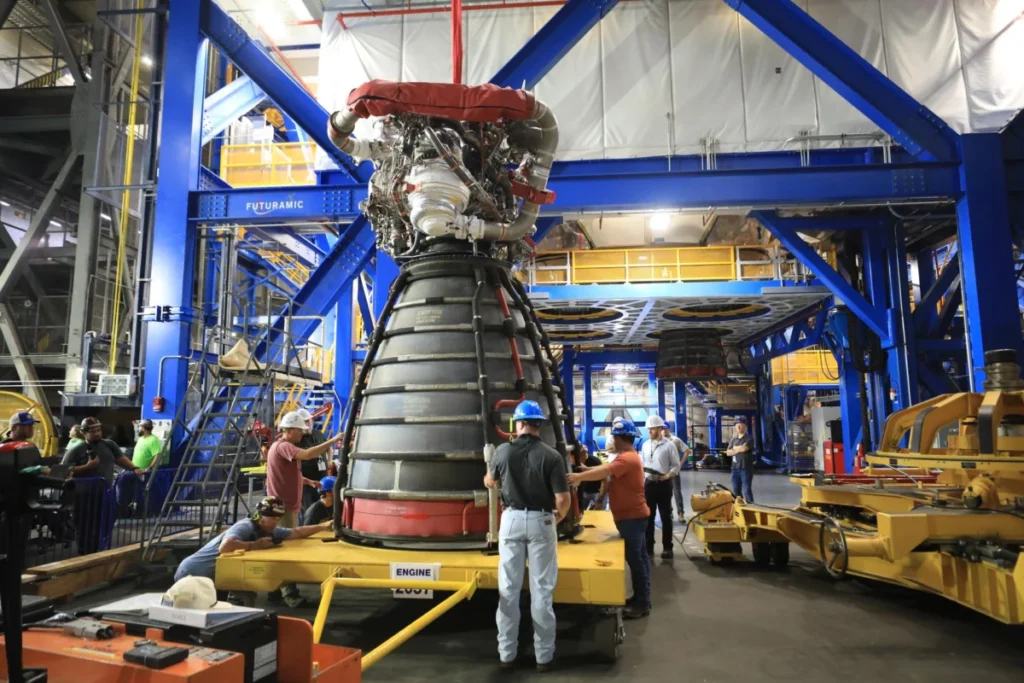
Technicians at NASA’s Kennedy Space Center in Florida commenced the critical installation of four RS-25 engines into the core stage of the agency’s Space Launch System (SLS) rocket on August 24th. This monumental undertaking marks a significant step forward in preparations for the Artemis III mission, slated to carry a human crew into low Earth orbit in 2027, with the ultimate objective of returning astronauts to the lunar surface. The selection of these specific engines carries a rich legacy, as each bears a unique serial number that meticulously documents its extensive flight history, including multiple pivotal missions during the Space Shuttle era.
A Legacy of Flight: The RS-25 Engines for Artemis III
The four RS-25 engines designated for the Artemis III mission – identified by their serial numbers E2054, E2057, E2048, and E2052 – are not new to the rigors of spaceflight. They are veteran engines that previously powered numerous Space Shuttle missions, a testament to their enduring reliability and performance. This reuse of flight-proven hardware underscores NASA’s strategic approach to space exploration, leveraging existing, well-understood technology to accelerate progress and manage costs.
Among these distinguished engines, E2048 holds a particularly notable place in spaceflight history. This engine played a crucial role in launching NASA astronaut Randy Bresnik’s earlier mission aboard the Space Shuttle Atlantis during STS-129. Even more historically significant, E2048 was also instrumental in the launch of Space Shuttle Discovery during STS-95 in 1998. This particular mission achieved a remarkable feat by returning U.S. Senator John Glenn, a revered space pioneer, to orbit. At 77 years old, Glenn’s participation in STS-95 made him the oldest person to have flown in space at that time, a record that stood for many years and captured the imagination of the world. The inclusion of such storied engines on the Artemis III rocket serves as a powerful symbol of NASA’s continuous pursuit of human space exploration, connecting the past achievements of the Shuttle program to the ambitious future of lunar exploration.
The Significance of the Space Launch System (SLS)
The Space Launch System (SLS) is the most powerful rocket NASA has ever built, designed to be the foundational element of America’s deep space exploration program. Its immense power is essential for launching the Orion spacecraft, carrying astronauts and cargo on missions to the Moon and eventually to Mars. The SLS consists of a massive core stage, two five-segment solid rocket boosters, and an upper stage. The core stage, standing an impressive 212 feet tall, is powered by the four RS-25 engines that are currently undergoing installation.
The RS-25 engines themselves are advanced liquid-propellant rocket engines that were originally developed for the Space Shuttle program. They are known for their efficiency, high thrust, and reusability. Each engine can produce a staggering 186,000 pounds of thrust at sea level, and when all four are firing in unison, they generate over 1.6 million pounds of thrust. For the Artemis missions, these engines have been upgraded to provide even greater power and efficiency, crucial for lifting the heavy SLS rocket and Orion spacecraft out of Earth’s gravity.
Artemis Program: A Return to the Moon and Beyond
The Artemis program represents NASA’s ambitious plan to land the first woman and the next man on the Moon by the mid-2020s, establishing a sustainable lunar presence and paving the way for future human missions to Mars. Artemis III is a pivotal mission within this program, as it is designated to be the first lunar landing mission since the Apollo program concluded over 50 years ago.
The mission profile for Artemis III involves launching astronauts aboard the SLS rocket, which will send the Orion spacecraft to lunar orbit. From there, a separate human landing system will descend to the lunar surface, carrying two astronauts. The crew will conduct surface operations, including scientific research and exploration, before returning to Orion for the journey back to Earth. The successful installation of the RS-25 engines is a tangible demonstration of progress towards achieving these historic goals.
Chronology of Engine Installation and Mission Milestones
The installation process for the RS-25 engines is a highly precise and complex operation. Technicians meticulously attach each engine to the forward and aft engine attachment struts on the core stage, ensuring secure and robust connections. This process involves intricate welding, bolting, and the connection of hundreds of electrical and hydraulic lines.
- August 24, [Year of Article Publication]: Technicians begin installing the four RS-25 engines (E2054, E2057, E2048, E2052) into the core stage of the SLS rocket at NASA’s Kennedy Space Center.
- [Recent Past Year]: The Artemis I mission, an uncrewed test flight of the SLS rocket and Orion spacecraft, successfully launched and orbited the Moon, validating the performance of the integrated system.
- [Upcoming Year, e.g., 2024]: The Artemis II mission, a crewed flyby of the Moon, is scheduled to launch, marking the first human flight aboard the SLS rocket and Orion spacecraft.
- [Upcoming Year, e.g., 2025]: The Artemis III mission’s core stage, now equipped with its RS-25 engines, will undergo further integration with other rocket components and testing.
- 2027: Scheduled launch of the Artemis III mission, aiming for the first human lunar landing in over five decades.
This timeline highlights the progressive nature of the Artemis program, with each mission building upon the successes of the previous ones. The engine installation is a critical step in this ongoing journey.
Supporting Data: The Power and History of RS-25 Engines
The RS-25 engines, formerly known as the Space Shuttle Main Engines (SSMEs), are a marvel of engineering. Each engine is capable of generating approximately 186,000 pounds of thrust at sea level and over 209,000 pounds of thrust in a vacuum. For the SLS, the engines operate at a higher thrust level than during the Shuttle program, reaching 110% of their rated power. This increased performance is essential for lifting the heavier Artemis payloads.
- Thrust per Engine: Approximately 186,000 lbs (at sea level)
- Total Thrust (4 engines): Over 1.6 million lbs (at sea level)
- Engine Type: Liquid Hydrogen/Liquid Oxygen (LH2/LOX)
- Duration of Burn: Approximately 8.5 minutes during launch
- Number of Flights per Engine (Shuttle Era): Typically between 10 and 30 missions
The engines’ reuse from the Space Shuttle program represents a significant cost savings and a reduction in development time. The Space Shuttle program, which ran from 1981 to 2011, saw the RS-25 engines complete over 300 missions. This extensive flight heritage provides NASA with a deep understanding of the engines’ performance characteristics, reliability, and maintenance requirements.
Engine E2048, for instance, has a distinguished service record. Its participation in STS-95 in 1998, which carried John Glenn, underscores its reliability and its role in historic spaceflights. Glenn’s return to space at an advanced age was a powerful symbol of continued human endeavor and the potential for older individuals to contribute to space exploration. The fact that this engine is now contributing to a mission that aims to land humans on the Moon again highlights the enduring legacy of the Shuttle era and its contribution to future space exploration.
Potential Statements and Reactions (Inferred)
While official statements specifically detailing the August 24th engine installation are typically released by NASA’s communications department, one can infer the sentiment within the agency and among spaceflight enthusiasts.
- NASA Program Managers: Would likely express satisfaction and a sense of accomplishment, emphasizing the dedication and expertise of the engineering and technician teams. They would highlight the importance of this milestone in keeping the Artemis III mission on track for its 2027 target. A hypothetical statement might read: "The successful installation of these four RS-25 engines marks a critical step forward for Artemis III. These engines are not just pieces of machinery; they are veterans of spaceflight, embodying the spirit of innovation and resilience that defines NASA’s human exploration efforts. We are confident in their performance as they power the next generation of lunar explorers."
- Aerospace Engineers and Technicians: Would likely feel a sense of pride and responsibility. The meticulous nature of their work, ensuring the flawless integration of these complex engines, is a testament to their skill. A technician might privately reflect on the historic significance of working on engines that have contributed to so many past missions and will now play a role in returning humans to the Moon.
- Astronauts Selected for Future Missions (including Artemis III): Would view this progress with great anticipation. The installation of the engines is a tangible sign that their training and the mission they are preparing for are moving closer to reality. They would likely express their eagerness to fly on the SLS rocket and contribute to the Artemis program’s objectives.
Broader Impact and Implications: A New Era of Lunar Exploration
The successful installation of these historic RS-25 engines on the Artemis III SLS rocket carries profound implications for the future of space exploration.
- Accelerated Lunar Presence: The Artemis program aims to establish a sustained human presence on the Moon. This means not just brief visits, but long-term research outposts and the potential for resource utilization. The Artemis III mission, by returning humans to the lunar surface, is the crucial first step in realizing this vision.
- Scientific Advancement: The scientific discoveries to be made on the Moon are vast. Astronauts will be able to conduct geological surveys, study lunar ice, and investigate the potential for in-situ resource utilization (ISRU), which could be critical for future deep space missions. The Artemis III mission will likely include scientific objectives focused on understanding lunar geology and the potential for resources.
- Technological Innovation: The challenges of sustained lunar presence will drive innovation in various fields, including life support systems, propulsion, robotics, and materials science. The development and refinement of technologies for Artemis will have spillover effects into other sectors on Earth.
- Inspiration and Education: The return of humans to the Moon will undoubtedly inspire a new generation of scientists, engineers, and explorers. It will reignite public interest in space exploration and underscore the importance of scientific and technological advancement. The stories of missions like Artemis III, powered by engines with such a rich history, will be passed down through generations.
- International Collaboration: While Artemis is a U.S.-led initiative, it involves significant international partnerships. This collaboration fosters diplomatic ties and allows for the pooling of resources and expertise, making deep space exploration more achievable and sustainable.
- Stepping Stone to Mars: The Moon is seen as a crucial proving ground for technologies and operational strategies that will be required for human missions to Mars. The lessons learned from Artemis missions, including the challenges and successes of lunar surface operations, will be invaluable for future Martian endeavors.
The installation of these RS-25 engines is more than just a technical procedure; it is a symbolic moment. It represents the confluence of past achievements and future aspirations, a tangible link between the pioneering spirit of the Space Shuttle era and the ambitious goals of the Artemis program. As these engines are secured within the core stage of the SLS rocket, they carry with them the legacy of countless journeys and the promise of new frontiers to be explored, bringing humanity one step closer to its cosmic destiny. The successful integration of these engines is a vital testament to the ongoing progress of NASA’s human spaceflight program and its unwavering commitment to pushing the boundaries of what is possible.