In the intricate landscape of modern motion control systems, the choice of communication protocols is paramount, dictated by the specific application scale and requirements. At the macroscopic level, connecting a network of drives, motors, and central controllers often necessitates robust industrial network protocols such as Ethernet, EtherCAT, or CAN. These protocols are engineered for long-distance communication, real-time performance across multiple nodes, and handling substantial data payloads. However, a different set of considerations emerges at the microscopic level—specifically, within the confines of a controller’s circuit board or directly between integrated circuits (ICs) within a microcontroller. Here, the emphasis shifts towards efficiency, simplicity, and high-speed data exchange over short distances, a niche perfectly filled by the Serial Peripheral Interface, or SPI.
Understanding the Serial Peripheral Interface (SPI)
The Serial Peripheral Interface (SPI) is a ubiquitous input-output standard for synchronous serial data transmission, predominantly employed in embedded systems for short-distance communication between various integrated circuits. Developed by Motorola in the mid-1980s, SPI emerged as a straightforward, high-speed solution for inter-chip communication, offering a less complex alternative to parallel buses for many applications. Its enduring popularity stems from its inherent simplicity and robust performance, making it a cornerstone in countless electronic designs.
At its fundamental physical layer, SPI operates as a four-wire serial interface, providing full-duplex communication. This means data can be transmitted and received simultaneously, a significant advantage in applications requiring rapid bidirectional data flow. The four wires typically comprise:
- SCLK (Serial Clock): Generated by the master device, this signal synchronizes data transmission and reception between the master and slave devices.
- MOSI (Master Out, Slave In): Data sent from the master to the slave device travels along this line.
- MISO (Master In, Slave Out): Data sent from the slave to the master device travels along this line.
- SS/CS (Slave Select/Chip Select): An active-low signal, also generated by the master, that selects a specific slave device for communication. Each slave device typically requires its own SS line, allowing a single master to communicate with multiple slaves individually.
Data rates for SPI can span from a few megahertz (MHz) to upwards of 10 MHz, and even higher in specialized implementations, making it suitable for a wide array of data-intensive tasks. The flexibility of SPI also extends to its data transmission size, which can be programmed from two to 24 bits, accommodating various data formats and peripheral requirements.
Advantages and Applications in Embedded Systems
One of SPI’s most compelling advantages is its efficient use of printed circuit board (PCB) space. By utilizing only four wires for communication, it drastically reduces the number of traces and pins compared to parallel bus systems, which might require eight, sixteen, or even more data lines in addition to control signals. This attribute is particularly critical in embedded systems, where board space is often at a premium, driving miniaturization and cost reduction.
SPI is extensively employed to facilitate data exchange between microcontrollers and a diverse range of peripheral devices. These include various sensor types (e.g., temperature, pressure, inertial measurement units), control devices (e.g., digital-to-analog converters, analog-to-digital converters), memory cards (e.g., SD cards, EEPROMs, Flash memory), and displays (e.g., OLED, LCD controllers). Its versatility makes it an indispensable tool for system designers.
SPI in Drive and Control Circuits: A Closer Look
In the context of motion control, SPI plays a crucial role in enabling precise and efficient communication within drive and control circuits. Typically, a motor driver equipped with SPI connectivity will feature an SPI port designed to interface directly with a microcontroller. This microcontroller then dispatches essential control signals, such as Pulse Width Modulation (PWM) signals, which regulate motor speed and torque. In some highly integrated designs, the controller logic might even reside on the same chip as the motor driver, further streamlining the communication pathway and minimizing latency. Beyond direct control, SPI also serves vital diagnostic purposes, allowing the microcontroller to query the motor driver for status information, error codes, and operational parameters, thereby enhancing system reliability and maintainability.
The architecture of SPI lends itself well to master/follower (often termed master/slave) configurations. A single master controller can communicate with one or more follower devices. While SPI inherently requires a separate Chip Select (CS) line for each slave in a multi-slave setup, making it pin-intensive if many slaves are present, its simplicity for point-to-point or a small number of slaves is unmatched.
Case Study: The Analog Devices TMC429 Motion Controller
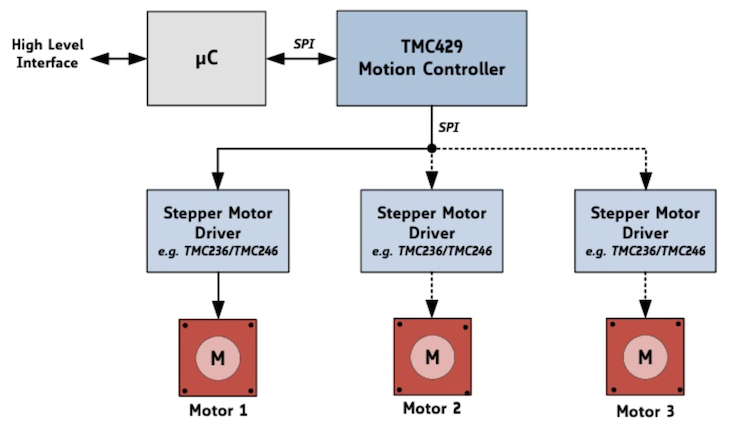
To illustrate SPI’s practical application, consider a motion control system built around the Analog Devices TMC429 motion controller chip. This specialized IC features both an SPI controller and a driver interface, making it an excellent example of SPI’s utility in complex motion applications. The TMC429 chip functions as a sophisticated three-axis motion controller, capable of precisely governing the position of stepper motors. It achieves this by generating and transmitting step and direction signals to external stepper motor drivers. These driver chips, in turn, interpret these digital signals and convert them into the appropriate coil currents required to actuate the stepper motors.
A notable feature of the TMC429’s design is its utilization of two separate four-wire SPI interfaces. One interface is dedicated to communication with a higher-level microcontroller, which typically provides the overall system commands and coordinates motion sequences. The second SPI interface is designed to communicate with up to three daisy-chained stepper motor drivers. This daisy-chaining capability allows for efficient control of multiple motors with a reduced number of microcontroller pins, showcasing SPI’s adaptability in multi-axis systems. This architecture not only simplifies wiring but also enables centralized control and monitoring of individual motor axes.
Broader Impact and Market Trends
The integration of SPI into motion control chips, exemplified by the TMC429, is driving innovation across a wide spectrum of applications. These include the automation of laboratory equipment, where precise and repeatable motion is critical for tasks like sample handling and reagent dispensing. In the burgeoning field of 3D-printing systems, SPI-enabled controllers ensure the accurate movement of print heads and build platforms, directly impacting print quality and speed. Furthermore, these chips are integral to various other industrial and consumer automation applications, from robotic arms to automated assembly lines, where fine-grained motor control is indispensable.
The increasing electrification across various vehicle subsystems represents another significant growth area for SPI-enabled motor controllers. As automotive manufacturers integrate more motors for functions ranging from power windows and seats to advanced driver-assistance systems (ADAS) and electric powertrains, the demand for compact, efficient, and reliable motor control solutions surges. Chip manufacturers are actively responding to this trend. Toshiba, for instance, has introduced advanced gate drivers specifically tailored for brushed DC motors in automotive applications. The TB9104FTG gate driver is a prime example, featuring integrated SPI with on-board motor control circuits. This integration not only streamlines the design process for automotive engineers but also incorporates built-in motor current sense amplifier circuitry and a PWM drive circuit, enhancing both control precision and diagnostic capabilities. Such integrated solutions reduce component count, simplify wiring harnesses, and improve overall system reliability, critical factors in the demanding automotive environment.
Comparison with Other Serial Protocols
While SPI is highly effective for inter-chip communication, it’s beneficial to understand its position relative to other common serial protocols like I2C (Inter-Integrated Circuit) and UART (Universal Asynchronous Receiver-Transmitter).
- I2C: Like SPI, I2C is a synchronous, two-wire protocol (SDA for data, SCL for clock) typically used for short-distance, inter-chip communication. Its primary advantage is requiring fewer pins and supporting multiple masters and slaves on the same bus with unique addresses. However, I2C is generally slower than SPI due to its open-drain configuration requiring pull-up resistors and its byte-oriented, acknowledged communication overhead. SPI’s dedicated MISO/MOSI lines allow for faster, full-duplex operation without the addressing overhead.
- UART: UART is an asynchronous serial communication protocol that uses only two wires (Tx and Rx). It does not require a clock signal, relying instead on pre-agreed baud rates between sender and receiver. This makes it simpler in terms of wiring but can lead to synchronization issues if baud rates are mismatched or drift. UART is commonly used for communication between a microcontroller and a PC, or between microcontrollers over slightly longer distances than typical SPI/I2C applications. However, its asynchronous nature and lack of a shared clock typically make it slower and less suitable for high-speed, byte-level inter-chip communication compared to SPI.
SPI’s key advantages over these alternatives for specific applications include its high speed, full-duplex capability, and the absence of a complex addressing scheme (since slaves are selected directly via CS lines). Its main drawback is the need for more pins when communicating with multiple slaves, as each slave requires its own Chip Select line.
Future Outlook and Continued Relevance
Despite being a mature technology, SPI’s fundamental strengths — simplicity, speed, and efficiency for short-distance inter-chip communication — ensure its continued relevance in an ever-evolving technological landscape. As embedded systems become more complex, integrating a greater number of sensors, actuators, and memory components, the need for a reliable and fast internal communication backbone remains critical. The ongoing miniaturization trend, fueled by the Internet of Things (IoT) and wearable technology, further solidifies SPI’s position, as designers continuously seek ways to reduce board space and power consumption without compromising performance.
Industry analysts predict that the market for embedded systems will continue its robust growth, driven by advancements in industrial automation, smart home devices, automotive electronics, and medical technology. Within this growth, the role of efficient communication protocols like SPI, often integrated directly into System-on-Chips (SoCs) and specialized controllers, will remain central. Manufacturers like Analog Devices and Toshiba continue to innovate, embedding SPI functionality into increasingly sophisticated chips that offer higher levels of integration, lower power consumption, and enhanced diagnostic capabilities. This ensures that while external network protocols manage the macro-level communication, SPI will continue to be the workhorse enabling the seamless, high-speed interaction between components at the very heart of electronic devices.