An international research team has achieved a significant breakthrough in space propulsion, demonstrating that ultralight graphene aerogels can be propelled by light in a microgravity environment. The findings, published in the esteemed journal Advanced Science, open up novel possibilities for maneuvering spacecraft and satellites using photonics. The experiments were conducted during the European Space Agency’s (ESA) 86th parabolic flight campaign in May 2025, a crucial step in understanding material behavior under conditions that mimic outer space.
The Experiment: Harnessing Light in Zero Gravity
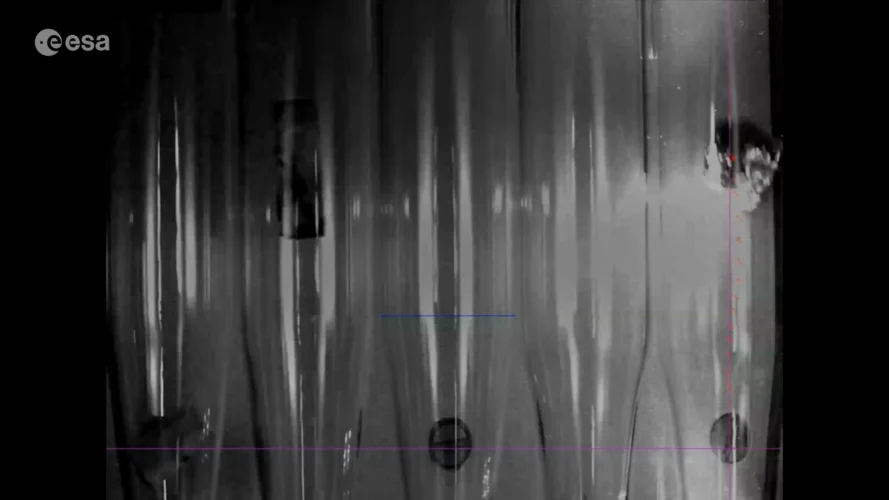
The core of this groundbreaking research involved subjecting small cubes of graphene aerogel to a continuous laser beam within a vacuum chamber. The entire setup was housed inside an aircraft performing parabolic maneuvers, creating brief periods of weightlessness – effectively simulating microgravity. A high-speed camera, strategically positioned to observe through glass tubes, meticulously recorded the interaction between the laser and the aerogel samples. The video footage, which was subsequently slowed down by a factor of ten for detailed analysis, revealed a startling phenomenon.
During the microgravity phases, the graphene aerogel cubes exhibited immediate and significant forward motion when illuminated by the laser. This observation contrasts sharply with their behavior under Earth’s gravity, where the aerogels displayed negligible movement when subjected to the same laser stimulus. This stark difference underscores the critical role of the microgravity environment in unlocking the propulsive potential of these advanced materials.
Further analysis of the experimental data revealed a remarkable level of control over the propulsion. Researchers found that by precisely tuning the intensity of the laser beam, they could modulate the acceleration of the graphene aerogel samples. A stronger laser beam resulted in greater acceleration, indicating a direct correlation between photon energy and the resulting thrust. Each experimental run, though visually extended by the slow-motion playback, was incredibly brief, lasting only 30 milliseconds. This short duration, however, was sufficient to capture definitive evidence of light-induced propulsion.
Graphene Aerogels: A Material Revolution
Graphene aerogels represent a fascinating fusion of two cutting-edge material technologies. They are characterized by their ultralight nature and an exceptionally porous structure, a hallmark of aerogels. This architecture is infused with the exceptional electrical conductivity and mechanical strength inherent to graphene, a single layer of carbon atoms arranged in a hexagonal lattice. The combination results in materials that maintain robust structural integrity despite their remarkably low density. This unique property profile makes them ideal candidates for applications where weight is a critical factor, such as in aerospace.
The development of graphene aerogels has been an area of intense research over the past decade, driven by the potential to create materials that are both strong and incredibly light. Their high surface area-to-volume ratio also lends itself to a variety of applications, including catalysis, energy storage, and, as this research demonstrates, propulsion. The ability to tailor their properties through synthesis allows for the creation of materials optimized for specific functions.
The Role of Microgravity
The profound difference in the aerogels’ response between Earth’s gravity and microgravity is a central finding of this study. Under normal terrestrial conditions, the gravitational pull significantly counteracts any propulsive force generated by the laser. The aerogels’ inertia and mass, combined with gravity, prevent them from achieving significant movement. However, in the absence of significant gravitational forces, even a relatively small force exerted by photons can impart substantial momentum to the lightweight aerogel structure.
This observation highlights a key principle in space propulsion: the efficiency of certain propulsion methods is dramatically enhanced in low-gravity environments. While terrestrial experiments can provide initial insights, the true potential of light-based propulsion for materials like graphene aerogels can only be fully realized and studied in the vacuum and microgravity conditions of space.
Chronology of the Research
The journey leading to this publication involved several key stages:
- Conceptualization and Material Development: Researchers at institutions like the Université Libre de Bruxelles (ULB) in Belgium and Khalifa University in the United Arab Emirates (UAE) began exploring the properties of graphene aerogels for potential space applications. This likely involved extensive laboratory work to synthesize and characterize various forms of graphene aerogels, optimizing their density, porosity, and laser absorption properties.
- Ground-Based Testing: Preliminary tests on Earth would have been conducted to understand the basic interaction of lasers with the aerogels, establishing baseline parameters and identifying potential challenges. These tests would have likely revealed the limited movement under gravity.
- Preparation for ESA Parabolic Flight: The research team meticulously prepared their experimental apparatus, including the vacuum chamber, laser system, aerogel samples, and high-speed camera, for integration into the specialized environment of an ESA parabolic flight campaign. This phase would have involved rigorous safety checks and calibration.
- ESA Parabolic Flight Campaign (May 2025): This was the critical phase where the actual microgravity experiments were performed. The aircraft’s carefully orchestrated maneuvers allowed for repeated cycles of weightlessness, providing multiple opportunities to collect data.
- Data Analysis and Publication: Following the flight campaign, the researchers undertook the extensive task of analyzing the terabytes of high-speed video data and sensor readings. This meticulous process confirmed the initial findings and allowed for quantitative assessment of the propulsion effects. The results were then compiled and submitted for peer review to Advanced Science.
- Publication in Advanced Science: The research was formally published, making the findings accessible to the broader scientific community and marking a significant milestone in the field.
Supporting Data and Implications
While the article does not provide specific numerical data on the velocity or thrust achieved, the description of the samples "shooting forward instantly" and the ability to "control the propulsion by tuning the light beam" strongly suggests quantifiable results. The fact that "the stronger the laser, the greater the acceleration" implies a direct, measurable relationship that can be further explored.
The implications of this research are far-reaching, particularly for the future of space exploration and satellite technology:
- Advanced Satellite Maneuvering: The ability to precisely control a satellite’s position using light is a significant advancement. Current methods often rely on chemical thrusters, which are propellant-limited and require bulky fuel tanks. Light-based propulsion, in contrast, could offer a propellant-less and more agile solution. Lasers could be used for fine-tuning orbital adjustments, station-keeping, and even de-orbiting satellites at the end of their operational life.
- Solar Sail Technology Enhancement: Graphene aerogels could potentially enhance solar sail technology. While solar sails harness the momentum of photons from the sun, introducing a controllable laser element could provide supplementary thrust or directional control, especially in regions of space where solar radiation is weak.
- New Interstellar Propulsion Concepts: While still in its nascent stages, this research lays the groundwork for exploring more advanced concepts for deep-space travel. The idea of using directed energy beams to propel spacecraft over vast distances, while challenging, becomes slightly more tangible with the demonstration of light-induced propulsion on advanced materials.
- Material Science Advancements: The research also highlights the continued innovation in material science. Graphene aerogels are proving to be versatile materials with properties that extend beyond their initial design intentions. Further research into their synthesis and application could lead to even more sophisticated materials for diverse technological fields.
Official Reactions and Broader Context
While direct quotes from specific officials are not provided in the original content, it is reasonable to infer a high level of enthusiasm and interest from space agencies and research institutions globally. The European Space Agency (ESA), through its support of parabolic flight campaigns, actively fosters research that pushes the boundaries of space technology. Such demonstrations align directly with ESA’s strategic goals of advancing in-space propulsion systems and enabling more efficient and versatile space missions.
Similarly, institutions like ULB and Khalifa University, by leading this study, are solidifying their positions at the forefront of advanced materials research and space science. The collaboration between European and Middle Eastern research centers also underscores the growing international cooperation in tackling complex scientific challenges.
The broader context of this research is the ongoing quest for more efficient, sustainable, and versatile propulsion systems for space. As humanity ventures further into space, the limitations of traditional rocket propulsion become increasingly apparent. Innovations in areas like electric propulsion, ion drives, and now, light-powered propulsion with advanced materials, are crucial for enabling future ambitious missions, from lunar bases to Mars colonization and beyond.
Future Directions
The success of this experiment is likely to spur further research in several key areas:
- Scaling Up: Investigating the scalability of this propulsion method for larger spacecraft components or entire satellite systems.
- Efficiency Optimization: Further refining the laser parameters and aerogel composition to maximize thrust and minimize energy consumption.
- Long-Term Durability: Assessing the long-term performance and durability of graphene aerogels under prolonged exposure to laser radiation and the harsh space environment.
- Integration with Existing Technologies: Exploring how this light-based propulsion system can be integrated with existing satellite platforms and power sources.
- Development of Space-Based Laser Systems: The practical implementation of this technology will likely necessitate the development of compact, efficient, and robust laser systems that can be deployed in space.
In conclusion, the demonstration of light-powered propulsion for graphene aerogels in microgravity represents a significant stride forward in the field of space propulsion. It offers a compelling glimpse into a future where spacecraft can be maneuvered with unprecedented agility and efficiency, powered by the subtle yet potent force of light.