H. Moser & Cie. has long occupied a unique niche within the independent watchmaking landscape, characterized by a blend of provocative design, vibrant aesthetics, and an approachable yet sophisticated ethos. For many enthusiasts, including this author, the brand has represented a refreshing departure from convention, capable of being perceived as both subtly understated and audaciously flamboyant. This duality has been a hallmark of Moser’s identity since its resurgence into the higher echelons of horology. However, as the brand evolves, so too does its positioning and product development, a transformation notably reflected in the H. Moser Pioneer Centre Seconds in a 40mm case, specifically the striking Arctic Blue variant. This timepiece, which has spent a significant period under review, serves as a tangible representation of the brand’s journey from its earlier, more irreverent phase to its current trajectory of ambitious expansion and industry integration.
A Shift in Strategy: From Provocation to Prestige
The evolution of H. Moser is a narrative of calculated ambition. A decade ago, the brand gained attention for its daring marketing stunts, such as trolling Apple with its "Apple Watch" (made of cheese) and its outspoken critiques of industry norms. This era, perhaps best described as "Our MAD Magazine Era," was marked by a playful subversion of horological traditions. Now, however, Moser appears to be entering a new chapter, tentatively titled "Ambition and Expansion." This signifies a move towards a more serious and refined approach, aimed at capturing a broader and more discerning audience.

This strategic shift is evident in the brand’s physical presence and market positioning. H. Moser has transitioned from its former location in the Carré at Watches & Wonders to a prominent spot in the main hall, now situated mere steps from established giants like A. Lange & Söhne and Vacheron Constantin. This relocation is more than just a change of venue; it symbolizes Moser’s self-perception as a peer within the watchmaking establishment, shedding its underdog persona. The brand’s enduring tagline, "Very Rare," now carries a dual meaning: a nod to its limited production numbers and a testament to its distinctive perspective, which has earned it a seat at the table of haute horlogerie.
The 40mm Pioneer: A Reshaping of Proportions and Appeal
A critical element of Moser’s strategy to reach a wider audience involves producing timepieces with more universally appealing case dimensions. The introduction of the Pioneer Centre Seconds in a 40mm diameter was a significant development, addressing a key concern for many who found the previous 43mm case size to be somewhat unwieldy. The author’s prior experience with the 43mm Pioneer "Mega Cool" highlighted the dial’s undeniable appeal, but the case’s substantial proportions were a limiting factor. The 40mm iteration, therefore, represented a much-anticipated refinement, making the Pioneer collection more accessible. It is indeed noteworthy that Moser continues to produce the 43mm version alongside the 40mm, a decision that prompts contemplation regarding market strategy and consumer preference.
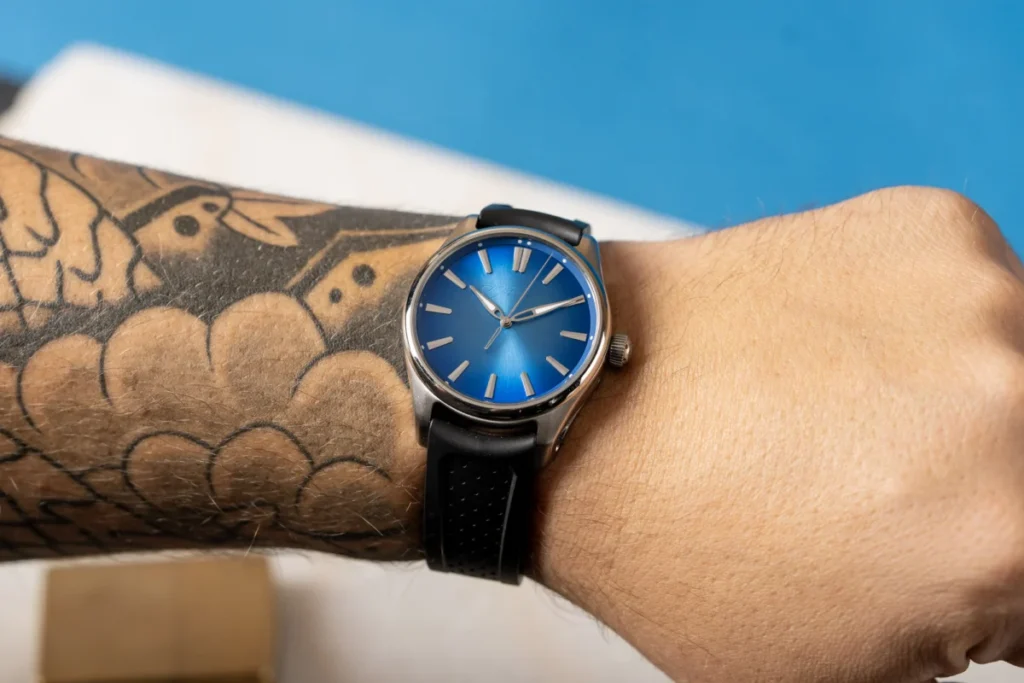
The 40mm Pioneer case is, in a word, exceptional. Its proportions have been meticulously calibrated, resulting in a more harmonious and comfortable wearing experience. While the larger 43mm case could technically be worn by individuals with larger wrists, its presence often felt borderline and less than optimal for prolonged wear. In contrast, the 40mm variant, despite retaining the core design language of its predecessor, feels significantly more ergonomic. This improvement is largely attributed to a reduction in overall dimensions without compromising the case’s distinctive character.

Dimensions and Ergonomics: A Masterclass in Proportionality
Measuring just under 48mm from lug to lug and 12mm in thickness (including the domed sapphire crystal), the 40mm Pioneer strikes a compelling balance. When the significant curvature of the sapphire crystal is accounted for, the actual thickness of the watch’s metal case is approximately 10.5mm. This measured thickness contributes to a more refined profile on the wrist. The 48mm lug-to-lug span, while not diminutive, firmly places it within the category of a substantial sports watch, yet it avoids the ostentatious presence that can sometimes accompany larger timepieces. The reduced lug-to-lug measurement, approximately 3mm shorter than the 43mm version, allows the elegantly curved lugs to exert a more significant positive influence on comfort, enhancing the overall wearability.
The caseband of the Pioneer further showcases Moser’s commitment to meticulous finishing. A signature design element is the recessed cutout, adorned with fine vertical lines. In the 40mm iteration, this detail feels more integrated and subtle, serving as a refined accent rather than a dominant visual feature, which was sometimes the perception in the larger case. This nuanced execution elevates the watch’s aesthetic sophistication.
The Arctic Blue Dial: A Study in Restrained Elegance

The dial of the H. Moser Pioneer Centre Seconds Arctic Blue is a masterclass in the brand’s signature fumé technique. H. Moser has been a pioneer in this aesthetic, predating its widespread adoption by other manufacturers, and continues to execute it with unparalleled mastery. The Arctic Blue fumé dial exhibits a gradual transition of color, deepening towards the periphery. Crucially, this transition is subtle and sophisticated, avoiding the overly dramatic or stark contrast that can sometimes characterize extreme fumé dials. Unlike some contemporary dials that feature intense textures or extreme color gradients, Moser’s restrained approach here allows the inherent beauty of the color and the dial’s subtle depth to shine through. This sophisticated execution avoids the potential for visual fatigue, making the dial a pleasure to behold day after day.
A key aspect of Moser’s design philosophy, particularly evident in their "Concept" series, is the emphasis on dial aesthetics, often achieved by omitting traditional hour markers, logos, and wordmarks. While the Pioneer, as a sports watch, necessitates legible hour markers, this 40mm variant comes remarkably close to the minimalist ideal. It features applied, faceted hour markers that are elegantly understated. Notably, there are no minute markers, and the brand’s name is subtly engraved and only visible at specific angles and under certain lighting conditions. This deliberate minimalism contributes to a sense of purity and allows the dial’s color and texture to remain the primary focus.
This minimalist approach, while aesthetically pleasing to many, can be a point of contention within the watch enthusiast community. Some purists advocate for a precise minute track for enhanced legibility and functionality. The Pioneer 40mm, in this regard, offers a compelling compromise, balancing Moser’s signature aesthetic with the practical requirements of a sports watch.
The Caliber HMC 200: In-House Prowess and Robust Performance

Powering the Pioneer Centre Seconds is the HMC 200 caliber, H. Moser’s in-house automatic movement. This robust and modern caliber serves as the foundation for more complex movements within the Moser collection and is renowned for its reliability and impressive 72-hour power reserve. During several weeks of testing, the HMC 200 demonstrated exceptional timekeeping accuracy, consistently running just a few seconds fast per week. This performance underscores the movement’s precision engineering.
While the finishing of the HMC 200 is largely machine-executed, it is executed to a very high standard, resulting in a visually appealing aesthetic visible through the exhibition caseback. The movement is well-proportioned to the case, creating a pleasing visual balance. A significant point of pride for H. Moser is its in-house production of its hairsprings through its sister company, Precision Engineering AG. This vertical integration, encompassing the hairspring, balance wheel, and escapement, highlights Moser’s deep commitment to manufacturing excellence and technical horology, a facet that often gets overshadowed by the brand’s striking visual designs. This capability firmly establishes Moser as a manufacturer with significant watchmaking bona fides beyond its aesthetic appeal.
The Rubber Strap: A Signature of Modern Sporty Chic
The standard configuration for the Pioneer Centre Seconds includes a supple, high-quality rubber strap. While a bracelet is available as a custom order, Moser is widely credited with popularizing the high-end independent watch on a rubber strap, a look that has evolved into a distinct sub-genre. This approach aligns perfectly with the Pioneer’s sporty character. The integrated tang buckle features design accents that echo the case’s aesthetic, a thoughtful detail that enhances the cohesive design.

The choice of a rubber strap significantly influences the wearing experience, particularly during warmer months. The author found the Arctic Blue Pioneer to be an ideal "summer watch," a designation that, while subjective, highlights the strap’s contribution to a casual and comfortable feel. The vibrant dial, paired with the casual nature of the rubber strap, creates a timepiece perfectly suited for less formal environments. It is difficult to imagine this watch performing as effectively on leather or other more formal strap materials, as its inherent casualness is amplified by the rubber.
Personal Perspective: A Reflection on Brand Trajectory
As an admirer of H. Moser, spending extended time with the Pioneer 40mm prompted reflection on its place within the brand’s broader collection and the author’s personal watch aspirations. While the 40mm Pioneer case is undeniably a significant improvement over its larger counterpart, it does not represent the collection that the author would personally gravitate towards for a potential Moser acquisition.
The author’s inclination would lean towards a steel Endeavour model, ideally with a Concept dial and a 40mm case. This combination, in the author’s view, encapsulates the quintessential Moser essence: a harmonious blend of versatility, unique design sensibilities, and exceptional craftsmanship, all presented in a wearable format suitable for diverse contexts. The Endeavour collection, with its more formal base, provides an ideal canvas for Moser’s experimental dial work and daring artistic expressions.

Furthermore, the Streamliner collection has increasingly garnered appreciation. While not an adherent to the integrated bracelet sports watch trend, the Streamliner’s bracelet is widely lauded for its originality, finishing, and comfort, often considered among the best in its class. The growing number of Streamliner owners who consider it a favorite within highly curated collections speaks volumes about its success.
In comparison to the Endeavour and Streamliner, the Pioneer collection, in both its 40mm and 43mm iterations, feels somewhat less defined. The Endeavour clearly excels as a canvas for Moser’s experimental dress watch concepts, while the Streamliner represents a sophisticated take on the integrated bracelet sports watch archetype. The Pioneer, with its 120 meters of water resistance and screw-down crown, positions itself as a capable sports watch but perhaps lacks the distinct personality and clear design intent of its siblings. It feels like a deliberate attempt to bridge different categories, and in doing so, may have compromised some of the brand’s inherent edginess.
Pricing and Market Positioning: A Strategy for Growth
The H. Moser Pioneer Centre Seconds Arctic Blue is priced at CHF 12,900, which, at the time of writing, translates to approximately $16,000 USD. This positions it as one of Moser’s more accessible offerings. While the concept of "value for money" in haute horlogerie is complex, the asking price is not perceived as exorbitant given the brand’s manufacturing capabilities and the quality of the timepiece.

It is crucial to temper expectations regarding speculative investment in H. Moser timepieces. The era of social media-driven hype inflaming the prices of independent watches is largely behind us. H. Moser’s strategic trajectory suggests a focus on sustainable growth and brand building rather than chasing ephemeral market trends. The brand’s current game plan appears to be firmly rooted in establishing itself as a respected and enduring independent manufacturer.
The brand’s presence in the main hall of Palexpo and its investment in expanding its retail footprint are clear indicators of its commitment to long-term growth. Timepieces like the Pioneer 40mm, offered in various colorways, serve as accessible entry points for new customers, allowing them to experience the H. Moser brand at a relatively lower barrier to entry. This strategy is likely to continue with the introduction of new models and variations.
Conclusion: A Maturation with Enduring Appeal
The H. Moser Pioneer Centre Seconds 40mm Arctic Blue represents a significant milestone in the brand’s evolution. It is, arguably, one of the most well-executed and broadly appealing watches Moser has produced. In achieving this, however, it has also smoothed some of the rough edges and provocative spirit that initially defined the brand. This is a natural progression for a company focused on future-proofing its business and solidifying its position within the industry.

While Moser continues to produce daring and conversation-starting pieces, such as the Streamliner Pump, the overall trajectory points towards a more measured and perhaps "safer" approach compared to the audacious conceptual pieces of the past. The Pioneer 40mm, while a superb watch, embodies this maturation. It is a testament to H. Moser’s success and its commitment to growth, even as it signals a departure from the provocative charm of its earlier years. The brand’s journey from a playful disruptor to a respected member of the horological establishment is evident, and the Pioneer 40mm Arctic Blue stands as a compelling artifact of this transformative period.