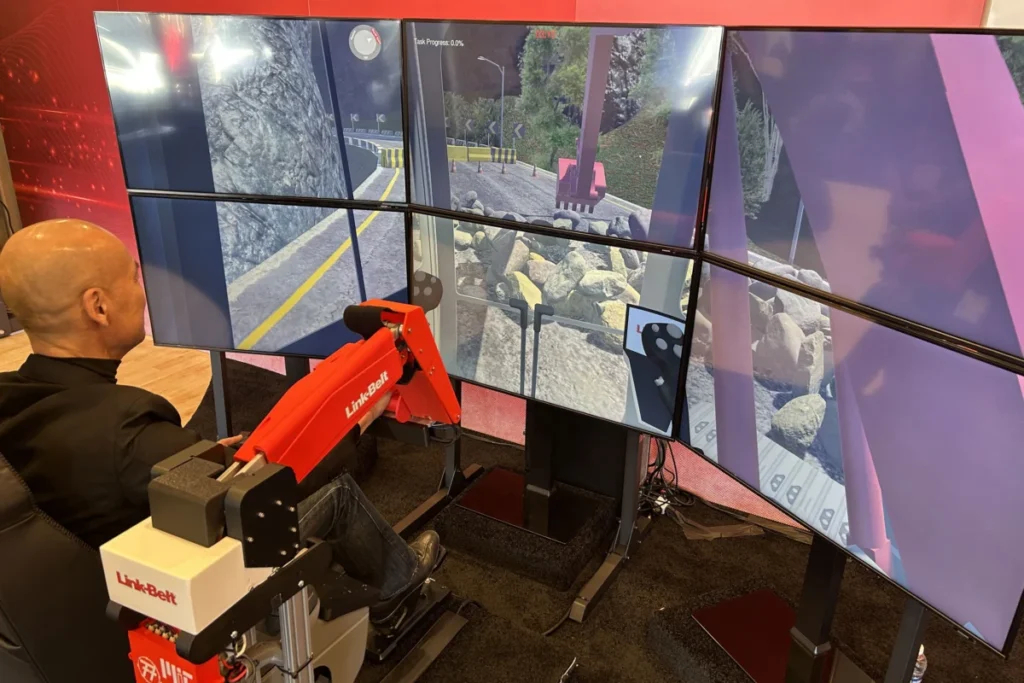
A groundbreaking advancement in human-machine interaction, developed by researchers at MIT in collaboration with Sumitomo Heavy Industries, promises to fundamentally transform the way heavy machinery, particularly excavators, are operated and how new operators are trained. Termed the "World-Space Interface" (WSI), this innovative control system replaces traditional, often complex, joystick mechanisms with a more intuitive, mimetic approach that significantly reduces the cognitive load on operators and drastically cuts down training times. This paradigm shift, detailed this week in the Journal of Computing and Civil Engineering, represents a pivotal moment for the construction, mining, and disaster response sectors, offering enhanced safety, efficiency, and accessibility to a critical workforce.
Hermano Krebs, a principal research scientist in MIT’s Department of Mechanical Engineering and a lead figure in this research, articulated the core benefit of the WSI, stating, “This is a more intuitive way to command the machine. With this new interface, we can eliminate a lot of the mental maps that an operator would need to build in order to operate an excavator.” This observation underscores a long-standing challenge in heavy machinery operation: the disconnect between an operator’s natural motor skills and the abstract commands required by joysticks. The WSI seeks to bridge this gap by allowing operators to directly mimic the actions they wish the machine to perform, essentially moving their own arm as if they were the excavator’s arm, making the machine an extension of their body rather than a separate entity to be remotely manipulated.
The Genesis of Intuitive Control: Addressing Industry Needs
The collaboration between MIT and Sumitomo Heavy Industries, an industrial machinery manufacturer based in Japan, began in 2018. Sumitomo’s impetus for seeking a novel solution stemmed from a pressing demographic challenge: Japan’s rapidly aging population of heavy machinery operators. The need for a faster, more efficient method to train their replacements was critical. Traditional training protocols, which often involve months, if not years, of hands-on experience in controlled environments, were proving unsustainable given the pace of workforce turnover and the increasing complexity of modern construction projects.
Currently, aspiring operators typically learn by driving actual excavators on designated training courses. This process demands a steep learning curve, requiring novices to mentally map the movements of multiple joysticks to the corresponding actions of the excavator’s arm, bucket, and cab. Mastering the coordination of these disparate controls to execute precise tasks, such as scooping and dumping materials, digging trenches, or clearing debris, introduces an additional layer of complexity that can take a significant amount of time and resources to overcome. The inherent danger of operating heavy machinery also means that initial training must be meticulously supervised, adding to the cost and duration.
Krebs’ group at MIT, with its extensive background in human-robot interactions and a particular focus on physical rehabilitation, brought a unique perspective to this challenge. Their long-standing research into how humans control their limbs and how they can most intuitively interact with machines provided a crucial foundation. This expertise allowed the team to approach the problem from a human-centric design perspective, seeking to align machine control with innate human motor patterns rather than forcing human adaptation to machine mechanics.
The World-Space Interface: A Machine Mimic in Action
The researchers reasoned that if they could eliminate the need for the laborious "mental map" construction, they could drastically shorten the training period. Their solution was to design a mechanical arm interface that physically resembles the excavator’s arm and bucket. This miniature arm, potentially worn by the operator "kind of like an exoskeleton," as Krebs describes, allows for direct, mimetic control. An operator simply moves their arm in the way they want the excavator’s arm to move, and the WSI translates these natural gestures into machine commands.
The term "World-Space Interface" itself is indicative of this direct translation. Krebs explained, "‘World-space’ refers to everything in the world that is outside of yourself, or in this case, outside of the excavator’s cab. Normally, operators have to build a mental map of how to manipulate things in the world-space. But now, we can just mime picking up rocks or dirt, and the computer will do that translation to the world-space for us." This intuitive connection bypasses the abstract layer of traditional joystick controls, allowing operators to think directly about the task at hand rather than the mechanics of control.
Over several years, the MIT and Sumitomo teams meticulously developed both the physical mechanical arm and the sophisticated software required to pair its movements with a virtual simulation of an excavator. This combination of the physical interface and the virtual environment forms the complete training and control platform. The team comprising MIT co-authors Moises Alencastre-Miranda, Joao Buzzatto, and Eran Beeri Bamani, alongside their Sumitomo collaborators, worked diligently to refine this system, moving it from concept to a demonstrable, validated technology.
Validation Through Rigorous Experimentation
To validate the effectiveness of the World-Space Interface, the research team conducted a series of training experiments involving a diverse group of volunteers, including both expert and novice excavator operators. The experiments utilized the WSI alongside a more traditional, joystick-based excavator simulator. The virtual environments were meticulously designed to reflect 15 realistic excavation scenarios, ranging from construction sites and highways to riverbanks, mining areas, and urban settings. Each environment presented various excavation tasks, such as scooping and dumping materials, digging and grading trenches, clearing debris, and breaking up rocks, mirroring the real-world challenges faced by operators.
The experimental design mirrored a typical week-long excavator driving course, with volunteers engaging in one hour of training each day for seven days. Tasks were progressively scaled in difficulty to assess learning curves and skill acquisition. The results were compelling and unequivocally demonstrated the WSI’s superiority in facilitating rapid skill acquisition.
For the traditional joystick simulator, novices consistently performed worse than experts initially, although their performance did show improvement over the training period – a testament to the steep learning curve associated with conventional controls. In stark contrast, when using the new World-Space Interface, novices performed just as proficiently as experienced operators from the very beginning of their training. This finding is revolutionary, suggesting that the WSI effectively eliminates the initial proficiency gap that plagues traditional training methods.
Joao Buzzatto, an MIT postdoc and co-author of the study, emphasized this point, stating, "In this case, joysticks are a non-intuitive way to control and coordinate the machine. This is the first interface that does not require me to command the excavator with joysticks." This sentiment encapsulates the profound impact of the WSI: it redefines the fundamental interaction model between human and heavy machine, making it accessible and effective from the outset.
Enhancing Immersion: The Role of Haptics
Looking ahead, the research team is actively working on integrating haptic feedback into the WSI’s physical arm. Haptics, the technology of touch feedback, would introduce an additional layer of realism and intuition. The vision is that as an operator uses the arm to mime an action, such as lifting a pile of heavy rocks, the interface arm would generate a corresponding force, providing tactile confirmation of the excavator’s interaction with the virtual or real environment. This feedback would allow the operator to "feel" the weight and resistance, further enhancing the immersive and intuitive nature of the control system. Solmon Jeong, a co-author and visiting engineer on the project, noted, "Haptics would make this an even more intuitive system," highlighting its potential to deepen the connection between operator and machine.
Broader Implications for the Construction Industry and Beyond
The implications of the World-Space Interface extend far beyond accelerated training. Its potential impact on the construction, mining, and other heavy industries is multifaceted and profound:
1. Addressing Workforce Shortages and Aging Demographics: The global construction industry faces a looming labor crisis, exacerbated by an aging workforce and a struggle to attract younger talent. In Japan, for instance, the average age of construction workers is over 50, with a significant portion nearing retirement. Similar trends are observed in other developed economies. The WSI offers a solution by making heavy equipment operation more accessible and less intimidating, potentially drawing in new recruits who might be deterred by the complexity of traditional controls. Faster training means a quicker onboarding process, helping to replenish the skilled labor pool more efficiently.
2. Enhanced Safety in Hazardous Environments: One of the most significant advantages of the WSI is its inherent suitability for remote tele-operation. As Krebs pointed out, "If work has to be done in a difficult or unsafe environment, you could have an operator sitting off-site in a trailer and using this arm to remotely tele-operate the excavator." This capability is revolutionary for scenarios involving unstable ground, hazardous materials, disaster recovery zones, or even extraterrestrial construction. Removing the operator from immediate danger not only saves lives but also allows for continuous operation in conditions that would otherwise be too risky for human presence. This moves the industry closer to a future where high-risk tasks are managed from secure, remote command centers, leveraging advanced connectivity and human-in-the-loop robotics.
3. Increased Efficiency and Productivity: With operators achieving proficiency from day one, projects can commence faster and proceed with fewer errors. The intuitive control could lead to more precise and efficient execution of tasks, reducing material waste and optimizing project timelines. This directness of control could also mitigate operator fatigue, leading to sustained performance over longer durations. The global construction market, valued at trillions of dollars, constantly seeks innovations that can shave off time and cost from projects, and the WSI presents a powerful tool in this pursuit.
4. Revolutionizing Training Methodologies: While companies like Caterpillar, Hyundai, and Komatsu are investing heavily in virtual simulators for operator training, these systems largely retain the traditional joystick interface. The WSI offers a fundamentally different approach that could become the gold standard for future training. Its ability to onboard novices effectively means less wear and tear on actual machinery during training, reduced fuel consumption, and lower insurance costs associated with training accidents. It allows for simulated practice in a vast array of challenging scenarios without any real-world risk.
5. Potential for Broader Application: The principles underlying the WSI – intuitive, mimetic control – are not limited to excavators. This human-robot interaction model could be adapted for other heavy machinery, such as cranes, loaders, agricultural equipment, and even highly specialized robotic systems used in fields like surgery or complex manufacturing. The ability for humans to intuitively control complex machines could unlock new levels of precision and adaptability across various industries.
6. Economic Impact and Investment: The development of such advanced interfaces will likely spur further investment in related technologies, including high-bandwidth, low-latency communication networks essential for effective tele-operation, and advanced sensor fusion for environmental awareness. The market for construction robotics and automation is projected to grow significantly, and solutions like the WSI are at the forefront of this expansion, offering substantial economic benefits through increased output and reduced operational costs.
The research, supported in part by Sumitomo Heavy Industries, highlights a successful synergy between academic innovation and industrial application. The insights from MIT’s human-robot interaction studies, combined with Sumitomo’s practical industry knowledge and manufacturing capabilities, have culminated in a technology poised to redefine a critical sector. As the construction industry continues to grapple with modernization, safety demands, and workforce challenges, the World-Space Interface stands as a beacon of progress, promising a future where heavy machinery operation is not just efficient, but instinctively human. The vision is clear: even first-time operators, equipped with this new arm-and-bucket controller, could theoretically get to work from day one, marking a significant leap forward in the evolution of human-machine collaboration.






