In a discovery that challenges the fundamental assumptions of astrobiology, a team of researchers at the Massachusetts Institute of Technology (MIT) has demonstrated that the building blocks of life can not only survive but also maintain complex structural integrity within the caustic environment of Venusian clouds. The study, published this week in the Proceedings of the National Academy of Sciences (PNAS), reveals that short chains of amino acids, known as peptides, remain stable and undergo sophisticated folding in concentrated sulfuric acid. This finding significantly expands the potential "habitability zone" of the universe, suggesting that life might exist in environments previously dismissed as too hostile for organic chemistry.
For decades, the search for extraterrestrial life has been guided by a "follow the water" strategy, focusing almost exclusively on planets with liquid water and pH levels similar to those found on Earth. Venus, often described as Earth’s "evil twin," has long been considered an unlikely candidate for life due to its surface temperatures of 900 degrees Fahrenheit and an atmosphere dominated by thick clouds of 98 percent sulfuric acid. However, the new research suggests that the lack of water in these clouds—once thought to be a barrier to life—may actually be the key to the preservation of biological molecules.
The Chemistry of Acidic Stability
The core of the study, led by MIT graduate student Jia Yi Zhang and senior authors Mei Hong and Sara Seager, centers on the behavior of peptides in high-concentration sulfuric acid. On Earth, sulfuric acid is notoriously destructive to biological tissue, primarily because it facilitates hydrolysis—a chemical reaction where water molecules break the bonds between amino acids. However, the MIT team discovered a counterintuitive chemical reality: at a concentration of 98 percent, sulfuric acid contains so little water that hydrolysis cannot occur.
"Without water, an acid that you would consider a harsh solvent suddenly is not as menacing as one might think," explains Mei Hong, an MIT professor of chemistry. The researchers found that in this water-deprived environment, the peptide bonds remain intact for weeks, effectively "freezing" the molecules in a state of preservation that would be impossible in a more dilute acidic solution.
The implications of this stability are profound. If the building blocks of life, such as peptides, can persist in Venus’s cloud layers, it opens the door to the possibility that more complex biological processes could take place 30 to 40 miles above the planet’s scorched surface. At these altitudes, temperatures are significantly milder, ranging from 30 to 70 degrees Celsius, creating a niche that could potentially support microbial life.
Structural Folding and the Omega Loop
The study went beyond mere survival, investigating whether these peptides could achieve the complex three-dimensional shapes necessary for biological function. In biology, the "form" of a protein determines its "function." For a molecule to act as an enzyme or a structural component of a cell, it must fold into a specific geometry.
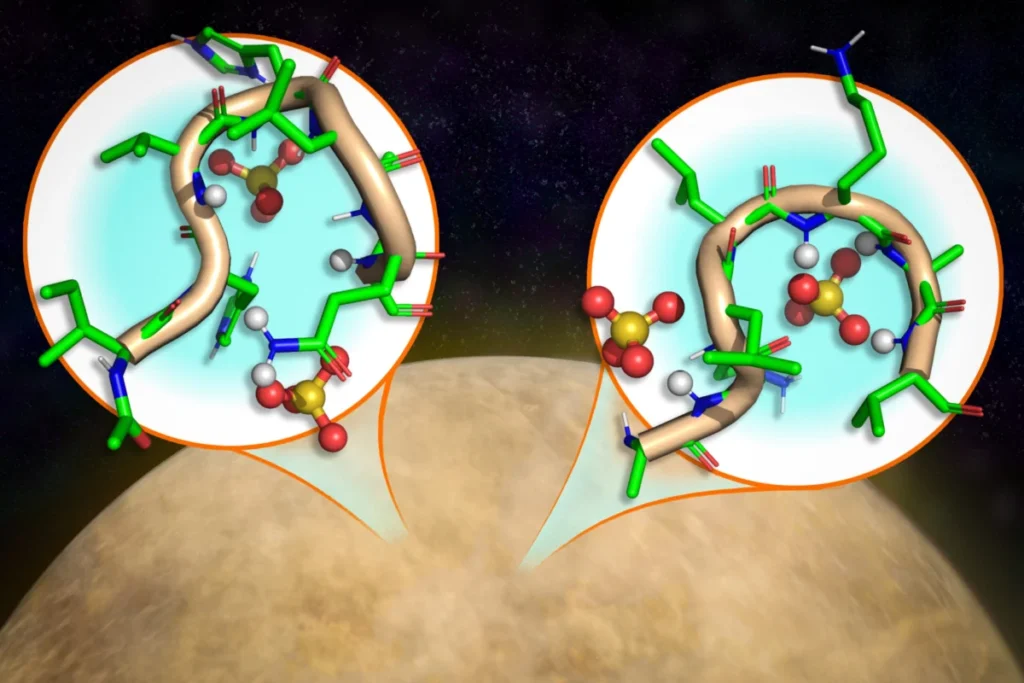
Using high-field 800-megahertz solution nuclear magnetic resonance (NMR) spectroscopy, the team analyzed several synthetic peptides, including a seven-amino-acid chain called HHQ. In an aqueous (water-based) environment, HHQ typically forms flat beta sheets that eventually aggregate into long fibrils. However, when submerged in concentrated sulfuric acid, the peptide behaved entirely differently. It folded into a specific, stable structure known as an "omega loop."
The omega loop is a structural motif found in many Earth-based proteins, where it often serves as a bridge between other structural elements like helices or sheets. The researchers discovered that molecules of sulfuric acid actually acted as a physical scaffold, sliding into the center of the peptide loop and holding it in place. This suggests that sulfuric acid is not just a passive solvent in this context, but an active participant in creating molecular architecture.
"What hadn’t been known is that peptides can survive so well and have specific three-dimensional shapes in an acidic environment," Hong noted. The discovery of these folded structures suggests that even in the absence of a traditional Earth-like biosphere, the chemical precursors for functional "acid-life" could be present.
A Timeline of Venusian Discovery
The current study is part of a broader, multi-year effort led by Sara Seager’s lab to re-evaluate Venus as a biological target. The timeline of this research reflects a growing interest in "alternative" biochemistries:
- 2020: A team led by Jane Greaves and including Sara Seager announced the detection of phosphine gas in the Venusian atmosphere. On Earth, phosphine is a byproduct of anaerobic life, sparking a global debate about potential microbial activity in the Venusian clouds.
- 2021-2022: Seager’s lab began systematic testing of biological "building blocks" in sulfuric acid. Initial experiments confirmed that nucleic acids (the components of DNA), lipids, and individual amino acids could remain intact in concentrated acid.
- 2023: The research shifted toward more complex polymers, specifically peptides, to determine if the transition from simple molecules to functional machines was chemically viable in acid.
- 2024: The publication of the PNAS paper confirms that peptides not only survive but fold into biologically relevant shapes, providing a chemical framework for the "Morning Star Missions" to Venus.
Supporting Data and Technical Methodology
To reach these conclusions, the researchers utilized the MIT Department of Chemistry Instrumentation Facility (DCIF). The use of the 800-megahertz NMR spectrometer allowed for unprecedented resolution in observing the magnetic properties of atomic nuclei within the molecules. This technology allowed the team to map the exact coordinates of the atoms in the HHQ, HHQ13, and K7 peptides.
The data showed that while the peptides were stable, their behavior was highly dependent on the concentration of the acid. At lower concentrations (where more water is present), the peptides degraded rapidly. It was only at the extreme 98 percent concentration—matching the conditions found in Venus’s clouds—that the protective, non-hydrolytic environment was achieved. This suggests that the very "harshness" of Venus’s environment is what allows these specific organic structures to persist.
Furthermore, the team observed that the peptides remained stable for at least several weeks during the testing period, with no signs of chemical degradation. This longevity is critical for any theory of life, as biological evolution requires molecules that can persist long enough to interact and form more complex systems.
Expert Reactions and Global Implications
The scientific community has reacted to these findings with a mixture of surprise and cautious optimism. Adriaan Bax, chief of the Section on Biophysical NMR at the National Institutes of Health (NIH), who was not involved in the study, described the results as "important and unexpected."
"The observation that these peptides retain a substantial degree of conformational order in concentrated sulfuric acid raises the prospect that folded oligopeptide/protein structures can exist in such environments," Bax stated. "This potentially supports the possibility of life in atmospheric conditions that are very different from Earth."
Sara Seager, who is also the lead for the privately funded Morning Star Missions to Venus, emphasized that this research should change how we prioritize targets in the search for extraterrestrial life. "We really don’t know the full extent of what planet archetypes are out there," Seager said. "We’re seeking exoplanets that might be a true Earth twin, but what if they’re all Venuses? Our findings definitely open up a whole range of possibilities."
Future Directions: Beyond DNA
The next phase of the research will look at even more complex "alien" architectures. Seager and her colleagues are now focusing on Peptide Nucleic Acid (PNA). PNA is a synthetic molecule that mimics the information-carrying capabilities of DNA but uses a peptide-like backbone instead of a sugar-phosphate backbone. Preliminary tests have shown that single-stranded PNA is stable in sulfuric acid; the team now aims to see if double-stranded PNA—the "double helix" of an acidic world—can form and remain stable.
The researchers also plan to test longer peptide chains to see if they can form more complex proteins, such as enzymes. If a peptide can be shown to facilitate a chemical reaction (catalysis) in sulfuric acid, it would provide the strongest evidence yet that a metabolism could function in the Venusian atmosphere.
The broader implications for space exploration are immediate. With NASA’s upcoming DAVINCI and VERITAS missions, and the private Morning Star Missions scheduled for the coming years, Venus has moved from being a "dead planet" to a primary laboratory for the study of exotic biology.
As humanity peers deeper into the cosmos with the James Webb Space Telescope, identifying the atmospheric signatures of "Venus-twins" may become as important as finding "Earth-twins." The MIT study proves that life, if it exists elsewhere, may not be a mirror of our own, but a testament to the incredible resilience of organic chemistry in the face of the most extreme environments the universe has to offer.
The research was supported by the Alfred P. Sloan Foundation, the NOMIS Foundation, and the National Institutes of Health. Sara Seager, a central figure in this research, will continue her work as she joins the University of Toronto faculty this September, maintaining her role as a leader in the search for life beyond Earth.