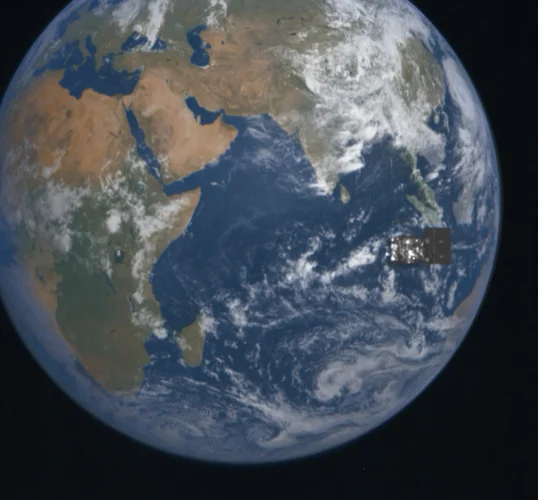
A routine operational maneuver by the European Space Agency’s (ESA) Proba-3 mission has resulted in a remarkable and unexpected visual offering: a striking image of Earth taken by the mission’s Occulter spacecraft. While the primary objective of Proba-3 is to observe the Sun’s corona by precisely aligning two spacecraft, this particular Earth observation highlights the dual capabilities of its sophisticated camera systems and offers a unique perspective on our planet. The image, captured on July 10, 2026, during the delicate process of bringing the two spacecraft into formation flight, showcases the intricate dance of technology and celestial observation that defines modern space exploration.
A Hidden Observer in Plain Sight
At first glance, the provided image appears to be a familiar vista of Earth from orbit, dominated by the vast blue expanse of the Indian Ocean and the sprawling landmasses of Africa, India, and Southeast Asia. However, a closer inspection, facilitated by an interactive slider in the original ESA release, reveals the presence of the Proba-3 Coronagraph spacecraft subtly integrated into the scene. This spacecraft, a key component of the Proba-3 mission, is designed to meticulously block the Sun’s bright disk, enabling the observation of its faint outer atmosphere, the corona. In this particular image, the Coronagraph is positioned to the right of the Indian Ocean, partially obscuring parts of the Indonesian Archipelago.
The interactive nature of the image, allowing viewers to transition between a black-and-white representation of what the Occulter’s cameras actually perceive and an artificially colored version for enhanced clarity, underscores the technical sophistication of the mission. The black-and-white view, as presented on the right side of the slider, offers an unvarnished look at the raw data captured by the Occulter’s wide-angle camera (WAC). This camera, equipped with advanced imaging technology, is instrumental in the mission’s formation flying capabilities.
The Intricate Dance of Proba-3: Coronagraph and Occulter
The Proba-3 mission is an ambitious undertaking by ESA designed to achieve unprecedented precision in solar corona observation. It comprises two spacecraft, the Coronagraph and the Occulter, which operate in a highly coordinated formation. The Coronagraph’s primary role is to act as an artificial Moon, precisely blocking the Sun’s direct light to allow its faint corona to be studied in detail. This requires an extraordinary level of positional accuracy, which is where the Occulter plays a crucial supporting role.
The Occulter spacecraft is equipped with a sophisticated camera system tasked with maintaining the precise relative positioning between the two satellites. This system includes a wide-angle camera (WAC) that tracks a set of flashing LED lights installed on the Coronagraph. These LEDs serve as visible beacons, allowing the Occulter to continuously monitor the Coronagraph’s position. Complementing the WAC is a narrow-angle camera (NAC), which provides higher resolution imagery for fine-tuning the alignment. This dual-camera approach ensures that the two spacecraft can maintain a stable separation of 147 meters, a critical distance for the Coronagraph to effectively obscure the Sun.
The ability of the Occulter’s camera system to autonomously adjust its position relative to the Coronagraph is a testament to the advancements in spacecraft autonomy and formation flying technology. This autonomous capability is not only vital for the scientific objectives of Proba-3 but also, as demonstrated by this recent image, offers the potential for serendipitous and aesthetically pleasing Earth observations.
A Chronology of Observation and Preparation
The image was captured on July 10, 2026. This date marks a significant phase in the Proba-3 mission, specifically during a routine operational procedure aimed at bringing the two spacecraft from a relative safe orbit into their designated formation flying distance. The process involved a series of calculated maneuvers to precisely position the Occulter and Coronagraph spacecraft 147 meters apart. This specific distance is crucial for the Coronagraph to effectively block the Sun and facilitate the observation of its corona.
The initial phase of the Proba-3 mission involved the launch of both spacecraft and their subsequent deployment into their operational orbits. Following this, extensive calibration and testing phases would have been undertaken to ensure the optimal functioning of all instruments and systems. The period leading up to July 10, 2026, would have been dedicated to meticulously planning and executing the gradual approach of the two satellites. This would have involved numerous orbital adjustments, real-time monitoring of their relative positions, and continuous recalibration of the formation flying systems.
The act of capturing the Earth image during this critical maneuver highlights the robust design of the Occulter’s camera system. It suggests that the system is not only capable of tracking its counterpart spacecraft with high precision but also possesses the flexibility to reorient itself to capture external targets, such as the Earth, when the geometric alignment is favorable. The fact that the image was taken "when the angle is just right" implies a specific orbital configuration where the Earth was positioned within the Occulter’s field of view, offering a unique perspective of the planet from the vantage point of the formation flying system.
Supporting Data and Technical Insights
The Proba-3 mission, launched in December 2023, is a prime example of ESA’s commitment to innovative and cost-effective space science. The mission’s total cost, while not directly related to the image itself, represents a significant investment in advancing our understanding of solar physics. The spacecraft are designed for a mission lifetime of approximately 2.5 years, during which they are expected to conduct numerous scientific observations.
The Occulter spacecraft, equipped with the WAC and NAC, operates with a high degree of autonomy. The WAC, with its wider field of view, is crucial for initial acquisition and tracking of the Coronagraph’s LEDs. The NAC, with its narrower field of view, provides the sub-arcsecond precision required for maintaining the exact formation. This level of precision is essential for creating a stable coronagraphic effect, where the light from the Sun is effectively blocked without introducing unwanted diffraction.
The LED lights on the Coronagraph are specifically designed to be visible to the Occulter’s cameras from the specified formation distance. Their flashing pattern and spectral characteristics would have been carefully chosen to optimize visibility against the background of space and the Sun. The Royal Observatory of Belgium, which processed the image, plays a key role in ESA’s solar physics research, contributing expertise in data analysis and interpretation.
Official Responses and Broader Implications
While direct statements from ESA officials specifically addressing this particular Earth image have not been released, the context of the Proba-3 mission suggests a strong positive reception. ESA consistently emphasizes the scientific return of its missions, and any visually striking imagery that also showcases the technological capabilities of its spacecraft is typically highlighted. The release of this image serves to underscore the dual-purpose nature of the Occulter’s camera system, demonstrating its utility beyond its primary formation flying function.
The ability to capture such images during routine operations also speaks to the resilience and adaptability of the Proba-3 mission. It suggests that the spacecraft are not only performing their primary scientific duties but are also capable of generating valuable secondary data, including stunning visual representations of our home planet. This can have several broader implications:
- Public Engagement and Education: Visually compelling images of Earth from space have a powerful effect on public perception and can inspire interest in space exploration and Earth science. This image, with its unique perspective and embedded spacecraft, can serve as an effective tool for science communication and education.
- Technological Demonstration: The image implicitly demonstrates the high precision and autonomy of the Proba-3 formation flying system. This success can pave the way for future missions that require even more sophisticated multi-spacecraft operations, such as distributed telescopes or advanced space-based observatories.
- Potential for Future Earth Observation: While not its primary mission, the Occulter’s camera system, by demonstrating its capability to capture Earth imagery with a spacecraft in its field of view, hints at the potential for future dedicated Earth observation missions that might incorporate similar formation flying techniques for specialized sensing.
The Proba-3 mission, by pushing the boundaries of formation flying and solar corona observation, continues to contribute significantly to our scientific understanding of the Sun. This recent image, however, offers a poignant reminder of the broader context of space exploration: the ongoing journey of discovery that encompasses not only the distant reaches of the cosmos but also the familiar beauty of our own planet, as seen through the eyes of its most advanced technological endeavors. The image serves as a testament to the ingenuity of engineers and scientists who meticulously craft these instruments, enabling them to perform their primary functions while also occasionally offering us breathtaking glimpses of our place in the universe.