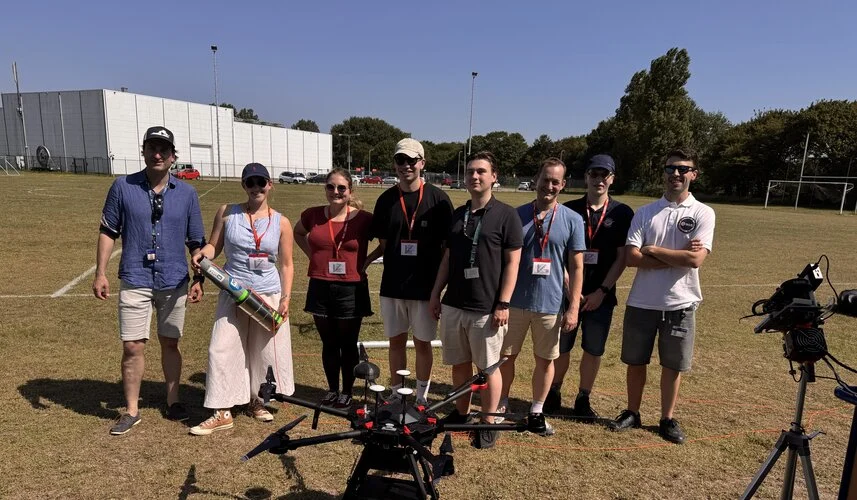
A groundbreaking test flight involving a student-developed radar retroreflector technology took place recently above the European Space Agency’s (ESA) technical centre, ESTEC, in the Netherlands. This pivotal event marked the culmination of extensive student research and design, showcasing a novel approach to enhancing the detectability of aerospace objects. The successful demonstration, conducted under a bright, hot sky, saw a sophisticated drone manoeuvre a specially designed passive reflector, propelling the technology closer to real-world application.
Genesis of Innovation: From Competition to Flight
The journey of this innovative radar retroreflector began as a student project, born from the competitive spirit of the Institute of Electrical and Electronics Engineers (IEEE) International Microwave Symposium (IMS) competition. A team from Ruhr University Bochum in Germany conceptualized and engineered a passive device capable of significantly improving radar visibility without requiring onboard active electronics. This competition, managed collaboratively by Václav Valenta from ESA and Markus Gardill from the Brandenburg University of Technology Cottbus-Senftenberg, provided a crucial platform for emerging talent in microwave aerospace systems.
The retroreflector, measuring approximately 28 cm in length, is ingeniously constructed from a metal tube adorned with precisely engineered cavities. Its primary function is to reflect radar signals directly back towards their source. This inherent property makes objects equipped with such a reflector exceptionally easy to detect and track from the ground or other radar platforms. Unlike conventional methods that rely on the inherent reflectivity of metallic structures, this passive reflector offers a consistent and enhanced return signal across a broader range of viewing angles. This is particularly significant for smaller aerospace vehicles like drones and sounding rockets, which often possess limited radar signatures.

The practical realization of this concept involved advanced manufacturing techniques. Stephan Hauptmeier, a member of the student team, highlighted the cost-effectiveness and accessibility of their design, stating, “What’s unique about this technology is that it’s very cheap. The reflector itself is passive, made by 3D printing and laser cutting.” This low-cost manufacturing approach democratizes access to advanced radar enhancement capabilities, opening doors for widespread adoption.
The ESTEC Test Campaign: A Rigorous Evaluation
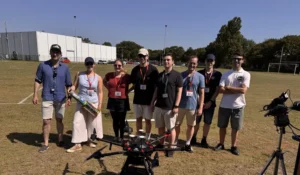
The test flight at ESTEC was designed to meticulously evaluate the retroreflector’s performance in a controlled, real-world scenario. ESA engineer Giovanni Serafini piloted a powerful drone, lifting the student-developed payload, suspended by a five-meter rope, to an altitude of 120 meters. The payload, housed within a longer plastic tube to simulate a sounding rocket, was then subjected to a series of dynamic maneuvers. The drone executed rapid descents, bringing the reflector to within three meters of the ground, and then traversed the width of the football field, all while under constant radar observation.
The test environment was challenging, with scorching summer temperatures impacting equipment. The test team, seeking respite from the heat under a parasol, maintained close proximity to their gear to prevent overheating, underscoring the practical considerations involved in aerospace testing. The visual documentation of the event, captured from below, shows the suspended reflector gently swaying in the breeze, a stark contrast to the complex engineering and scientific principles at play.
The objective of these maneuvers was to verify the retroreflector’s consistent performance under varying flight dynamics and altitudes. Daria Tsukanova, representing the Ruhr University Bochum team, elaborated on the core functionality: “A retroreflector is a passive structure, in this case a 28 cm long metal tube covered with cavities, designed to reflect signals back towards their source. This makes an object easier to detect and track without requiring active electronics or transmitters onboard.” This passive nature is a key advantage, as it eliminates the need for power sources or complex onboard systems, thereby reducing weight, complexity, and potential failure points.

Leveraging Automotive Radar Technology: A Cost-Effective Advantage
A significant aspect of the retroreflector’s potential lies in its compatibility with existing radar infrastructure. Hauptmeier further explained, “Another advantage is that to detect it, we can use a radar technology well-established in the automotive industry – the same one that is part of driver assistance systems and will, for example, cause a car to break automatically if an obstacle is detected. This means no special ‘space-grade’ radar is needed.” This integration with automotive radar technology represents a substantial cost-saving and logistical advantage. The widespread adoption of radar systems in vehicles means that a vast network of ground-based radar infrastructure could potentially be utilized for tracking objects equipped with these retroreflectors, without the need for significant new investment in specialized space-grade equipment.
Václav Valenta, ESA’s microwave engineer, underscored the synergistic nature of this project. He noted, "This has been a unique opportunity to leverage hardware previously developed within ESA’s Technology Development Element programme for planetary and in-orbit missions, based on automotive radar technology. By making one of these prototypes available to students, we enable them to gain practical experience with real radar technology and explore how such systems can be configured and optimised for specific applications.” This statement highlights ESA’s commitment to fostering innovation by bridging the gap between academic research and practical application, utilizing its own technological advancements to empower emerging engineers.
The radar unit employed for the ESTEC tests had a prior journey. Initially sent to Imperial College London, engineer Václav Pavlíček made crucial modifications to its system configuration and operating parameters. These adjustments were vital to adapt the technology for its new terrestrial use cases, demonstrating the adaptability and collaborative nature of the project.
Timeline of Development and Future Prospects
The project’s timeline illustrates a rapid progression from conceptualization to practical testing. The initial design and development phases likely spanned several months within the university setting, culminating in the IEEE competition. Following their success, the project gained traction, leading to the ESTEC test campaign. This recent flight serves as a critical validation step, paving the way for more ambitious future trials.

The next significant milestone for the student-developed retroreflector is its planned launch aboard a sounding rocket. This will take place later this summer in Brno, Czech Republic, where the rocket will ascend to approximately one kilometer above ground level. This high-altitude test will provide invaluable data on the retroreflector’s performance in a more representative flight environment, simulating the trajectory of suborbital experiments.
The Czech Rocket Society is providing their new Sherpa rocket for this upcoming launch, further expanding the collaborative network involved in this initiative. Karol Masztalerz, an ESA Graduate Trainee, commented on the project’s evolution: "This project is a great example of how student initiatives can evolve beyond the competition environment. What began as a university-led challenge has grown into an international collaboration between ESA, two European universities – the Ruhr University Bochum in Germany and Imperial College London in the UK – industry partners and the Czech Rocket Society, who are providing their new Sherpa rocket for the next round of testing.”
This expansion signifies a successful transition from a single university project to a multi-stakeholder international collaboration. The involvement of Imperial College London alongside Ruhr University Bochum, coupled with industry partners and ESA’s technical expertise, amplifies the project’s potential impact and scope.
Broader Implications and Future Trajectories
The successful testing of this student-developed radar retroreflector technology holds significant implications for various sectors of the aerospace industry and beyond. For scientific missions involving sounding rockets, the ability to reliably track experiments during their ascent and descent is crucial for data recovery and mission success. Current radar systems, while effective for larger metallic rockets, can struggle with smaller, less reflective payloads, especially at certain angles. The retroreflector effectively bridges this gap, ensuring continuous visibility.

Furthermore, the technology has potential applications in space debris monitoring. As the volume of orbital debris continues to grow, enhanced tracking capabilities are paramount for collision avoidance and the development of mitigation strategies. Retroreflectors could be affixed to satellites or other orbital assets to improve their radar signature, making them more readily detectable and manageable.
The cost-effectiveness and passive nature of the design also make it an attractive solution for commercial drone operations. Enhanced tracking could improve airspace management, prevent unauthorized flights, and facilitate the recovery of lost drones. In the realm of defense, improved target identification and tracking capabilities are always in demand, and this technology could offer a low-cost, high-impact solution.
The collaborative model employed in this project—where academic research is nurtured by space agencies and industry partners—serves as a blueprint for future innovation. By providing students with access to advanced facilities and expertise, ESA and its partners are not only advancing specific technologies but also cultivating the next generation of aerospace engineers and scientists. The journey from a competition entry to an ESA-backed launch campaign is a testament to the power of collaboration and the potential of innovative student-led projects to shape the future of space exploration and technology. The upcoming sounding rocket launch will undoubtedly be a critical juncture, providing further data to solidify the retroreflector’s position as a valuable tool in the aerospace technological arsenal.