An international research collective, featuring prominent chemical engineers Dr. Christopher Parlett, Xinyue Zhou, and Yutao Jiang, has announced a breakthrough in the field of sustainable chemistry with the development of a highly efficient single-atom catalyst designed to transform agricultural waste into high-value chemical building blocks. The study, recently published in the prestigious journal ACS Catalysis, details the creation of a ruthenium-based catalyst that addresses one of the most persistent challenges in the transition to a circular bioeconomy: the efficient breakdown of lignin. By isolating individual ruthenium atoms within a specialized nitrogen-doped carbon framework, the team has successfully identified the precise molecular mechanisms required to sever the resilient chemical bonds that define lignin’s structure. This discovery not only enhances the efficiency of biomass conversion but also provides a scalable blueprint for reducing the global manufacturing sector’s reliance on petroleum-derived aromatics.
The Lignin Paradox: A Resource Trapped by Complexity
Lignin is a fundamental component of the cell walls of terrestrial plants, providing the structural rigidity and water-transport capabilities necessary for trees and crops to grow tall and withstand environmental stressors. As the largest renewable source of aromatic chemicals on Earth, lignin constitutes up to 35% of the waste biomass generated by the global agriculture and forestry industries. Despite this abundance, lignin has historically been treated as a low-value byproduct. In the paper and pulp industry, for instance, millions of tons of lignin are produced annually, yet the vast majority is simply burned for low-grade heat because its molecular architecture is notoriously difficult to dismantle.
The primary obstacle lies in lignin’s complex, irregular three-dimensional network. Unlike cellulose, which is a linear polymer of glucose units that can be relatively easily broken down into fermentable sugars, lignin is composed of various phenolic units linked by exceptionally strong carbon-oxygen (C-O) and carbon-carbon (C-C) bonds. Breaking these bonds requires significant energy or harsh chemical reagents, which often degrade the resulting molecules into a useless char or a mixture of chemicals too complex to refine. For decades, the "lignin paradox" has persisted: we have a massive, renewable reservoir of aromatic precursors, yet we lack the "molecular scissors" precise enough to harvest them efficiently without destroying their value.
Engineering the Single-Atom Catalyst
To address this challenge, the research team focused on the emerging field of single-atom catalysis (SAC). Traditional catalysts often utilize metal nanoparticles, where thousands of atoms are clustered together. However, in such clusters, only the atoms on the surface are available to participate in chemical reactions, while the interior atoms remain idle. This leads to a significant waste of precious metals and often results in less selective reactions.
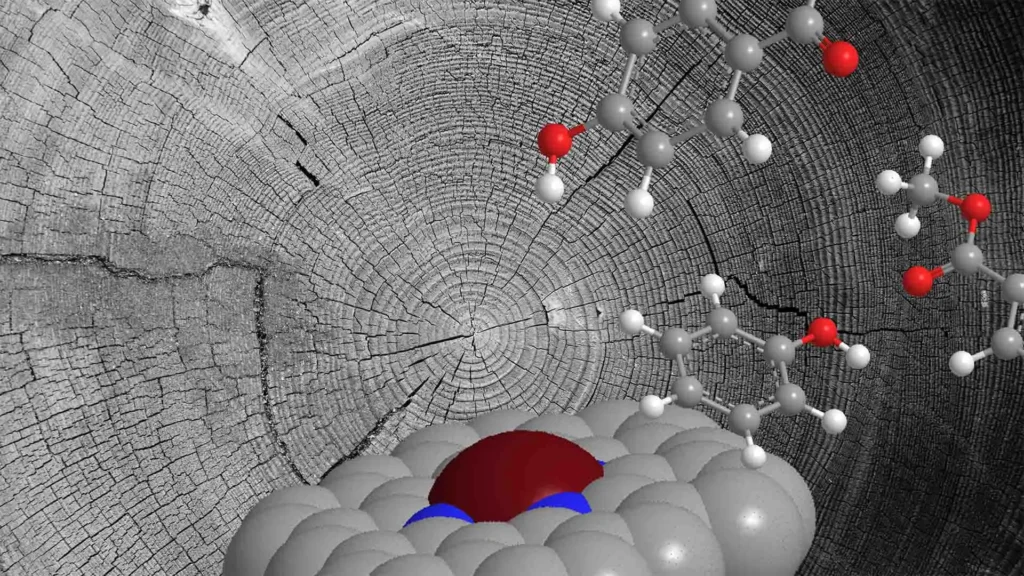
The catalyst developed by Dr. Parlett and his colleagues utilizes ruthenium—a rare transition metal—but in a radically different configuration. Instead of clusters, the researchers embedded individual ruthenium atoms within a matrix of nitrogen-doped carbon. By ensuring each ruthenium atom is isolated and surrounded by four nitrogen atoms—a configuration known as a "Ru-N4 site"—the team achieved maximum atom efficiency. In this state, every single ruthenium atom acts as an active catalytic center.
This "single-atom" approach offers two distinct advantages. First, it requires a fraction of the metal content used in conventional catalysts, drastically lowering the cost of the material. Second, the uniform nature of the Ru-N4 sites ensures that the chemical environment is identical across the entire catalyst surface. This uniformity allows for a level of precision and selectivity that is impossible with traditional heterogeneous catalysts, where different surface facets and defects can trigger a variety of unwanted side reactions.
Uncovering the Molecular Mechanism of Bond Cleavage
A significant portion of the study was dedicated to answering a fundamental question: exactly how does this atomic arrangement break lignin apart? Historically, lignin research has been hampered by a "black box" approach, where researchers knew a catalyst worked but could not explain the step-by-step molecular process. By combining sophisticated laboratory experiments with advanced computational modeling, the international team was able to reconstruct the catalytic cycle in unprecedented detail.
The researchers discovered that the Ru-N4 sites serve as highly active platforms for oxygen activation. When the catalyst is introduced into the reaction environment, it facilitates the adsorption of oxygen molecules, which are then converted into highly reactive oxygen species. These species act as the "molecular scissors," specifically targeting the ether linkages (C-O bonds) and the robust C-C bonds that hold the lignin fragments together.
The computational models revealed that the nitrogen atoms surrounding the ruthenium play a critical role in tuning the electronic properties of the metal. This tuning lowers the energy barrier required for the oxygen to interact with the lignin molecules, allowing the reaction to proceed under much milder conditions than previously thought possible. This mechanistic insight is a major contribution to the field, providing a clear roadmap for the future design of catalysts tailored for specific types of biomass.
Performance Metrics and Real-World Application
The effectiveness of the Ru-N4 catalyst was first demonstrated using "model compounds"—simplified molecules that mimic the essential structure of lignin. Under optimized conditions, the catalyst achieved nearly 100% conversion of these model compounds. More importantly, it produced high yields of valuable aromatic products, most notably phenol. Phenol is a critical industrial chemical used in the production of resins, adhesives, plastics, and pharmaceuticals, with a global market value exceeding $20 billion.
However, the team did not stop at laboratory simulations. To test the true viability of their discovery, they applied the catalyst to real-world lignin samples extracted from various biomass sources. The results were consistent with the model tests: the catalyst successfully dismantled the complex, "dirty" lignin from agricultural waste, yielding a suite of aromatic compounds that can serve as direct replacements for those currently derived from crude oil.
Furthermore, the process operates under relatively mild temperatures and pressures and does not necessitate the use of toxic or highly corrosive chemicals. This "green" profile is essential for industrial adoption, as it reduces the energy footprint of chemical manufacturing and minimizes the environmental risks associated with waste disposal and chemical handling.
Expert Perspectives and Economic Context
The implications of this research extend far beyond the laboratory. Dr. Christopher Parlett, Lecturer in Chemical Engineering and a lead researcher on the project, emphasized the importance of atomic-level understanding in the global transition to sustainability. "Understanding exactly how these catalysts work at the atomic level allows us to design better materials for converting renewable resources into valuable chemicals," Dr. Parlett stated. "By making it easier to upgrade lignin and convert it into higher-value products, the research could support a broader shift away from traditional linear petroleum-derived chemical production and toward a more circular, biomass-based economy."
Industry analysts suggest that the ability to efficiently valorize lignin could revolutionize the economics of bio-refineries. Currently, many bio-fuel operations struggle with profitability because they only utilize the carbohydrate portion of the plant (cellulose and hemicellulose). By unlocking the value of the lignin fraction—the remaining 30% of the feedstock—refineries could significantly increase their revenue streams, making renewable fuels and chemicals more competitive with fossil-fuel alternatives.
Chronology of the Research Development
The path to this discovery followed a rigorous multi-year timeline of scientific inquiry:
- Phase I: Catalyst Synthesis (2021-2022): The team focused on the precise synthesis of the nitrogen-doped carbon support and the stabilization of isolated ruthenium atoms to prevent them from clumping into nanoparticles.
- Phase II: Characterization (2022): Using high-resolution electron microscopy and X-ray absorption spectroscopy, the researchers confirmed the existence of the Ru-N4 sites and mapped the electronic structure of the catalyst.
- Phase III: Mechanistic Modeling (Early 2023): Computational chemists utilized density functional theory (DFT) to simulate the interaction between the catalyst, oxygen, and lignin bonds, predicting the reaction pathway.
- Phase IV: Validation and Testing (Late 2023): The catalyst was put to the test against both model compounds and real biomass, refining the temperature and pressure parameters to maximize yield.
- Phase V: Peer Review and Publication (2024): The findings were submitted to ACS Catalysis, undergoing rigorous scrutiny by the scientific community before publication.
Broader Impact and the Path Toward a Circular Economy
The development of the Ru-N4 single-atom catalyst arrives at a critical juncture in global environmental policy. As nations strive to meet carbon-neutrality targets by 2050, the chemical industry—which accounts for a significant portion of industrial greenhouse gas emissions—must find ways to decouple production from fossil fuels.
Aromatics, such as phenol, benzene, and toluene, are the foundational "building blocks" of modern life. They are found in everything from the nylon in our clothing and the plastics in our electronics to the aspirin in our medicine cabinets. Currently, over 95% of these aromatics are derived from petroleum. Transitioning to a lignin-based supply chain would effectively turn agricultural waste into a carbon-neutral feedstock for the entire chemical industry.
The research conducted by Dr. Parlett, Zhou, Jiang, and their international partners provides the technical foundation for this transition. By demonstrating that single-atom catalysts can master the complexity of lignin, they have moved the world one step closer to a future where the chemicals we rely on are grown in fields rather than pumped from the earth. The next phase of this research will likely involve scaling up the catalyst production and collaborating with industrial partners to integrate this technology into existing bio-refinery infrastructures. As the global community looks for tangible solutions to the climate crisis, breakthroughs like the Ru-N4 catalyst offer a clear, scientifically-backed path toward a more sustainable and circular industrial future.