The global automotive industry is undergoing a monumental transformation, driven by an accelerating shift towards electric vehicles (EVs). This paradigm shift, while promising a greener future, simultaneously intensifies the demand for advanced technological solutions, particularly in enhancing the energy efficiency of electric motors. At the heart of this challenge lies a phenomenon known as iron loss, or magnetic hysteresis loss. This inherent inefficiency occurs within the motor core, typically constructed from soft magnetic materials, as magnetic fields repeatedly reverse direction during operation. Each reversal expends energy, dissipating it as heat, which not only reduces the motor’s overall efficiency but also poses a significant hurdle to performance and longevity.
Furthermore, the operational environment of electric motors often involves high temperatures. These elevated thermal conditions introduce another layer of complexity, as they can partially demagnetize the very materials designed to facilitate magnetic flux. This demagnetization further exacerbates the energy loss problem, creating a intricate interplay between magnetic properties, thermal dynamics, and overall system performance. Addressing this multifaceted challenge is paramount for unlocking the full potential of electric vehicle technology and ensuring sustainable progress towards global decarbonization targets.
The Intricate World of Magnetic Domains and Energy Loss
A fundamental understanding of these effects necessitates delving into the microscopic realm of magnetic domains. These are minute, self-contained magnetic regions within materials, each possessing a uniform magnetization direction. The collective arrangement, structure, and dynamic behavior of these domains critically dictate how magnetic materials respond to external magnetic fields, thermal fluctuations, and consequently, how much energy they lose during operation. The interplay between these domains, particularly under varying temperature conditions, directly influences the efficiency and stability of the soft magnetic materials used in motor cores.
Decoding Complex Magnetic Maze Domains
Among the myriad configurations of magnetic domains, some soft magnetic materials exhibit exceptionally intricate structures known as maze domains. These formations earn their moniker from their distinctive zig-zag, labyrinth-like appearance, a visual manifestation of their underlying complexity. A defining characteristic of these maze domains is their propensity for abrupt structural transformations in response to changes in temperature. Such dynamic shifts profoundly influence the energy dissipation mechanisms within the material, making them a crucial area of study for improving motor efficiency.
However, despite their significance, scientists have long grappled with fully comprehending these intricate structures. The difficulty stems from a confluence of interacting factors, including the material’s precise microscopic architecture, the nuanced effects of thermal energy, and the overarching principles of energy stability that govern their behavior. Traditional analytical and experimental methods have often fallen short in providing a comprehensive, holistic view of these complex interactions, leaving significant gaps in our understanding.
A New AI-Enhanced Framework Emerges from Tokyo University of Science
Recognizing these limitations and the urgent need for a more sophisticated analytical approach, a team of pioneering researchers embarked on an ambitious project. Led by Professor Masato Kotsugi and Dr. Ken Masuzawa from the Department of Material Science and Technology at Tokyo University of Science (TUS), Japan, the team collaborated with experts from the University of Tsukuba, Okayama University, and Kyoto University. Their collective endeavor culminated in the development of a groundbreaking new model: the entropy-feature-eXtended Ginzburg-Landau (eX-GL) model.
This innovative framework represents a significant leap forward, designed to systematically investigate the energy landscape of maze domains. The team applied this approach to a rare-earth iron garnet (RIG), a material known for its complex magnetic properties, aiming to unlock the secrets held within its labyrinthine magnetic structures.
Professor Kotsugi articulated the core motivation behind their innovation, stating, "Conventional simulations oversimplify real materials, while experiments reveal complexity without a clear way to quantify cause and effect. Our physics-based explainable artificial intelligence framework addresses these limitations and is designed to mechanistically explain temperature-dependent magnetization reversal processes." This statement underscores the critical need for a tool that can bridge the gap between theoretical models and experimental observations, offering both predictive power and mechanistic insight. The findings of their seminal research were subsequently published in the prestigious journal Scientific Reports, marking a significant contribution to the field of materials science and magnetism.
The Global Imperative: Electric Vehicle Growth and Efficiency Demands
The context for this research is the unprecedented global surge in electric vehicle adoption. Driven by climate change concerns, stricter emissions regulations, and technological advancements, the EV market has seen explosive growth over the past decade. In 2023, global EV sales surpassed 14 million units, representing over 18% of the total car market, a dramatic increase from less than 5% just five years prior. Projections from the International Energy Agency (IEA) suggest that by 2030, EVs could account for 60% of new car sales in some regions, with a global fleet potentially exceeding 300 million vehicles.
This rapid expansion places immense pressure on every component of the EV ecosystem, particularly the electric motor. Energy efficiency in electric motors is not merely a technical specification; it directly translates into tangible benefits for consumers and the environment. Higher efficiency means longer driving ranges, reducing "range anxiety" and the frequency of charging. It also implies less strain on the battery pack, potentially extending its lifespan and reducing the overall cost of ownership. From an environmental perspective, every percentage point increase in motor efficiency contributes to a reduction in overall energy consumption and, by extension, the carbon footprint of transportation.
Iron loss, the specific challenge this research addresses, is a major contributor to this inefficiency. It accounts for a significant portion of the energy lost in the motor, transforming useful electrical energy into wasted heat. For a typical EV motor, even a small reduction in iron loss can lead to substantial improvements in range, power delivery, and thermal management, which is crucial for preventing motor overheating and maintaining performance over extended periods. Materials scientists and engineers worldwide are therefore in a race to develop next-generation soft magnetic materials and motor designs that can minimize these losses, pushing the boundaries of what is currently possible.
Chronology of Discovery: A Blend of AI and Physics
The journey to unraveling the hidden complexities of maze domains involved a carefully structured, multi-stage research process:
- Initial Observation (Pre-2020): Scientists had long observed maze domains and their temperature-dependent behavior, but a comprehensive understanding remained elusive due to the complex interplay of factors.
- Problem Identification (Early 2020s): Prof. Kotsugi and Dr. Masuzawa identified the limitations of existing methods – conventional simulations were oversimplified, and experiments lacked quantitative cause-and-effect explanations. This spurred the conceptualization of a new, integrated approach.
- Model Development (2021-2022): The collaborative team from TUS, University of Tsukuba, Okayama University, and Kyoto University began developing the eX-GL model. This involved integrating advanced mathematical topology (persistent homology) with machine learning and established physics principles (Ginzburg-Landau theory).
- Experimental Phase (2022-2023): Microscopic images of magnetic domains in rare-earth iron garnet (RIG) samples were systematically captured across a range of temperatures. This provided the empirical data necessary to feed into the newly developed eX-GL model.
- Data Analysis and Model Application (2023): The eX-GL model was applied to the collected image data. This phase involved the iterative process of identifying topological features, extracting key patterns via machine learning, constructing the free-energy landscape, and mathematically linking microstructures to magnetization reversal.
- Key Discoveries and Validation (Late 2023): The researchers successfully identified PC1 as a dominant feature correlating with magnetization reversal and uncovered four critical energy barriers governing these dynamics.
- Publication (Early 2024): The groundbreaking findings were published in Scientific Reports, making the research accessible to the broader scientific community.
Methodology: AI and Physics Unveil Hidden Magnetic Behavior
The core of this research lies in its innovative methodology, which seamlessly integrates advanced computational techniques with fundamental physics principles. To empirically investigate how temperature influences magnetization reversal within maze domains, the researchers meticulously captured microscopic images of the magnetic domains in their rare-earth iron garnet (RIG) sample at various precisely controlled temperatures. These high-resolution images served as the raw data, providing a visual record of the domain structures’ evolution under thermal stress.
The subsequent analysis leveraged the power of the eX-GL model, which operates in a sophisticated multi-stage process:
-
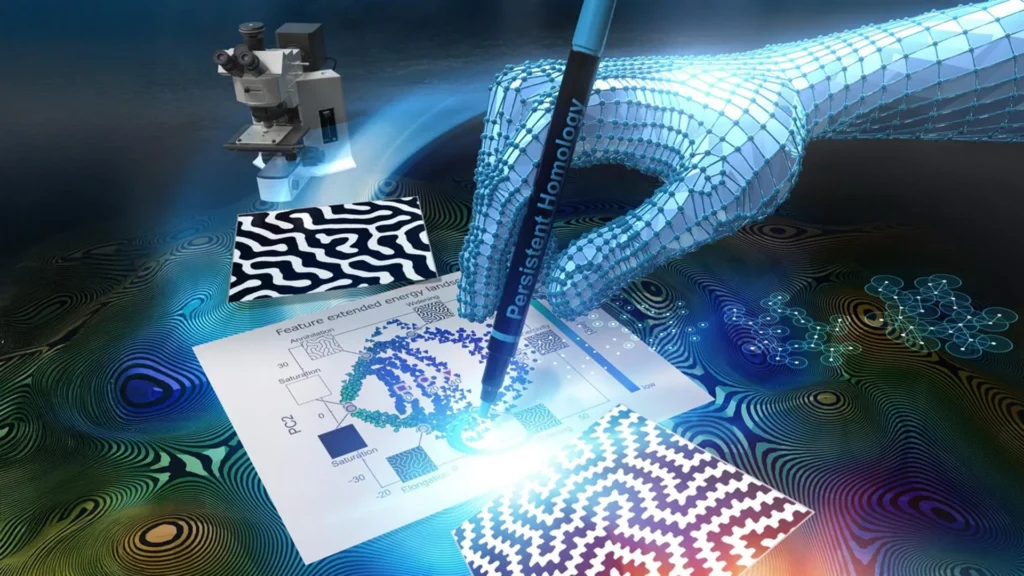
Persistent Homology (PH): Mapping the Magnetic Topology: The initial stage of the eX-GL model employs Persistent Homology (PH), a cutting-edge mathematical method derived from topological data analysis. PH is uniquely adept at identifying and quantifying topological features within complex datasets, regardless of their scale. In this context, PH was used to detect and characterize the uneven structural characteristics and intricate connections within the magnetic domain images. It allowed the team to discern underlying patterns and "shapes" of the magnetic domains that might be imperceptible through conventional image analysis, providing a robust, scale-independent description of the domain morphology. This step is crucial for transforming raw image data into a mathematically tractable representation of the magnetic microstructure.
-
Machine Learning for Feature Extraction and Pattern Recognition: Following the PH analysis, machine learning-based pattern recognition algorithms were deployed. These algorithms sifted through the vast amount of topological data generated by PH to identify the most salient and influential features. By learning from the complex relationships within the data, the machine learning component was able to distill the critical elements that dictate the magnetic material’s behavior. This process culminated in the generation of a digital free-energy landscape. This landscape is a computational representation that dynamically tracks how the magnetic microstructures evolve as the system’s energy changes, offering a powerful visualization of the energy states and transitions.
-
Mathematical Analysis: Linking Microscopic to Macroscopic: The final stage involved rigorous mathematical analysis. This step was dedicated to establishing a clear and quantitative link between the observed microscopic domain structures—as characterized by the free-energy landscape—and the macroscopic magnetization reversal process of the material. This bridging of scales is a critical achievement, as it allows researchers to predict and understand bulk material properties based on their underlying atomic and domain-level behaviors.
Through this meticulous approach, the researchers successfully identified a dominant feature, termed PC1 (Principal Component 1), which proved to be highly effective in capturing and describing the magnetization reversal process. By systematically connecting PC1 with the fundamental physical properties of the material, the team was able to visualize and characterize four major energy barriers. These barriers, previously hidden from direct observation, were revealed to exert a profound influence on the dynamics of magnetization reversal, acting as critical points that must be overcome for the magnetic state to change.
Unveiling Hidden Energy Barriers Inside Magnetic Materials
The identification and detailed analysis of these four energy barriers and their associated microstructures represented a pivotal breakthrough. This phase of the research provided unprecedented insights into how different forms of energy contribute to and affect the magnetization reversal process within the material. The researchers meticulously measured and quantified the energy transfer involving several key magnetic interactions:
- Exchange Interactions: These fundamental quantum mechanical forces drive the alignment of neighboring atomic magnetic moments, playing a crucial role in maintaining the integrity of magnetic domains.
- Demagnetizing Effects: These arise from the magnetic fields generated by the material itself, which tend to oppose the internal magnetization and can lead to the formation of domains to minimize overall energy.
- Entropy: In thermodynamics, entropy is a measure of disorder or randomness. In magnetic materials, entropy can influence domain configurations, particularly at higher temperatures, as the system seeks to maximize its disorder.
Beyond merely identifying these energy forms, the study yielded another significant discovery: maze domains become demonstrably more complex as the total length of their domain walls increases. This escalating complexity, a key characteristic of their behavior, was found to be directly driven by a intricate interplay between entropy and exchange forces. This finding is critical because domain walls are regions where magnetization changes direction, and their movement is often associated with energy loss. Understanding the factors that govern their complexity provides a direct pathway to minimizing these losses.
By elucidating these specific physical mechanisms behind the reversal behavior of maze domains, the research has not only advanced fundamental understanding but also laid groundwork for future material design. The ability to precisely quantify these energy contributions and their influence on domain dynamics empowers scientists to engineer soft magnetic materials with tailored properties for specific applications, such as high-efficiency electric motors.
Expert Endorsement and Universal Applicability
Professor Kotsugi underscored the transformative potential of their developed framework: "Our eX-GL approach effectively automates the interpretation of complex magnetization reversal processes and enables the identification of hidden mechanisms, difficult to discern using conventional methods." This statement highlights the efficiency and precision afforded by their AI-driven methodology, moving beyond laborious manual analysis or limited simulations.
He further emphasized the broader implications, stating, "In addition, since free energy is a universal thermodynamic metric, our model can be extended to other systems with similar characteristics." This speaks to the versatility and generalizability of the eX-GL model. Its foundation in universal thermodynamic principles means it is not confined solely to magnetic materials or maze domains. It could potentially be adapted to investigate complex energy landscapes in a diverse array of physical systems, from superconductors and ferroelectric materials to even biological systems where intricate energy states dictate functional behavior. This universal applicability significantly amplifies the impact of the research, positioning the eX-GL model as a powerful new tool in scientific discovery across multiple disciplines.
Broader Impact and Implications for Future Technology
The implications of this research extend far beyond the academic understanding of magnetic phenomena; they hold profound potential for real-world technological advancements, particularly in the realm of energy efficiency and advanced materials.
-
Revolutionizing Electric Vehicle Motors: The most direct impact will be on electric vehicle motors. By providing a deeper understanding of iron loss and how to mitigate it, this research paves the way for the development of next-generation soft magnetic materials that are significantly more energy-efficient. This could lead to:
- Increased EV Range: More efficient motors mean less energy wasted as heat, translating directly into longer driving distances on a single charge.
- Faster Charging and Smaller Batteries: With reduced energy consumption, EVs could potentially require smaller battery packs for the same range, leading to lighter vehicles, faster charging times, and reduced manufacturing costs.
- Enhanced Durability and Reliability: Less heat generation means less thermal stress on motor components, potentially extending their lifespan and reducing maintenance needs.
- Compact and Lighter Motors: Improved material efficiency could allow for smaller, lighter motor designs that deliver the same or even greater power, crucial for vehicle performance and packaging.
-
Beyond Electric Vehicles: A Wider Industrial Impact: Electric motors are ubiquitous, powering everything from industrial machinery and home appliances to robotics and renewable energy generators like wind turbines. Improvements in magnetic material efficiency driven by this research could lead to:
- Industrial Energy Savings: Significant reductions in energy consumption across various industries, contributing to lower operational costs and reduced carbon emissions on a global scale.
- More Efficient Renewable Energy: Enhanced efficiency in generators could lead to greater power output from wind turbines and hydroelectric systems, maximizing clean energy production.
- Advanced Robotics and Consumer Electronics: Smaller, more efficient motors are critical for the miniaturization and improved performance of devices ranging from drones to smartphones.
-
Advancements in Materials Science and Engineering: The eX-GL model itself represents a significant methodological contribution. Its ability to automate the interpretation of complex energy landscapes and identify hidden mechanisms provides a powerful new tool for materials scientists. This could accelerate the discovery and optimization of:
- New Magnetic Materials: Tailored for specific applications, such as high-frequency transformers, spintronic devices, or advanced data storage solutions.
- Superconductors and Ferroelectrics: Materials with similar complex domain structures, where understanding energy landscapes is crucial for unlocking their full potential.
- Catalysts and Nanomaterials: Where surface energy and structural dynamics play critical roles in their functional properties.
-
The Rise of Explainable AI in Scientific Discovery: This research exemplifies the growing power of Artificial Intelligence when integrated with fundamental physics. The "explainable AI" aspect is particularly important, as it provides not just predictions but also mechanistic insights, helping scientists understand why certain phenomena occur. This approach fosters trust in AI-driven discoveries and accelerates the scientific process by generating testable hypotheses grounded in physical principles.
-
Economic and Environmental Contributions: By fostering innovation in energy-efficient technologies, this research contributes to global economic competitiveness, particularly for nations like Japan that are at the forefront of advanced materials science. Environmentally, every step towards greater energy efficiency in motors is a step towards reducing global energy demand, mitigating climate change, and promoting a more sustainable future.
This study, therefore, not only casts a revealing light on the intricate mechanics of maze domains but also introduces a broader, universally applicable strategy for investigating complex energy landscapes in magnetic systems and a multitude of other related physical materials. It stands as a testament to the power of interdisciplinary collaboration and innovative computational approaches in pushing the boundaries of scientific understanding and technological progress.
This research was supported by a Japan Society for the Promotion of Science (KAKENHI) Grant-in-Aid for Scientific Research (A) (21H04656). Additional support came from JST-CREST (Grant No. JPMJCR21O1). C. Mitsumata received support from the Tsukuba Research Center for Energy Materials Science (TREMS) at the University of Tsukuba.