Backyard Brains, a pioneering company dedicated to making neuroscience accessible, has unveiled its latest innovation, SpikerBot, a revolutionary educational robot designed to teach complex neurological principles through intuitive, neuron-based programming. This groundbreaking device aims to bridge a significant gap in neuroscience education, allowing users to program lifelike behaviors not with traditional code, but by constructing virtual neural circuits, fostering a deeper understanding of how brains work.
The launch of SpikerBot, currently supported by a successful Kickstarter campaign ending June 14, represents a pivotal moment in STEM education, offering a tangible and engaging platform for exploring the intricate world of neurobiology. With an eventual retail price of $299, early backers can secure a unit for $219, underscoring Backyard Brains’ commitment to making advanced scientific tools more attainable.
A Paradigm Shift in Robotics and Neuroscience Education
Traditionally, learning robotics involves grappling with complex programming languages and abstract "if-then" statements, often leading to frustration and disengagement for beginners. SpikerBot fundamentally redefines this learning curve by introducing a visual programming environment where users manipulate virtual neurons and synapses to create emergent behaviors. As Co-Founder & CEO Greg Gage and Designer Alex Hatch explained in an interview, the philosophy is simple yet profound: "there’s no code, no LLMs, just neurons, synapses, and behavior emerging from a circuit a kid designed." This approach mirrors the natural processes of biological brains, where complex actions arise from the interaction of simpler neuronal units.

This innovative programming method draws direct inspiration from the foundational work of Valentino Braitenberg, particularly his seminal 1984 book, Vehicles: Experiments in Synthetic Psychology. Braitenberg’s thought experiments described simple hypothetical vehicles whose sensor-motor connections directly influenced their behavior, leading to surprisingly complex and "lifelike" actions such as fear, love, or aggression, purely from basic wiring. SpikerBot embodies this philosophy, allowing users to observe how simple connections between sensors (like light or sound) and actuators (like motors or lights) can give rise to sophisticated, seemingly intelligent behaviors. For instance, a creature that chases objects can be built with just two neurons, demonstrating the elegance and efficiency of neural networks. Conversely, tasks that are trivial in traditional computer logic, such as counting in binary, become intricate challenges when constrained to a neural architecture, highlighting the fundamental differences between biological and silicon-based computation.
Bridging the Neuroscience Literacy Gap
Backyard Brains has long identified a critical void in contemporary science education: the "neuroscience literacy gap." While elementary school curricula often introduce the basic concept of a single neuron, the educational thread typically breaks until specialized college-level courses, leaving a vast chasm in understanding how millions of neurons collectively generate thought, emotion, and behavior. This discontinuity is akin to teaching a student about a transistor in primary school and then expecting them to write complex Python code without any intermediate knowledge of electronics, circuits, or programming paradigms.
This gap contributes to a broader societal challenge. With approximately one in five people experiencing a neurological condition, a lack of public understanding about the brain’s fundamental operating principles can hinder empathy, delay diagnosis, and complicate discussions around mental health and neurological disorders. SpikerBot directly addresses this by providing an engaging, hands-on platform for students to explore how neural circuits function, how information is processed, and how behaviors emerge from these interactions. By demystifying the brain at an accessible, intermediate level, SpikerBot aims to cultivate a generation with a more profound and intuitive grasp of neuroscience, fostering greater awareness and understanding of both typical brain function and neurological conditions. Backyard Brains’ previous educational tools, such as the SpikerBox (which allows users to record actual neuron spikes from insects) and the Human-Human Interface (enabling control of another person’s arm muscles), have consistently focused on making real neuroscience experiments accessible, and SpikerBot continues this legacy by bringing neural circuit design to the forefront.
An Intuitive and Engaging Programming Language

The core of SpikerBot’s innovation lies in its visual programming app, where the "brain" of the robot is designed by dragging and connecting virtual neurons and axons on screen. This interface eschews the scrolling lines of text common in traditional coding environments, instead presenting a holistic "patch synthesizer" view where the entire circuit is visible at once. This immediate visual feedback, coupled with instantaneous changes – transforming a neuron from excitatory to inhibitory and observing the robot’s immediate reaction – creates a dynamic, experimental learning experience that moves at "the pace of thought."
This approach significantly enhances engagement by allowing users to quickly iterate and experiment without the delays of compiling code or uploading new versions. It capitalizes on human intuition, enabling the rapid creation of natural behaviors. Imagine building a robot that follows a person around with just a few connections, then incrementally adding "dog-like" responses at a comfortable pace. This intuitive, play-based learning helps maintain interest far longer than abstract coding exercises, allowing users to develop a sense of agency and discovery. The app’s polished design, reflecting extensive development and refinement, further underscores Backyard Brains’ commitment to a user-friendly and aesthetically pleasing experience. Its beauty lies not just in its functionality but in its elegant presentation of complex scientific concepts.
The app comes pre-loaded with a library of sample "brain models," allowing users to deconstruct, modify, and learn from existing behaviors. These models are not arbitrary; they are grounded in actual neuroscience, demonstrating patterns and techniques found in real biological brains. Developed with feedback from both child educators and professional neuroscientists, SpikerBot ensures that the concepts learned are scientifically accurate and pedagogically effective. Users can explore fundamental neurological patterns such as recurrent pairs (neurons that excite each other in a loop, contributing to memory or sustained activity) and lateral inhibition (where the activation of one neuron suppresses the activity of its neighbors, crucial for sensory processing and edge detection), thereby gaining a practical understanding of concepts like working memory and sensory perception.
The Hardware: A Brain on Wheels
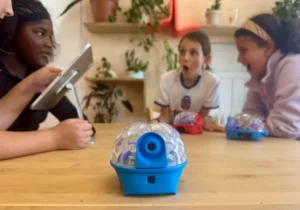
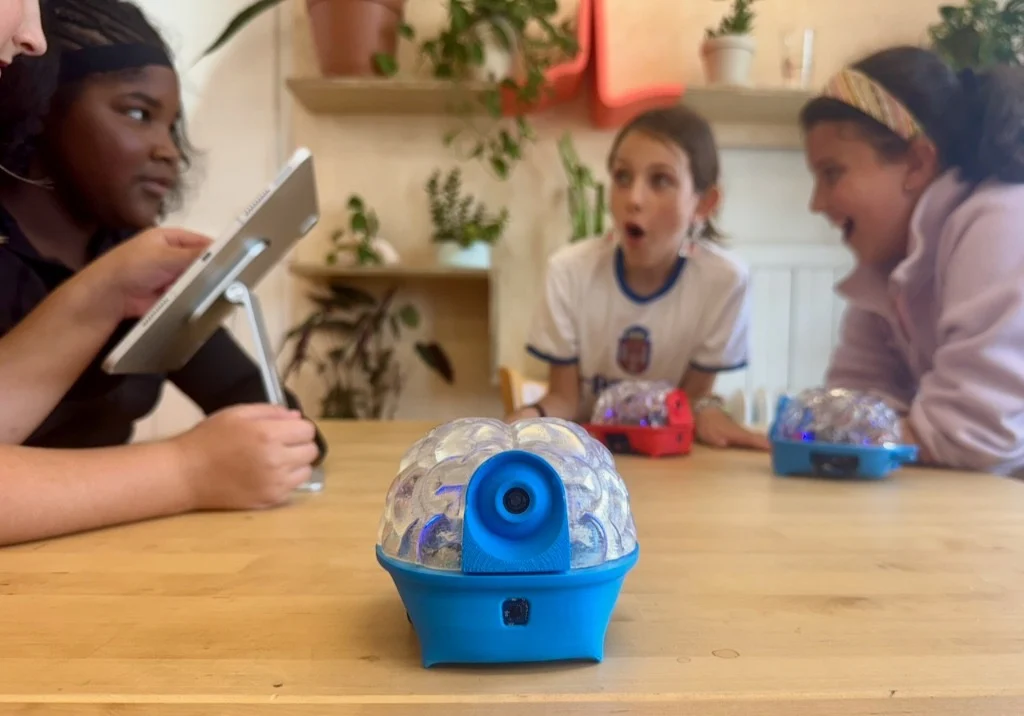
The SpikerBot itself is a cleverly designed, brain-shaped robot, echoing Backyard Brains’ distinctive logo. This mobile platform is equipped with an array of sensors—a camera for visual input, a microphone for auditory cues, and a distance sensor for spatial awareness—allowing it to perceive and react to its real-world environment. Beyond sensing, it features integrated lights and sounds, meticulously crafted to mimic natural, organic responses rather than typical machine outputs. Lights fade in and out like bioluminescent cells, and sound effects are charming and quirky, adding personality to the robot’s emergent behaviors.

The physical design also emphasizes customizability and expandability. Connection points on the chassis enable users to attach 3D-printed accessories, allowing for creative personalization that transforms the base robot into a dragon, a cat, or any creature the imagination can conjure, further enhancing the learning experience through creative expression.
Moreover, SpikerBot supports integration with Backyard Brains’ existing peripherals, notably their Spiker:bit board. This connectivity opens up exciting possibilities, such as controlling the robot’s movements and behaviors using electromyographic (EMG) signals from a user’s own arm muscles, directly linking human physiology to robotic action. This powerful feature not only makes the learning experience deeply personal but also demonstrates the fundamental principles of bio-interfacing and neural control.
Designed for Longevity and Community
Backyard Brains has consciously designed SpikerBot for long-term usability and accessibility. The accompanying app is entirely free and does not rely on cloud-based authentication, ensuring continued functionality regardless of internet access or future service changes. The robot itself operates on easily swappable AA batteries, eschewing the trend of non-replaceable, constantly decaying lithium-ion cells. To further enhance sustainability and performance, Backyard Brains offers its own custom, high-performance NiMH AA batteries, supporting convenient recharging and extended play. These design choices reflect a commitment to durability, user autonomy, and environmental responsibility, making SpikerBot a truly sustainable educational investment.
The Kickstarter campaign, which concludes on June 14, provides an opportunity for early adopters to support this innovative project and secure a SpikerBot at a discounted price. Backyard Brains has a robust track record of successfully delivering impactful educational tools through crowdfunding, inspiring confidence in their ability to bring SpikerBot to fruition. Their previous successes demonstrate a proven capability to navigate the challenges of product development and distribution, reinforcing the credibility of this new venture.

Looking ahead, the potential for SpikerBot is vast. While the current iteration boasts a rich set of behaviors and learning opportunities, the development team anticipates a future rich with undiscovered possibilities. As Alex Hatch aptly noted, "a lot we haven’t seen because you guys haven’t built anything yet." This statement encapsulates the collaborative spirit of the project, inviting users to become active participants in the evolution of SpikerBot’s capabilities, fostering a community of innovators who will collectively push the boundaries of what this brain on wheels can achieve. The platform is designed to be open-ended, encouraging experimentation and allowing for the continuous discovery of new neural patterns and emergent behaviors, ensuring its relevance and engagement for years to come.
In essence, SpikerBot is more than just a robot; it is a gateway to understanding the very mechanisms of intelligence and behavior, offering a unique blend of robotics, neuroscience, and intuitive programming that promises to redefine STEM education for a new generation. By making the complexities of the brain accessible and engaging, Backyard Brains is not just building robots; they are cultivating a deeper understanding of ourselves.