A groundbreaking development in the field of synthetic chemistry has seen researchers successfully engineer a novel hollow CdS@polydopamine nanoreactor designed to replicate two crucial functionalities observed in living cells. This innovative construct offers a transformative approach to integrating the highly organized chemical processes characteristic of biological systems into synthetic nanomaterials, paving the way for more efficient and sustainable chemical transformations. The findings, which promise to redefine paradigms in artificial photosynthesis and energy catalysis, were recently published in the esteemed Journal of the American Chemical Society. The pioneering work was spearheaded by Professor LI Can at the Dalian Institute of Chemical Physics (DICP) of the Chinese Academy of Sciences (CAS), in a productive collaboration with Professor Jian Liu’s research group at Inner Mongolia University.
The Quest for Artificial Cells: Nanocell Engineering
The intricate world of living cells stands as the ultimate inspiration for chemists and materials scientists. Within their microscopic boundaries, cells execute an astonishing array of complex biochemical reactions with unparalleled efficiency, specificity, and precision. This cellular prowess stems from a highly organized internal architecture, where various molecular components are strategically compartmentalized within tightly regulated spaces. These confined environments facilitate controlled molecular movement, specific interactions, and optimized reaction kinetics, all under carefully tuned conditions of pH, redox potential, and substrate concentration.
For decades, scientists have harbored ambitions to harness these fundamental biological principles and translate them into engineered synthetic systems. This ambitious endeavor has given rise to the emerging field of nanocell engineering. At its core, nanocell engineering seeks to fabricate artificial cell-like structures, often referred to as nanoreactors, which possess specialized surfaces, internal pores, or well-defined cavities. These synthetic mimics aim to replicate the sophisticated organizational and functional aspects of natural cells, bridging concepts from cell biology with cutting-edge nanotechnology. The ultimate goal is to create platforms capable of performing complex multi-step reactions with efficiencies approaching, or even surpassing, those found in biological systems, but with the added advantages of robustness, tunability, and scalability for industrial applications. Early efforts in this field focused on encapsulating enzymes or catalysts within liposomes or polymer capsules. However, recent advancements, like the one from DICP and Inner Mongolia University, are moving towards integrating more dynamic, cell-like features directly into the material’s architecture, pushing the boundaries of what synthetic systems can achieve.
Unpacking the CdS@Polydopamine Nanoreactor Design
The newly developed nanoreactor represents a significant leap forward in biomimetic design, primarily due to its sophisticated material composition and structural ingenuity. At its heart lies a hollow CdS (cadmium sulfide) core, enveloped by a shell of polydopamine. Cadmium sulfide is a well-known semiconductor material widely employed in photocatalysis due to its favorable band gap energy, which allows it to absorb visible light efficiently. This light absorption is crucial for initiating the desired photochemical reactions. However, CdS alone often suffers from rapid charge recombination and limited stability in aqueous environments, factors that hinder its widespread application.
The choice of polydopamine for the shell is equally strategic and critical to the nanoreactor’s biomimetic capabilities. Polydopamine is a synthetic polymer inspired by the adhesive proteins found in mussels. It is renowned for its excellent biocompatibility, robust adhesive properties, and, critically, its abundant catechol groups. These catechol groups are redox-active and can readily undergo reversible oxidation to o-benzoquinone, a property that forms the basis of one of the nanoreactor’s key cell-inspired features. Moreover, polydopamine shells offer a protective layer for the CdS core, enhancing its stability and providing a porous yet confined environment for reactants. The combination of CdS as a light-harvesting and electron-generating component with the functional and protective polydopamine shell creates a synergistic system, where each material contributes uniquely to the overall performance and biomimetic function. This core-shell architecture is not merely a structural choice but a functional design, carefully engineered to optimize both light absorption and catalytic activity.
Feature 1: The Dynamic Proton Relay Mechanism
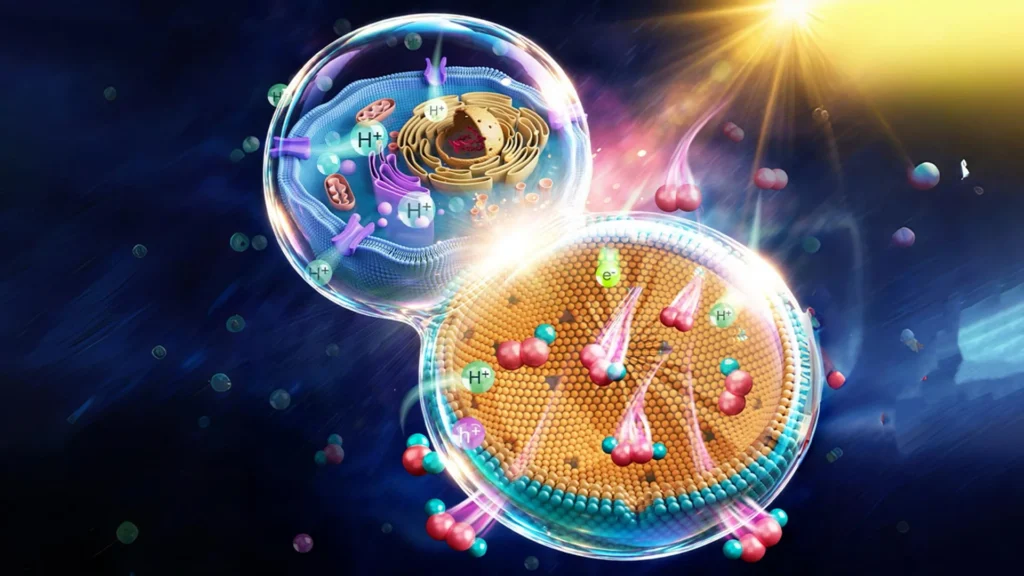
One of the two primary biomimetic elements integrated into this nanoreactor is a dynamic catechol/o-benzoquinone redox pair strategically embedded within the polydopamine shell. In living cells, proton gradients and proton movement are fundamental to countless biochemical processes, including ATP synthesis and nutrient transport, often facilitated by active proton pumps. While this synthetic system does not operate as an active proton pump that consumes energy to move protons against a gradient, it cleverly mimics a different, yet equally vital, aspect of proton management: a proton relay.
A proton relay system functions by rapidly accepting and releasing protons, effectively shuttling them across a membrane or within a confined space. In the nanoreactor, the reversible oxidation-reduction cycle between catechol and o-benzoquinone serves precisely this purpose. Catechol groups, upon oxidation, release protons, while o-benzoquinone groups can accept protons upon reduction. This continuous cycling significantly accelerates proton-coupled electron transfer (PCET) processes. PCET is a ubiquitous and critical reaction pathway in biological systems and many catalytic cycles, where the movement of a proton and an electron are tightly coupled and often occur in a concerted manner. This coupling is essential for overcoming kinetic barriers and enhancing reaction rates in processes like oxygen reduction, water splitting, and various redox enzyme reactions. By facilitating PCET through this dynamic proton relay, the nanoreactor effectively mimics the precise proton management found in cellular respiration and photosynthesis, enabling highly efficient electron and proton transport necessary for driving the desired chemical reactions. This dynamic interplay within the polydopamine shell is a sophisticated imitation of cellular machinery, allowing for precise control over reaction intermediates and pathways.
Feature 2: Compartmentalization and Confined Catalysis
The second pivotal cell-inspired feature of the nanoreactor is its ingenious compartmentalized structure. Just as cellular organelles like mitochondria and chloroplasts provide confined environments for specific biochemical pathways, the CdS@polydopamine nanoreactor features a nanoscale hollow cavity encased by a porous shell. This architectural design creates a distinct confined environment that offers several critical advantages for enhancing catalytic reactions.
Firstly, the confined space within the hollow cavity allows for the local accumulation of reactants. By concentrating the substrate molecules, the effective local concentration increases, thereby enhancing the collision frequency between reactants and the catalytic sites. This principle, known as proximity effect, is a cornerstone of enzyme catalysis, where enzymes bind substrates in a pocket, effectively increasing their local concentration and accelerating the reaction. Secondly, the porous shell facilitates controlled molecular diffusion. It allows necessary reactants to enter the cavity and products to exit, but it can also selectively enrich certain molecules or exclude others, much like cellular membranes regulate transport. This controlled diffusion ensures a steady supply of substrates while preventing the leakage of important intermediates, thus maintaining high reaction efficiency.
Furthermore, this compartmentalized architecture plays a crucial role in light-driven reactions, particularly for the CdS core. The hollow structure, surrounded by the light-absorbing CdS, creates an internal light-trapping effect. Incoming photons are not immediately reflected or transmitted but are scattered and re-absorbed multiple times within the cavity, increasing the probability of absorption by the CdS photocatalyst. This enhanced photon utilization is critical for maximizing the efficiency of light-driven reactions, ensuring that the energy from visible light is effectively harvested and converted into chemical potential. Together, the confined environment, controlled diffusion, and efficient light trapping make this compartmentalized nanoreactor a highly effective mimic of the optimized reaction spaces found within living cells, leading to significantly improved catalytic performance.
Advancing Green Chemistry: Hydrogen Peroxide Production
The combination of these two biomimetic features—the dynamic proton relay and the compartmentalized structure—is particularly effective in balancing the kinetics of oxygen reduction and water oxidation. These two half-reactions are critically important and must operate in concert during the production of hydrogen peroxide (H2O2). Hydrogen peroxide is a vital industrial chemical with diverse applications, serving as an environmentally benign oxidant, bleach, disinfectant, and propellant. It is extensively used in pulp and paper bleaching, textile processing, wastewater treatment, and in the synthesis of various organic chemicals.
Traditionally, industrial production of H2O2 primarily relies on the anthraquinone oxidation process, a multi-step, energy-intensive method that requires organic solvents and produces significant waste. There is a strong global impetus to develop greener, more sustainable methods for H2O2 synthesis, particularly those that can directly produce it from abundant resources like water and oxygen using renewable energy sources such as sunlight. Photocatalytic production of H2O2 from water and oxygen, powered by solar energy, represents an ideal green alternative, aligning with principles of sustainable chemistry. However, achieving high efficiency and selectivity for H2O2 in a single step using photocatalysis remains a significant challenge, largely due to the difficulty in balancing the electron-hole separation and the kinetics of the two competing half-reactions (oxygen reduction to H2O2 and water oxidation).
The CdS@polydopamine nanoreactor addresses this challenge remarkably. Under visible-light illumination in an aqueous solution, the nanoreactor demonstrated an impressive H2O2 photosynthesis rate of 3.24 mmol gcat.-1 h-1. To put this into perspective, typical photocatalytic H2O2 production rates often range from hundreds of micromoles to a few millimoles per gram per hour, making this achievement highly competitive and indicative of the nanoreactor’s superior design. Furthermore, the system achieved a solar-to-chemical conversion efficiency of 1.2%. While not yet at the level required for large-scale industrial deployment (which often demands efficiencies above 5-10% for economic viability), this figure represents a significant step forward in direct solar H2O2 production. For reference, the theoretical maximum solar-to-chemical efficiency for water splitting is around 15-20%, and for H2O2 production, it’s also quite high, meaning there’s still room for optimization. However, achieving 1.2% in a single-step, direct photocatalytic process under ambient conditions is a noteworthy milestone, showcasing the potential of biomimetic design to push the boundaries of energy conversion. This efficiency is particularly encouraging given the complexity of coordinating multiple reaction steps within a single nanomaterial.
Understanding the Mechanism: Advanced Analytical Techniques
To fully comprehend the intricate workings of this sophisticated nanoreactor and validate their design principles, the research team employed a comprehensive suite of advanced analytical techniques. This multidisciplinary approach was critical for dissecting the complex interplay between light absorption, charge separation, proton transfer, and catalytic reactions at the nanoscale.
The methodologies included in situ spectroscopy, which allowed researchers to monitor the chemical species and their transformations in real-time during the photocatalytic process. Techniques such as transient absorption spectroscopy and electron paramagnetic resonance (EPR) spectroscopy provided invaluable insights into the dynamics of charge carriers (electrons and holes) and reactive oxygen species, revealing how quickly and efficiently they were generated and utilized. Photochemical analysis further quantified the rates and yields of the reactions, establishing the experimental performance metrics.
Beyond experimental observations, the team leveraged sophisticated computational tools. Finite element simulations were employed to model the physical phenomena occurring within the nanoreactor, such as light distribution, mass transport of reactants and products within the porous shell and hollow cavity, and local concentration gradients. These simulations provided a spatial understanding of the reaction environment. Complementing this, theoretical calculations, including density functional theory (DFT), were used to probe the electronic structure of the materials, reaction pathways, transition states, and energy barriers. These calculations elucidated the fundamental mechanistic details at the atomic and molecular level, specifically clarifying the Z-scheme heterojunction-based photocatalytic mechanism responsible for the efficient H2O2 synthesis. The Z-scheme, inspired by natural photosynthesis, is a strategy that mimics the "Z" shape of electron flow in photosynthetic systems, allowing for efficient charge separation and maintaining high redox potential, crucial for driving energetically demanding reactions like water oxidation and oxygen reduction. This rigorous combination of experimental and theoretical approaches provided a holistic understanding of how the cell-inspired features contribute to the overall enhanced photocatalytic activity.
Practicality and Sustainability: A Recyclable System
Beyond its impressive catalytic performance, the practical application and environmental sustainability of the nanoreactor were also carefully considered. A major hurdle in applying nanomaterials in industrial processes is their recovery and reusability, particularly when dealing with powder catalysts in liquid suspensions. To address this, the researchers ingeniously embedded the CdS@polydopamine nanoreactors within an environmentally benign sodium alginate hydrogel matrix.
Sodium alginate is a natural polysaccharide derived from brown seaweed, known for its non-toxicity, biodegradability, and ability to form stable hydrogels. By encapsulating the nanoreactors within this hydrogel, the team created macroscopic, solid photocatalyst beads. This immobilization strategy offers several significant advantages. Firstly, it facilitates easy separation and recycling of the catalyst from the reaction mixture, eliminating the need for costly and energy-intensive centrifugation or filtration steps typically required for nanoparticle recovery. This reusability is paramount for industrial viability and cost-effectiveness. Secondly, the hydrogel matrix provides a stable microenvironment for the nanoreactors, potentially protecting them from aggregation and degradation, thereby enhancing their long-term operational stability.
The result was a robust, recyclable photocatalyst system capable of continuously synthesizing H2O2 under natural sunlight. Crucially, the system maintained stable performance over extended periods, demonstrating its potential for practical, real-world applications. The use of natural sunlight as the energy source further underscores the sustainability aspect, offering a truly green alternative to conventional energy-intensive H2O2 production methods. This integration into a hydrogel matrix showcases a forward-thinking approach, bridging fundamental scientific discovery with engineering considerations for practical implementation, a critical step towards translating laboratory breakthroughs into industrial solutions.
Institutional Collaboration and Expertise
This significant scientific achievement is a testament to the power of collaborative research and the specialized expertise brought together by the involved institutions. The Dalian Institute of Chemical Physics (DICP) of the Chinese Academy of Sciences (CAS) has a long-standing reputation as a world-leading research institution in catalysis, chemical engineering, and energy conversion. Prof. LI Can, a highly respected figure in photocatalysis and renewable energy research, leads a prominent group at DICP known for pushing the boundaries of artificial photosynthesis and sustainable chemical production. His leadership was instrumental in conceptualizing and guiding this complex biomimetic nanoreactor design.
The collaboration with Prof. Jian Liu’s team at Inner Mongolia University brought complementary expertise to the project, likely contributing significantly to the material synthesis, characterization, and mechanistic understanding. Such inter-institutional partnerships are increasingly vital in modern scientific research, allowing for a broader range of skills, equipment, and perspectives to be applied to challenging problems. The Chinese Academy of Sciences, as the national scientific research organization, provides a robust framework and substantial resources for such high-impact research, fostering an environment conducive to innovative discoveries that address global challenges in energy and environment.
Future Horizons: Implications and Outlook
The development of this hollow CdS@polydopamine nanoreactor marks a significant stride towards realizing the vision of advanced biomimetic chemical systems. As Prof. Li aptly summarized, "Our study provides a new strategy for engineering biomimetic nanoreactors that increasingly replicate the sophisticated functions of living cells, opening new opportunities in artificial photosynthesis, energy catalysis, and synthetic chemistry."
The implications of this research are far-reaching. In artificial photosynthesis, the ability to efficiently convert solar energy into chemical fuels and products, this nanoreactor provides a blueprint for designing next-generation photocatalysts that can mimic the complex electron and proton transfer networks of natural photosynthesis. This could lead to more efficient and selective production of not only H2O2 but also other valuable chemicals like hydrogen fuel or reduced carbon compounds. In energy catalysis, the principles demonstrated here could be applied to various energy-intensive reactions, leading to more sustainable processes for fuel production, CO2 reduction, and waste treatment. The precise control over reaction environments and kinetics offered by biomimetic design holds immense promise for developing catalysts with unprecedented performance.
Furthermore, in synthetic chemistry, this work opens avenues for creating novel reaction platforms that can perform multi-step cascade reactions with high selectivity and yield, mirroring the enzymatic pathways in biosynthesis. This could revolutionize the production of pharmaceuticals, fine chemicals, and advanced materials, reducing waste and energy consumption associated with traditional methods. The concept of integrating dynamic proton relays and compartmentalization into synthetic materials could inspire a new class of "smart" catalysts that respond to their environment or perform self-regulating functions.
While the current solar-to-chemical conversion efficiency of 1.2% indicates that further optimization is required for large-scale industrial adoption, the fundamental principles validated by this research lay a strong foundation for future advancements. Researchers will likely focus on improving the light absorption capabilities of the CdS, enhancing the stability and turnover frequency of the polydopamine proton relay, and further refining the overall nanoreactor architecture. The scalability of the synthesis process and the long-term durability of the hydrogel-immobilized catalysts will also be critical areas of investigation. This research serves as a powerful demonstration that by drawing inspiration from the ingenious designs of nature, scientists can engineer synthetic systems capable of addressing some of humanity’s most pressing challenges in energy, environment, and sustainable chemistry. The journey to fully mimic the sophistication of living cells is long, but this nanoreactor represents a crucial and inspiring step along that path.