In 2022, the global construction industry’s significant environmental footprint was starkly illuminated by data indicating that the production of construction materials accounted for over 7 percent of total global carbon emissions. This staggering figure raises a critical question for the future of sustainable development: how much of this material consumption was truly essential for the creation of our built environment, encompassing houses, commercial buildings, and vital infrastructure like bridges?
A sophisticated computational technique known as topology optimization has long held the promise of revolutionizing structural design by drastically reducing material usage. In some instances, this method has demonstrated the potential to cut material requirements by as much as 90 percent, a feat that, if widely adopted, could translate into a multi-gigaton reduction in the carbon emissions attributed to the construction sector. However, despite its impressive theoretical capabilities, topology optimization has largely remained confined to the realm of academic research, primarily applied in niche areas such as advanced 3D printing applications. Its widespread adoption by engineers tasked with designing structures at the scale of buildings and bridges has been hindered by a fundamental disconnect between the theoretically optimal designs it produces and the practical realities of construction.
The core of this challenge lies in the fact that topology optimization, in its traditional form, often generates designs that are prohibitively complex and difficult to realize within the strict time and budget constraints that are paramount to the construction industry. Builders and developers are inherently focused on feasibility, efficiency, and cost-effectiveness, factors that have historically made the intricate, organic forms often produced by topology optimization impractical for large-scale implementation.
Bridging this critical gap, researchers at the Massachusetts Institute of Technology (MIT) have unveiled a groundbreaking framework designed to make topology optimization designs significantly more constructible. This innovative approach, detailed in a new paper published in the journal Automation in Construction, empowers users to impose specific constraints on algorithmically generated structures, thereby limiting their complexity to align with real-world building capabilities.
Integrating Design Intelligence with Practical Constraints
The MIT framework allows designers to define parameters that govern the complexity of the generated structures. For example, users can set limits on the number of components that converge at any given junction within the design and specify the minimum allowable size for individual structural elements. This granular control ensures that the resulting designs are not only structurally sound and material-efficient but also practical to manufacture and assemble.
Furthermore, this research builds upon previous advancements by incorporating the ability to design structures utilizing multiple materials. Critically, it also takes into account the unique properties of each material, intelligently distributing loads and precisely defining how different components should be connected. This holistic approach recognizes the intricate interplay between material selection, the ease with which a design can be constructed, and the overall optimization of the structure.
"There’s an interplay between the materials you’re using, the constructability of designs, and the optimization of the structure," explained senior author Josephine Carstensen, MIT’s Gilbert W. Winslow (1937) Career Development Professor in Civil Engineering. "You need to be able to address all three at the same time. That’s what we tried to do here."
Demonstrating Tangible Carbon Reductions
To validate their framework, the MIT team applied their approach to design various steel, wood, and multi-material truss structures, simulating their performance in supporting loads typical for buildings and bridges. Their analysis revealed that the carbon emissions associated with material usage varied significantly depending on the specific constraints applied during the design process. This empirical demonstration underscores the potential of their framework to guide engineers toward more sustainable material choices and design methodologies.
The researchers expressed optimism that their framework will serve as a catalyst for integrating topology optimization into mainstream construction practices. "In the literature, there’s sometimes been a disconnect between the carbon savings you can achieve on a computer and the realistic carbon savings you can achieve for built structures – especially when it comes to design technologies like topology optimization," Carstensen elaborated. "The problem lies in the lack of constructability of designs. These designs have been perceived as too difficult to make with conventional methods, so they are never even attempted. That’s what is exciting about our approach: we can add constraints so that you will never be in a situation where the design that comes out is too hard to make."
The paper detailing this significant advancement was co-authored by first author Zane Schemmer, a PhD student in Civil and Environmental Engineering at MIT, alongside Professor Carstensen.
The Evolution of Topology Optimization for Practicality
Topology optimization, as a computational method, has been in development for decades. Its fundamental principle involves employing algorithms to optimally distribute material within a defined design space, aiming to achieve maximum structural integrity with minimum weight. The often-striking outcomes of this process are frequently characterized by complex, web-like geometries that can pose significant challenges for even highly skilled engineers to translate into physical structures.
"A big question Josephine and I were asking is why isn’t industry using it?" Schemmer recalled. "What are the obstacles that prevent industry from designing things more efficiently, and how can we fill the gaps between research and real life?"
In recent years, the academic community has witnessed a growing effort to enhance the usability of topology optimization. Schemmer and Carstensen sought to consolidate these existing approaches and introduce novel capabilities, notably the creation of designs that effectively integrate multiple materials – a challenge that had previously limited the scope of optimization.
"A big aspect of sustainability going forward will be not only using less material, but also implementing materials efficiently based on considerations like where you are in the world, your access to materials, and each of their associated carbon costs," Schemmer emphasized.
Advanced Algorithmic Integration for Multi-Material Design
The foundation of their framework rests on a class of mathematical tools known as mixed-integer algorithms. These algorithms are instrumental in making binary decisions, such as selecting specific materials for structural components or determining the nature of connections between them.
"You can’t have a part that’s 72 percent timber and 28 percent steel," Schemmer explained. "Instead, it says, ‘This truss or cable is going to be made out of this,’ and then based on that decision, how do we make sure all of these connections meet their strength standards?"
The system’s decision-making process also rigorously accounts for material properties. For instance, it recognizes that while steel is well-suited for compressive loads in struts, it is not ideal for tensile loads in cables. Furthermore, the model incorporates a more realistic representation of how structural parts connect than previous methodologies, acknowledging the distinct assembly rules for different materials.
"In 3D printing, the way things come together is easy," Carstensen noted. "In construction, that’s not the case. If you’re building with timber there’s a certain rule set, versus steel has a different rule set."
Users of the framework can further refine the complexity of their designs by specifying the maximum number of connections permissible at each joint and the minimum angle between connected components. The inclusion of minimum size limits for parts also significantly enhances the practical constructability of the generated designs.
"It’s tough to give a contractor these complex, intricate designs because it’s going to be super difficult to build," Schemmer commented. "A lot of times contractors won’t pick up a project like that to begin with."
Real-World Case Studies and Trade-offs
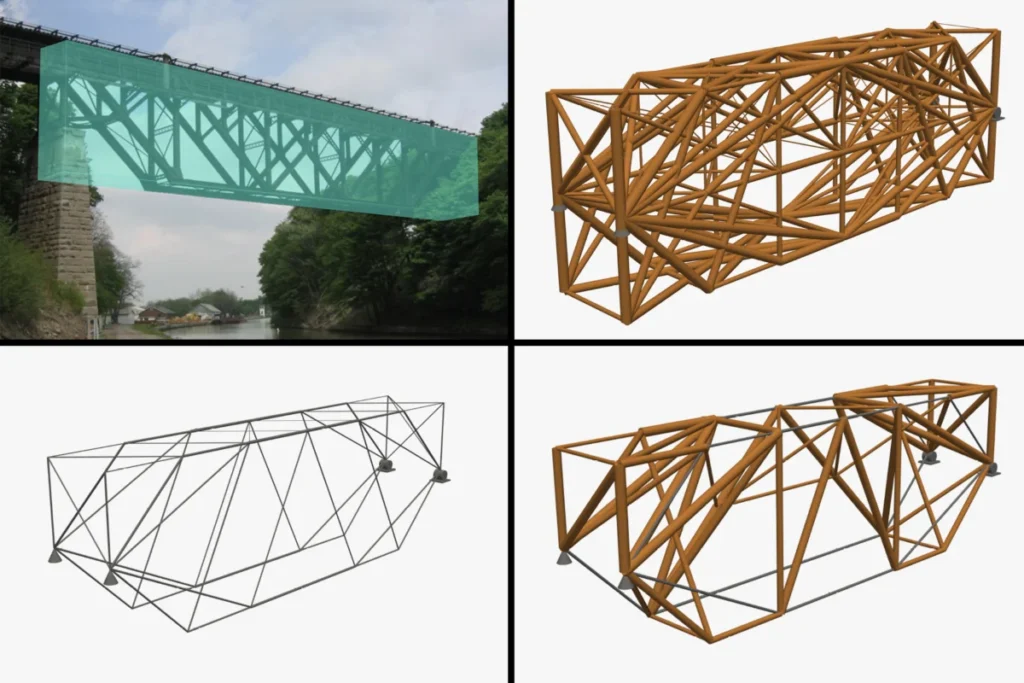
To illustrate the impact of their approach, the researchers compared structures designed using their framework with those generated by conventional topology optimization methods. The results highlighted dramatic differences in the final designs, fundamentally altering how the structures would be realized in practice. As a practical example, they analyzed the truss design of the Lockport "Upside-Down Bridge" near Buffalo, New York. By applying individual constraints, such as a minimum angle for part connections or minimum part sizes, they were able to meticulously assess how each constraint influenced the final design.
Subsequently, they generated truss designs utilizing solely wood, solely steel, and a combination of wood and steel. This comparative analysis demonstrated how different material choices and design configurations present distinct trade-offs between environmental impact and constructability.
"We saw how the system knew that you could design a bridge of pure steel, but that might not be best from a carbon standpoint," Schemmer observed. "Or you could design a bridge out of purely timber, but that might not be the strongest. But these materials can work together, so you use timber for the carbon savings and steel where you need extra strength, and there’s a balance you can find in these structures."
From Research Labs to Construction Sites
The researchers acknowledge that their approach is more computationally intensive than some alternative methods. However, they successfully ran their experimental programs on a MacBook Pro, suggesting that the framework is practical and accessible for most civil engineering firms.
"It’s computationally a little tougher to solve, but there’s a lot of tools coming out nowadays that make these problems a lot more feasible," Schemmer stated. "This approach has been avoided by industry in the past, but now we think it’s a practical way to solve problems dealing with variable constraints."
The researchers are confident that with access to greater computational resources, their framework can be expanded to accommodate a wider array of materials and be applied to significantly larger structures, extending beyond homes, small buildings, and bridges to encompass extensive infrastructure projects.
Looking ahead, Professor Carstensen indicated that the team plans to construct scaled-down physical structures based on the model’s designs. This empirical validation will further solidify the accuracy of their predictions. Additionally, they intend to incorporate additional constraints into their model to streamline its usability for civil engineers in the design of global infrastructure.
"As a structural engineer by training, I was never taught how to design for low-carbon," Schemmer remarked. "To tackle a problem as big as climate change, addressing the built environment is a great place to start. One of the most tangible things we can do is work at the layer of construction, at the design stage, because that’s a fundamental step that we can control. There’s a lot of decisions we make early on that lead us to use extra material we don’t need."
This pioneering research was made possible through funding from the MIT Morningside Academy for Design. The implications of this work are substantial, offering a pathway to significantly reduce the environmental impact of the construction industry by making advanced, material-efficient design techniques both accessible and practical for everyday engineering applications. The ability to balance theoretical optimization with the pragmatic demands of construction marks a significant step forward in the global effort to build a more sustainable future.