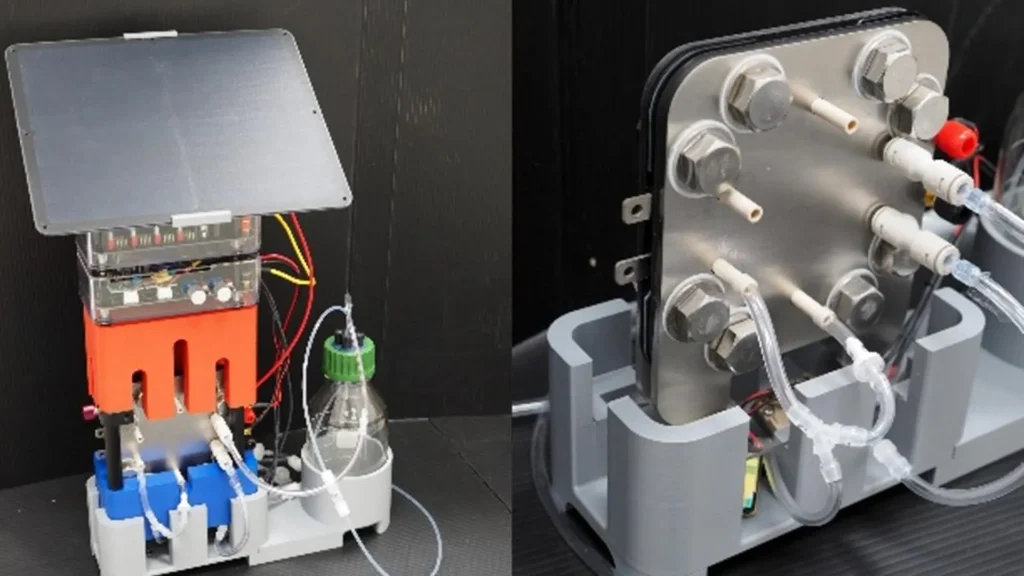
Researchers at Osaka Metropolitan University have engineered a groundbreaking artificial photosynthesis system capable of generating solar fuels with unprecedented consistency and efficiency, fundamentally eliminating the traditional reliance on battery-based control equipment. This significant advancement stems from the direct integration of a self-regulating chemical component into the electrolyzer itself, a design innovation that dramatically reduces both system complexity and overall cost, marking a critical step towards scalable and economically viable solar fuel production.
The core principle behind artificial photosynthesis, much like its natural counterpart in plants, involves harnessing sunlight to transform ubiquitous raw materials – water and carbon dioxide – into energy-rich chemical compounds. Among the most promising of these products is formic acid, a versatile chemical that not only serves as a valuable industrial feedstock but also holds immense potential as a carbon-neutral fuel and a highly efficient medium for energy storage. The global imperative to transition away from fossil fuels and mitigate climate change has intensified research into such renewable energy pathways, positioning artificial photosynthesis as a cornerstone technology for a sustainable future.
The Quest for Sustainable Solar Fuels: An Overview
The global energy landscape is undergoing a profound transformation, driven by urgent environmental concerns and the finite nature of fossil resources. Solar energy, abundant and ubiquitous, stands at the forefront of this transition. However, its intermittent nature – sunlight availability fluctuates with time of day, weather conditions, and seasons – poses significant challenges for grid stability and continuous energy supply. This intermittency necessitates robust and cost-effective energy storage solutions. While electrochemical batteries, particularly lithium-ion technologies, have seen rapid deployment for short-to-medium duration storage, their limitations in terms of cost, material sourcing, energy density for long-duration applications, and environmental footprint remain areas of active research and development.
Solar fuels, produced via artificial photosynthesis, offer a compelling alternative for long-duration energy storage. By converting transient solar energy into chemical bonds, these fuels can be stored indefinitely, transported, and utilized on demand, much like conventional fossil fuels but without the associated carbon emissions if the CO2 feedstock is sourced from industrial emissions or direct air capture. The concept of a "solar refinery" that produces a variety of carbon-neutral fuels and chemicals from sunlight, water, and CO2 is a long-held scientific aspiration, moving closer to reality with innovations like that from Osaka Metropolitan University.
The Mechanism of Artificial Photosynthesis and its Challenges
At the heart of any artificial photosynthesis system lies an electrolyzer, a device that uses electricity, typically supplied by solar cells, to drive chemical reactions that convert water and carbon dioxide into desired products like formic acid or hydrogen. The energy from the solar cells is thus captured and stored in the chemical bonds of these fuels.
A persistent and significant operational challenge for these systems has been maintaining efficient performance despite the inherent variability of sunlight throughout the day. Solar panels perform optimally at a specific voltage and current, known as the Maximum Power Point (MPP), which changes constantly with irradiance and temperature. To address this, many artificial photosynthesis systems incorporate Maximum Power Point Tracking (MPPT) technology. MPPT is a sophisticated method that continuously monitors and adjusts the electrical load presented to the solar panels, ensuring they operate at their MPP and deliver the highest possible power output to the electrolyzer.
However, conventional MPPT setups introduce their own set of complexities and costs. They typically rely on a combination of power electronics, such as DC-DC converters, and often require batteries or supercapacitors to smooth out the energy flow, buffering against rapid fluctuations in solar input and providing a stable power supply to the electrolyzer. While effective in optimizing power delivery, these additional components contribute significantly to the overall system’s balance-of-system (BoS) costs, increase the physical footprint, add layers of electronic complexity, and introduce potential points of failure, thereby impacting the system’s reliability and scalability. For artificial photosynthesis to become commercially viable, these economic and operational hurdles must be overcome.
Osaka Metropolitan University’s Breakthrough: A Self-Regulating Electrolyzer
Recognizing these limitations, a dedicated team at the Research Center for Artificial Photosynthesis at Osaka Metropolitan University, led by Associate Professor Yasuo Matsubara and Professor Yutaka Amao, embarked on a mission to fundamentally redesign the electrolyzer itself. Collaborating with Iida Group Holdings Co., Ltd., their innovative approach sidesteps the need for external MPPT electronics and batteries by integrating a specially designed solid electrolyte directly into the device.
This novel design allows the electrolyzer to automatically perform the MPPT function on its own, a groundbreaking feature that eliminates the requirement for conventional battery-based control systems. Instead of relying on external electronics, converters, or bulky batteries, the electrolyzer autonomously adjusts its electrical characteristics by leveraging its intrinsic thermal and impedance properties.
Professor Amao elaborated on this ingenious mechanism: "As sunlight increases, the electrolyzer naturally heats up. The system is designed so that this warming causes the electrical resistance to drop, allowing electricity to flow more freely. This makes the system automatically adjust its electrical behavior, effectively tracking the maximum power point without any external electronic intervention." This inherent self-regulation is a paradigm shift in the design of solar fuel production systems, promising greater simplicity, robustness, and cost-effectiveness. Professor Amao further emphasized the broader implications: "This self-regulating behavior helps keep fuel production more stable throughout the day and automates the system, while significantly reducing dependence on batteries and costly external components."
Chronology of Development and Public Demonstration
The development of this self-regulating electrolyzer has been the culmination of years of dedicated research into material science, electrochemistry, and system integration at Osaka Metropolitan University. The journey involved extensive theoretical modeling, material synthesis, iterative design improvements, and rigorous testing in laboratory settings.
A pivotal milestone in the project’s timeline was the early demonstration of the technology at the "Joint Pavilion Iida Group × Osaka Metropolitan University" exhibition, an integral part of the lead-up to the Osaka Kansai Expo 2025. This public showcase provided an invaluable opportunity to validate the system’s performance under near-real-world conditions and demonstrate its potential to a wider audience. Professor Matsubara reflected on this early success: "We were confident that it would be successful, as we previously showcased this research at the ‘Joint Pavilion Iida Group × Osaka Metropolitan University’ exhibition as part of the Osaka Kansai Expo 2025. It successfully generated enough formic acid to power a miniature diorama in the pavilion, showing its potential as an efficient artificial photosynthesis system that could potentially be used to charge applications in our homes." This successful demonstration, even at a miniature scale, served as a powerful proof-of-concept, affirming the researchers’ convictions and signaling the technology’s readiness for further scaling and deployment. The Expo itself, with its theme "Designing Future Society for Our Lives," provides an ideal platform to highlight innovations like this that promise to shape a more sustainable future.
Stable Formic Acid Production Under Real-World Conditions
The true test of any solar energy technology lies in its performance under actual outdoor conditions, where sunlight levels can fluctuate dramatically. The Osaka Metropolitan University team subjected their self-regulating system to such rigorous testing. The results were highly encouraging: the system consistently produced formic acid from water and CO2, maintaining stable output even as ambient sunlight levels varied throughout the day. This real-world validation underscores the efficacy of the integrated self-regulating mechanism, proving its ability to adapt dynamically to changing environmental conditions without external control.
Formic acid (HCOOH) is a chemical of significant interest as a solar fuel. It is a simple organic acid that is liquid at room temperature, making it easy to store and transport, unlike gaseous hydrogen. It has a relatively high energy density and can be safely handled. Formic acid can be directly used in certain types of fuel cells to generate electricity, or it can be catalytically decomposed to produce hydrogen and carbon dioxide, effectively serving as a safe and convenient hydrogen carrier. Furthermore, formic acid is a valuable chemical feedstock used in various industries, including leather tanning, textile dyeing, and as a preservative and antibacterial agent in livestock feed. Producing it from captured CO2 offers a pathway for circular carbon economy, turning a waste product into a valuable resource.
Broader Impact and Implications
The implications of Osaka Metropolitan University’s innovation extend far beyond the laboratory. This breakthrough addresses several critical barriers to the widespread adoption of artificial photosynthesis and solar fuel technologies.
-
Cost Reduction: By eliminating the need for expensive power electronics (MPPT controllers, DC-DC converters) and electrochemical batteries, the system significantly reduces the capital expenditure (CapEx) associated with artificial photosynthesis installations. This directly impacts the Levelized Cost of Energy (LCOE) for solar fuels, making them more competitive with fossil fuels and other renewable energy storage solutions. Lower costs are paramount for market penetration and industrial scaling.
-
System Simplification and Reliability: Fewer components mean a simpler system design, easier manufacturing, and reduced maintenance requirements. This inherent simplicity translates into higher operational reliability, as there are fewer parts that can fail. For industrial applications, reliability is a key determinant of economic viability.
-
Enhanced Scalability: The modular nature and simplified design of these self-regulating electrolyzers could facilitate easier scaling from laboratory prototypes to commercial-scale installations. This is crucial for meeting the large-scale energy demands of industries and national grids.
-
Decentralized Energy Production: A simpler, more robust, and cost-effective system could enable decentralized production of solar fuels, potentially even at a household or community level, as hinted by Professor Matsubara’s reference to powering home applications. This could empower energy independence and resilience, particularly in remote areas.
-
Environmental Benefits and Carbon Circularity: The ability to efficiently convert captured carbon dioxide into a valuable fuel like formic acid presents a powerful strategy for carbon capture and utilization (CCU). If industrial CO2 emissions are used as a feedstock, this process effectively creates a closed carbon loop, reducing net atmospheric carbon while simultaneously producing clean energy or chemical products. This aligns perfectly with global decarbonization efforts and the transition towards a circular economy.
-
Advancement in Energy Storage: This technology offers a compelling alternative for long-duration energy storage. While batteries excel at short-to-medium duration storage, solar fuels can store energy for weeks, months, or even longer without significant losses, addressing the critical need for seasonal energy balancing and grid stability in systems with high renewable penetration.
While the achievement is substantial, further research and development will undoubtedly focus on optimizing catalyst efficiency, improving long-term durability, and demonstrating the technology at even larger scales. Questions regarding the overall energy conversion efficiency, the stability of the solid electrolyte over extended periods, and the ultimate cost competitiveness with existing fuel production methods will be key areas for future investigation. Nevertheless, this innovation from Osaka Metropolitan University represents a monumental leap forward in the field of artificial photosynthesis.
The findings of this pioneering research have been published in EES Solar, a highly respected journal in the field of energy and environmental science, underscoring the scientific rigor and significance of the work. As the world continues its urgent pursuit of sustainable energy solutions, this self-regulating, battery-free artificial photosynthesis system stands as a testament to human ingenuity, offering a brighter, cleaner, and more resilient energy future.