The European Space Agency (ESA) is extending an unprecedented opportunity to European researchers and companies, inviting them to test cutting-edge software directly in the challenging environment of deep space aboard ESA’s Hera mission. This initiative marks a significant step in fostering onboard intelligence, advanced image processing, and AI-driven autonomy, positioning Europe at the forefront of next-generation space exploration and planetary defence technologies.
A Mission Transformed: From Asteroid Investigation to In-Orbit Laboratory
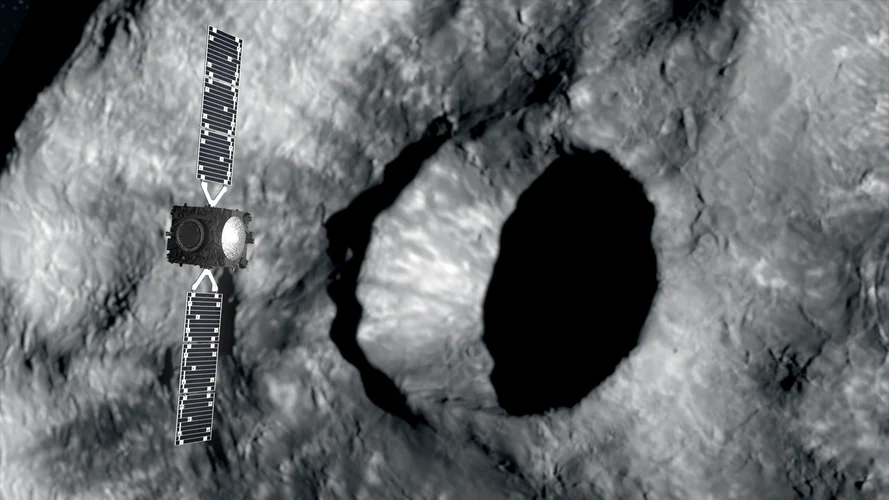
Originally designed to investigate the aftermath of NASA’s Double Asteroid Redirection Test (DART) impact on the asteroid Dimorphos, ESA’s Hera spacecraft is set to evolve into a remarkable flying software laboratory. Following the completion of its primary scientific objectives in mid-2027, Hera will be approximately 150 million kilometers from Earth. This extraordinary vantage point will serve as a testing ground for innovative software solutions that can operate autonomously and intelligently in the vastness of space, reducing reliance on constant communication with ground control.

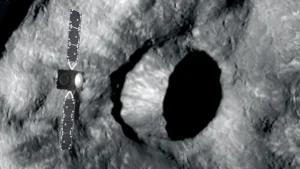
Hera’s journey began with a crucial mission: to study the binary asteroid system Didymos and its smaller moonlet, Dimorphos. In 2022, NASA’s DART spacecraft successfully impacted Dimorphos, altering its orbit around Didymos. Hera’s subsequent arrival in late 2026 will allow for an unprecedented close-up examination of the impact site, providing invaluable data to understand the physics of asteroid deflection and the effectiveness of kinetic impactors – a cornerstone of planetary defence strategies.
The Hera mission, launched in October 2024, is a testament to international collaboration in planetary defence. It carries a suite of sophisticated instruments, including high-resolution cameras, a spectrometer, and a magnetometer, to gather detailed information about Dimorphos’s composition, internal structure, and the ejecta plume created by the DART impact. The spacecraft’s trajectory and operational timeline have been meticulously planned to maximize scientific return.
Pushing the Boundaries of Onboard Intelligence
The transition of Hera into a software laboratory is driven by a strategic vision to accelerate technological advancement and enhance the capabilities of future space missions. ESA is actively seeking targeted, innovative experiments that can push the frontiers of onboard intelligence beyond current procedural limitations. These experiments will be developed to operate safely within a protected "sandbox" environment on Hera’s flight-critical systems, ensuring the spacecraft’s primary mission remains uncompromised.

Dietmar Pilz, ESA’s Director of Technology, Engineering and Quality, emphasized the significance of this initiative. "This is an exceptional opportunity that will help accelerate European innovation, enabling researchers and industry to push the boundaries of onboard intelligence and autonomy," Pilz stated. "We invite Europe’s innovators to shape the next generation of intelligent, robust, and autonomous space missions. We are looking for targeted, innovative experiments that push onboard intelligence beyond today’s procedural boundaries, while running safely alongside Hera’s flight-critical systems in a protected ‘sandbox’ environment. These ideas will help ESA mature technologies that reduce reliance on ground control, increase mission resilience, and enable more capable future exploration missions."
The implications of successfully testing and implementing advanced onboard intelligence are far-reaching. For deep space exploration, where communication light-travel times can range from minutes to hours, autonomous decision-making is paramount. This could enable spacecraft to react to unforeseen events, optimize resource utilization, and conduct complex scientific maneuvers without continuous human intervention. In the realm of planetary defence, enhanced autonomy could lead to faster response times in the event of an asteroid threat and more sophisticated mission planning for deflection or observation scenarios.
A Call for Innovation: The Open Space Innovation Platform
To facilitate this groundbreaking initiative, ESA is leveraging its Open Space Innovation Platform (OSIP). This dedicated online portal serves as a hub for submitting innovative ideas for space exploration and technology development. European researchers and companies are invited to submit proposals for software experiments that leverage Hera’s unique deep-space environment.

The submission process involves an initial outline form for evaluation by ESA. Successful proposals will then be invited to submit a full implementation package, including source code, for rigorous validation. The deadline for submitting the full implementation is May 31, 2027. The planned operational period for these selected experiments is a one-month window during August 2027.
"By opening its mission infrastructure to innovators, ESA aims to enable the acceleration of technology development and strengthening Europe’s leadership in advanced space systems," the agency stated in its announcement. "If you have an idea that will push the boundaries of the mission even further, submit your ideas via ESA’s Open Space Innovation Platform."
Technical Safeguards: Ensuring Mission Integrity
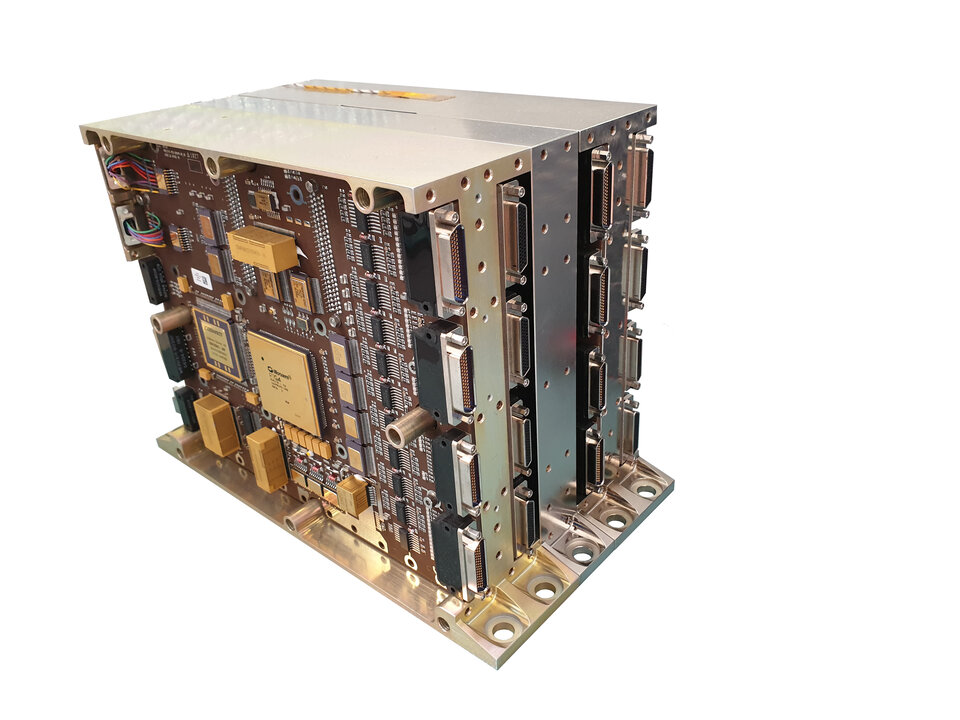
The technical implementation of this software laboratory is a complex undertaking, with safety and reliability being paramount. Hera’s onboard computer is equipped with a European-developed dual-core LEON3 processor. This architecture is key to the sandbox concept.

Jorge Lopez Trescastro, an ESA software engineer working on the Hera mission, explained the technical safeguards: "Our priority is to perform these experiments in an entirely safe way, so we are taking advantage of the fact that Hera’s onboard computer runs on a European-developed dual-core LEON3 processor. One core will operate the actual spacecraft, while the other has a safe sandbox environment that has been optimized to host guest software. Access to spacecraft instruments and subsystems will be fully facilitated, while the hosted software will only run for two to three hours at a time, and be shut off immediately if any problems are identified. Setting all this up to execute in a safe and reliable way has been really challenging, but now we are ready, and really excited to see what ideas the community brings forward!"
This dual-core approach ensures that any experimental software running in the sandbox environment cannot interfere with Hera’s core flight operations. The limited runtime and immediate shut-off capability provide robust protection against potential failures or unexpected behavior from the guest software. This meticulous engineering allows for experimentation without jeopardizing the mission’s success or the valuable scientific data it is collecting.
A Legacy of Technology Demonstration
ESA has a long-standing commitment to in-orbit technology demonstration, utilizing missions like the Proba (Project for On-Board Autonomy) series to test novel technologies. The Proba satellites, including the current Proba-3 formation flying mission, have provided valuable platforms for validating advanced instruments and operational concepts. Additionally, upcoming missions like the Henon CubeSat for deep space exploration further underscore ESA’s dedication to pushing technological frontiers.

These missions serve a critical purpose: to de-risk future, more ambitious space programs by allowing new technologies to be tested and refined in the actual space environment. This iterative process accelerates the transfer of innovation from laboratory prototypes to operational mission readiness.
A notable precedent for this software testing initiative was ESA’s OPS-SAT CubeSat. This flying laboratory provided a similar opportunity for software developers to run standard software in space, famously including a port of the classic video game Doom. The Hera initiative represents a significant evolution of this concept, moving from testing general software to focusing on sophisticated AI and autonomy applications within a complex deep-space mission context.
Ian Carnelli, Hera mission manager, highlighted the broader vision: "Usually, we operate precious deep-space missions based on carefully validated procedures and frequent ground control oversight. But in this case, we are inviting European innovators to work in a real mission environment to help redefine how spacecraft might think, decide and operate in the future. The goal is not to hand over control of Hera, but to safely test ideas that could light the way towards more capable, more autonomous, and more resilient spacecraft operations."
The Future of Space Exploration: Autonomous and Intelligent
The Hera software laboratory initiative is more than just an experiment; it’s a strategic investment in the future of space exploration and planetary defence. By empowering European researchers and companies to develop and test advanced autonomous systems in a real-world deep-space environment, ESA is fostering a new generation of intelligent spacecraft.
The successful implementation of these advanced onboard capabilities will have profound implications:
- Enhanced Mission Capabilities: Spacecraft will be able to undertake more complex scientific investigations, adapt to dynamic environments, and operate more efficiently with reduced reliance on ground support.
- Increased Resilience: Autonomous systems can react swiftly to anomalies or hazards, enhancing mission survival rates in the unforgiving environment of space.
- Accelerated Discovery: Faster data processing and decision-making onboard will allow for quicker identification of scientific targets and more dynamic mission execution, potentially leading to faster scientific breakthroughs.
- Cost-Effectiveness: Reduced reliance on continuous ground control can lead to more cost-efficient mission operations over their lifespan.
- Strengthened European Leadership: This initiative positions Europe as a leader in the development and deployment of advanced space technologies, particularly in the critical areas of AI and autonomy.
The call for ideas through the Open Space Innovation Platform is an open invitation to shape this future. The selected teams will not only contribute to the advancement of space technology but also gain invaluable experience in operating software on a genuine deep-space mission. As Hera continues its journey, it will not only unravel the mysteries of asteroids but also serve as a beacon for innovation, demonstrating the power of collaborative development and the potential of intelligent machines in the exploration of the cosmos. ESA’s bold move with the Hera mission promises to be a significant catalyst in the ongoing evolution of space exploration, ushering in an era of more capable, autonomous, and resilient spacecraft.