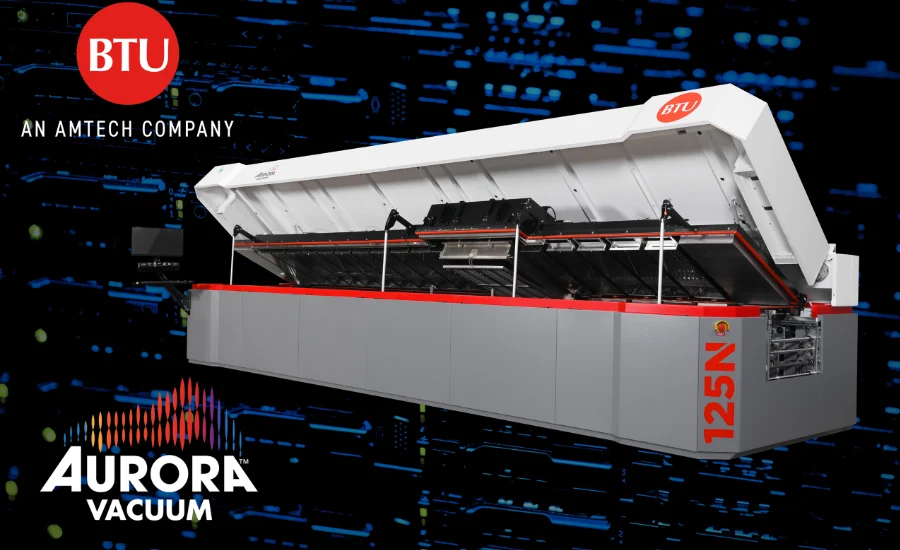
WESTFORD, Mass. – BTU International Inc., a leading supplier of advanced thermal processing equipment for the electronics manufacturing industry, has officially unveiled its groundbreaking Aurora Vacuum Reflow Oven. This innovative system is meticulously engineered to address one of the most persistent and critical challenges in modern electronics assembly: the reduction of solder voids, all while maintaining the high throughput demanded by today’s sophisticated production lines. The introduction of the Aurora Vacuum Reflow Oven marks a significant advancement in soldering technology, promising enhanced reliability and performance for a new generation of complex electronic devices.
Understanding Solder Voiding: A Critical Challenge in Modern Electronics Manufacturing
Solder voids, microscopic air or gas pockets trapped within solder joints, represent a long-standing impediment to the reliability and longevity of electronic components. These seemingly minor imperfections can have disproportionately severe consequences. From a thermal perspective, voids reduce the effective contact area between the component and the PCB, impeding heat dissipation and potentially leading to localized hotspots. In an era where integrated circuits are operating at ever-higher power densities, efficient thermal management is paramount. A compromised thermal path can accelerate component degradation, leading to premature failure and reduced product lifespan. Electrically, voids can increase resistance and inductance within the joint, impacting signal integrity and power delivery, which is particularly critical in high-frequency applications. Mechanically, voids act as stress concentrators, weakening the solder joint and making it more susceptible to cracking or delamination under thermal cycling or mechanical shock.
The problem of solder voiding has become increasingly acute with the advent of miniaturization and advanced packaging technologies such as quad-flat no-lead (QFN) packages, ball grid arrays (BGAs), and system-in-package (SiP) modules. These components often feature large thermal pads or complex interconnect structures where traditional reflow processes struggle to effectively vent trapped gases. Furthermore, the industry’s shift towards lead-free solders, which often exhibit higher viscosity and different wetting characteristics compared to their leaded counterparts, has exacerbated the voiding challenge. Estimates suggest that voiding can reach upwards of 20-30% in some challenging packages with conventional reflow methods, a level deemed unacceptable for high-reliability applications. Reducing voids is not merely about cosmetic perfection; it directly translates into superior product performance, extended operational life, and ultimately, greater customer satisfaction and reduced warranty claims.
The Evolution of Reflow Technology and the Emergence of Vacuum Reflow
The journey of reflow soldering technology has been one of continuous innovation, driven by the ever-increasing demands of the electronics industry. Early methods involved simple hot plates or infrared lamps, evolving quickly into forced convection ovens that offered better temperature uniformity and control. These convection ovens, which circulate hot air or nitrogen, became the industry standard, providing efficient and repeatable soldering for a wide range of components and board types. However, as components became smaller, more complex, and densely packed, and as the requirements for thermal and electrical performance grew more stringent, the inherent limitations of atmospheric reflow began to surface, particularly concerning solder void formation.
The concept of vacuum reflow emerged as a powerful solution to this problem. By introducing a vacuum cycle during or immediately after the solder reflow phase, trapped gases and volatile compounds within the solder paste are actively drawn out of the molten solder joint. This physical removal of gas bubbles significantly reduces the incidence and size of voids, leading to denser, more robust solder connections. While vacuum reflow technology has existed for some time, its integration into high-volume, high-throughput production environments has presented engineering challenges. BTU International, with its long-standing expertise in thermal processing, has positioned itself at the forefront of this technological evolution, developing systems that not only leverage vacuum capabilities but also optimize them for industrial-scale manufacturing. The Aurora Vacuum Reflow Oven represents the culmination of years of research and development, building upon BTU’s legacy of designing robust and precise thermal solutions.
Deep Dive into the Aurora Vacuum Reflow Oven’s Advanced Features
The Aurora Vacuum Reflow Oven is a testament to sophisticated engineering, integrating a suite of features designed to meet the rigorous demands of advanced electronics assembly. Its architecture and operational parameters are optimized for both performance and efficiency.
Central to its design is a capacious 24-inch vacuum chamber, capable of accommodating circuit boards measuring up to an impressive 24.4 by 28 inches. This large format capability is crucial for manufacturing products like server boards and large format automotive control units, which often exceed the dimensions handled by conventional reflow ovens. Beyond size, the system supports dual-lane production, a critical feature for high-volume manufacturing environments. The ability to process two independent streams of PCBs simultaneously significantly boosts throughput, maximizing line efficiency and reducing per-unit production costs. This is further enhanced by the system’s innovative use of three independent conveyors, which maintain a continuous, uninterrupted product flow through the entire reflow process, including the vacuum cycle. This multi-conveyor system prevents bottlenecks and ensures consistent processing times for each board.
Precision thermal management is another cornerstone of the Aurora’s design. The Aurora 125N50 configuration boasts 10 heated zones positioned before the vacuum chamber. These zones are meticulously controlled to establish the optimal pre-heat and soak profiles required for various solder pastes and component types, ensuring proper flux activation and solvent evaporation before the critical reflow stage. Within the vacuum chamber itself, three additional heated zones, complemented by two internal panel heaters, maintain precise thermal conditions during the vacuum cycle. This independent heating of the vacuum chamber is a critical innovation, preventing thermal shock or undesirable cooling that could compromise the integrity of the molten solder or disturb component placement. Following the reflow and vacuum stages, four controlled cooling zones ensure a gradual and controlled solidification of the solder joints, which is essential for developing optimal metallurgical properties and preventing stress-induced defects. The ability to precisely manage heating and cooling rates across these numerous zones allows manufacturers to tailor thermal profiles to an exceptionally fine degree, accommodating the diverse requirements of different solder alloys (e.g., SAC305, SAC405, low-temp solders) and component thermal masses.
Understanding that component integrity is paramount, especially with delicate and densely packed PCBs, BTU International has integrated features to ensure gentle processing. A "soft-start vacuum control" mechanism minimizes rapid pressure changes during the evacuation phase. Abrupt pressure drops can potentially dislodge or shift small, lightweight components, leading to misalignments or shorts. By gradually reducing pressure, the Aurora ensures that components remain securely in place. Complementing this, a "low-vibration conveyor and vacuum system" further mitigates any mechanical disturbances. Vibrations, even subtle ones, can cause component movement, particularly with micro-BGA or fine-pitch components. The design of the Aurora specifically targets the reduction of such movements, safeguarding the integrity of the assembly throughout the entire process. These features collectively contribute to higher yields and reduced rework, a direct benefit for manufacturers handling high-value assemblies.
Addressing the Needs of Modern Electronics: Target Applications and Market Drivers
The introduction of the Aurora Vacuum Reflow Oven is strategically timed to meet the escalating demands of several key sectors within the electronics industry, where reliability and performance are non-negotiable.

Large Server Boards: The exponential growth of cloud computing, data centers, and artificial intelligence necessitates increasingly powerful and reliable server infrastructure. Server boards are characterized by their large size, high component density, and often feature complex multi-chip modules (MCMs) and high-power processors. These boards operate continuously under significant thermal loads, making robust solder joints crucial for long-term reliability. Reduced voiding directly translates to improved thermal management of critical components, ensuring stable operation and preventing costly downtime in data centers. The Aurora’s capacity for large boards and its ability to deliver ultra-low voiding are precisely what these applications require.
Automotive Electronics: The automotive industry is undergoing a profound transformation, driven by advancements in autonomous driving, electric vehicles, and sophisticated infotainment systems. Electronic control units (ECUs) in modern vehicles must withstand extreme temperatures, vibrations, and humidity throughout the vehicle’s lifespan. Safety-critical applications, such as engine control, braking systems, and advanced driver-assistance systems (ADAS), demand zero-defect manufacturing. Solder voids in these components can lead to intermittent failures or complete system breakdowns, with potentially catastrophic consequences. The Aurora’s ability to produce highly reliable, void-free solder joints is indispensable for meeting the stringent quality and safety standards of automotive electronics.
High-Performance Computing (HPC) Hardware: HPC applications, including supercomputers, scientific research, and advanced graphics processing units (GPUs), push the boundaries of processing power and data throughput. These systems rely on tightly integrated components and advanced packaging, where thermal dissipation is a constant challenge. Components like high-bandwidth memory (HBM) and specialized accelerators require impeccable solder joints to ensure both electrical and thermal integrity. The Aurora’s precision thermal control and void-reduction capabilities enable manufacturers to produce HPC hardware that can sustain peak performance without succumbing to thermal degradation or signal integrity issues.
Beyond these core sectors, the Aurora Vacuum Reflow Oven is also poised to benefit other high-reliability applications, including medical devices, aerospace and defense electronics, and 5G infrastructure. Each of these fields demands components that function flawlessly under extreme conditions, where the cost of failure is exceptionally high.
BTU International’s Strategic Vision and Leadership in Thermal Processing
Rob DiMatteo, general manager of BTU International, succinctly articulated the strategic imperative behind the Aurora’s development: “Today’s electronics manufacturers need more than low voiding; they need consistent, repeatable production at scale. Aurora Vacuum delivers the process stability, thermal precision, and production efficiency required to maximize yields while supporting the most demanding manufacturing applications, including large server boards.” This statement encapsulates BTU’s understanding of the evolving landscape of electronics manufacturing. It acknowledges that while void reduction is critical, it must be achieved without compromising throughput or introducing variability into the production process.
BTU International has a rich history spanning over seven decades, consistently delivering innovative thermal processing solutions. Founded in 1950, the company established itself as a pioneer in high-temperature furnaces and later diversified into reflow ovens for the electronics industry. This deep institutional knowledge and extensive experience in thermal engineering are evident in the Aurora’s design. The company’s commitment to research and development has allowed it to anticipate industry trends and develop technologies that address emerging challenges. The Aurora Vacuum Reflow Oven reinforces BTU’s position as a market leader, not just in providing equipment, but in offering comprehensive solutions that enable manufacturers to achieve higher quality, greater efficiency, and superior yields. Their focus on "process stability" and "thermal precision" speaks to the need for tightly controlled manufacturing environments where every variable is managed to produce consistent, high-quality results, minimizing costly rework and scrap.
Market Implications and Broader Industry Outlook
The introduction of advanced systems like the Aurora Vacuum Reflow Oven carries significant implications for the electronics manufacturing industry and the broader technological landscape.
Enhanced Product Reliability and Longevity: The primary benefit of significantly reduced solder voids is a direct improvement in the reliability and lifespan of electronic products. For end-users, this translates to more durable devices with fewer defects and a lower total cost of ownership. For manufacturers, it means fewer warranty claims, enhanced brand reputation, and greater customer loyalty. As electronic devices become more integral to daily life and critical infrastructure, their reliability becomes paramount.
Increased Manufacturing Efficiency and Yields: By addressing a key source of defects, the Aurora helps manufacturers achieve higher first-pass yields. Reduced rework, less scrap material, and optimized production cycles directly contribute to improved operational efficiency and profitability. The dual-lane capability and continuous flow design further amplify this efficiency, allowing for greater output without sacrificing quality. This is particularly vital in a competitive global market where efficiency gains can provide a crucial edge.
Competitive Advantage for Adopters: Companies that invest in advanced vacuum reflow technology like the Aurora will gain a significant competitive advantage. They will be better equipped to meet the stringent quality demands of high-growth sectors such as automotive, aerospace, and high-performance computing. This capability allows them to secure lucrative contracts and positions them as preferred suppliers for critical applications, pushing the boundaries of what is possible in electronic design and functionality.
Future-Proofing Manufacturing Processes: The trend towards smaller, more powerful, and more complex electronic components is irreversible. Advanced packaging techniques, heterogeneous integration, and the drive for higher functional density will continue to challenge conventional manufacturing methods. Vacuum reflow technology is not just a solution for current problems but a foundational technology for future innovations. It provides a robust platform for handling new materials, advanced solder pastes, and increasingly delicate components, positioning manufacturers to adapt to future technological shifts. This includes the ongoing development of advanced materials, the increasing use of 3D packaging, and the integration of diverse functionalities onto a single substrate, all of which demand the utmost precision in interconnect formation.
Impact on Quality Standards and Supply Chains: As the capabilities of equipment like the Aurora become more widespread, it is likely to influence industry quality standards. What was once an acceptable level of voiding may become insufficient as market expectations for reliability rise. This could, in turn, drive improvements throughout the electronics supply chain, from solder paste manufacturers to component suppliers, all striving to meet the higher bar set by advanced assembly processes.
In conclusion, BTU International’s Aurora Vacuum Reflow Oven is more than just a new piece of equipment; it represents a strategic leap forward in electronics manufacturing. By meticulously addressing the pervasive issue of solder voids without compromising production throughput, the Aurora empowers manufacturers to produce electronics of unparalleled reliability and performance. This innovation is critical for sustaining growth and driving advancement across a spectrum of high-stakes industries, solidifying BTU International’s enduring legacy as a leader in thermal processing technology.