For more than two decades, a persistent anomaly in the field of nuclear physics has challenged the prevailing understanding of how atomic nuclei behave during radioactive decay. This phenomenon, characterized by an unexpected surge in low-energy gamma-ray emissions, has long eluded a definitive theoretical explanation. However, a landmark study led by researchers from the Facility for Rare Isotope Beams (FRIB) at Michigan State University, in collaboration with Lawrence Livermore National Laboratory (LLNL) and Ohio University, has finally identified the mechanism behind this "low-energy enhancement." Published in the prestigious journal Nature, the findings provide a breakthrough that bridges the gap between experimental observation and nuclear theory, with profound implications for astrophysics, national security, and the future of nuclear energy.
The Decades-Old Puzzle of the Low-Energy Enhancement
Gamma rays represent the most energetic form of electromagnetic radiation, produced when an unstable atomic nucleus transitions from an "excited" state to a more stable, lower-energy configuration. Traditionally, nuclear models predicted that as the energy of these gamma rays decreases, the probability of their emission should also decrease. However, experimental data collected over the last 20 years frequently contradicted this assumption.
Beginning in the early 2000s, researchers utilizing the "Oslo Method"—a technique developed at the University of Oslo to extract nuclear level densities and gamma-ray strength functions—noticed a startling trend. In several isotopes, there was a dramatic "up-bend" or spike in the number of gamma rays emitted at very low energies. This "low-energy enhancement" (LEE) was not a minor statistical deviation; it was a significant increase that suggested a fundamental piece of the nuclear puzzle was missing.
The unpredictability of the LEE made it particularly frustrating for the scientific community. It did not appear in every nucleus, and there was no reliable way to forecast which isotopes would exhibit the behavior. Eleanor Ronning, the study’s lead author and a former graduate student at FRIB, noted that the phenomenon was a "shock to the community" because it fundamentally challenged existing nuclear shell models.
A Targeted Experiment: Isolating the Magnetic Flip
To resolve the mystery, the research team designed a sophisticated experiment focused on the decay of a specific radioactive isotope: copper-70. Using the advanced capabilities of the FRIB, the team observed the copper-70 isotope as it underwent beta decay to transform into zinc-70.
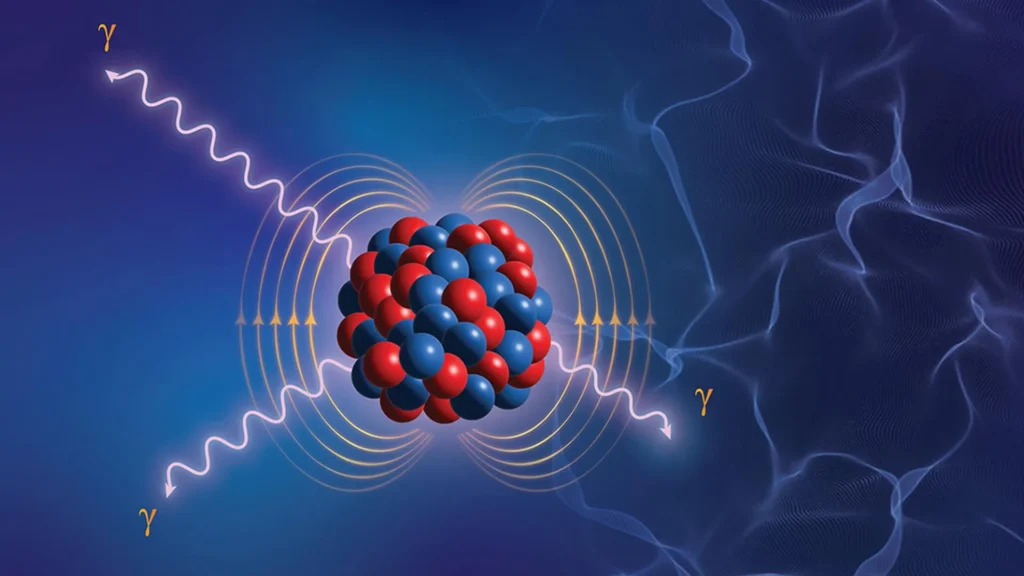
The primary goal was to distinguish between two types of nuclear transitions that occur during decay: electric and magnetic. In an electric transition (E1), the physical distribution of protons within the nucleus shifts, altering the electric dipole moment. In a magnetic transition (M1), the nucleons—protons and neutrons—undergo a "spin-flip," effectively reversing their internal magnetic orientations without necessarily changing their spatial distribution.
FRIB’s unique instrumentation allowed the researchers to isolate these two distinct decay paths. By separating the decay states, the team could observe which transition was responsible for the excess gamma rays. The results were definitive: the low-energy enhancement occurred exclusively during the magnetic transitions. This confirmed that the "up-bend" is a magnetic phenomenon, driven by the collective behavior of nucleons flipping their magnetic poles as the nucleus seeks stability.
Andrea Richard, co-lead of the study and an assistant professor at Ohio University, emphasized the importance of this discovery. "This is a key step forward," she stated. "We now have a consistent explanation that connects experimental observations with theory."
The Chronology of the Discovery
The road to this discovery involved years of theoretical preparation followed by intense experimental execution. The project began as a joint proposal by Ronning and Richard, who sought to leverage the next-generation power of FRIB to test hypotheses that were previously untestable.
The experimental phase took place over a week-long, 24/7 run at FRIB. During this period, the facility’s linear accelerator produced a high-intensity beam of rare isotopes. LLNL scientists and FRIB researchers worked in continuous shifts to monitor the data stream, ensuring the stability of the detectors and the integrity of the collected gamma-ray spectra.
Following the week of data acquisition, the team spent months performing rigorous data analysis. They had to account for background radiation and ensure that the zinc-70 states were correctly identified. By comparing the experimental strength functions with state-of-the-art theoretical models, the researchers were able to prove that the M1 magnetic dipole strength was the sole driver of the enhancement observed in the copper-to-zinc transition.
Implications for National Security and Nuclear Forensics
While the study focused on the fundamental properties of the copper-70 nucleus, the implications of the findings extend far into the realm of applied nuclear science, particularly concerning national security and the maintenance of the United States’ nuclear stockpile.
The National Nuclear Security Administration (NNSA) relies heavily on accurate nuclear models to interpret data from past underground tests and to ensure the reliability of current nuclear deterrents without the need for new explosive testing. Darren Bleuel, an LLNL scientist and co-author of the study, explained that the discovery allows for more precise interpretations of nuclear performance. "We can improve the knowledge of our stockpile performance and interpretation of past test program results using the improved theory based on these discoveries," Bleuel said.
Furthermore, the research has direct applications in nuclear forensics. In the event of an unauthorized nuclear detonation or the discovery of illicit nuclear materials, forensic scientists analyze the isotopic signatures and gamma-ray profiles to determine the origin and nature of the material. By understanding the low-energy gamma-ray enhancement, experts can more accurately "fingerprint" nuclear events, identifying the source of the material with higher confidence.
Understanding the Origin of Elements in the Cosmos
The discovery also provides a critical piece of the puzzle for astrophysicists studying the origin of heavy elements in the universe. Elements heavier than iron, such as gold, platinum, and uranium, are created through a process known as the rapid neutron-capture process, or "r-process."
The r-process occurs in extreme cosmic environments, such as supernovae or the collision of two neutron stars. During these events, atomic nuclei are bombarded with neutrons at an incredible rate. The path of this element creation is dictated by the probability of a nucleus capturing a neutron versus the probability of it emitting a gamma ray (a process known as the neutron-capture cross-section).
The low-energy enhancement significantly alters these probabilities. If a nucleus is more likely to emit low-energy gamma rays, it changes the rate at which it stabilizes and, consequently, the abundance of the elements eventually produced in the stellar explosion. By integrating the magnetic transition findings into astrophysical models, scientists can more accurately predict the chemical evolution of the galaxy and explain why certain heavy elements are found in the quantities they are on Earth.
Advancements in Nuclear Energy and Decay Heat
The nuclear energy sector also stands to benefit from this research. In a nuclear reactor, even after the fission reaction is stopped (scrammed), the radioactive decay of fission products continues to generate heat, known as "decay heat." Accurate modeling of this heat is essential for designing cooling systems and ensuring reactor safety during both normal operations and emergency shutdowns.
A significant portion of decay heat is carried away by gamma rays. If certain fission products exhibit low-energy enhancement, current models might be underestimating or miscalculating the distribution of that energy. The findings from FRIB and LLNL provide a more granular understanding of how energy is released at the subatomic level, potentially leading to more efficient reactor designs and more robust safety protocols for the handling of spent nuclear fuel.
Fact-Based Analysis: Why This Matters Now
This study represents a triumph of collaborative "Big Science." The Facility for Rare Isotope Beams, a U.S. Department of Energy Office of Science user facility, was specifically built to explore the "dripline" of the table of isotopes—the limits where nuclei can no longer hold onto their protons or neutrons. The ability to produce a clean beam of copper-70 and monitor its decay with such precision is a testament to the facility’s world-leading status.
The resolution of the LEE mystery also highlights a shift in nuclear physics toward "precision spectroscopy." No longer content with broad averages, physicists are now able to probe the specific "spin-parity" of individual states in exotic nuclei. This level of detail is necessary to validate the complex "ab initio" (from first principles) calculations that are currently being developed to describe the nuclear force.
Future Research and Global Impact
The FRIB and LLNL team’s work on copper-70 is likely the first of many such investigations. Now that the magnetic nature of the low-energy enhancement has been identified, researchers will look to see if this holds true across other regions of the nuclear chart, particularly in heavier isotopes where the LEE has also been observed.
The study also reinforces the importance of domestic scientific infrastructure. By training the next generation of scientists, like Eleanor Ronning, and providing them with the tools to solve 20-year-old mysteries, the U.S. maintains its competitive edge in nuclear physics. As the world looks toward a future that may include increased reliance on nuclear energy and heightened needs for non-proliferation monitoring, the ability to understand the fundamental heartbeat of the atom—the gamma ray—remains more vital than ever.
In conclusion, the identification of magnetic transitions as the source of low-energy gamma-ray enhancement marks a definitive chapter in nuclear physics. It transforms a scientific anomaly into a predictable tool for discovery, illuminating the dark corners of the nucleus and providing a clearer view of the processes that power the stars and secure the modern world.